The Romanit Palace, one of the oldest buildings of the Capital: from the Princely Chancellery to the Museum of Art Collections
- Articles
- 06 MAR 26
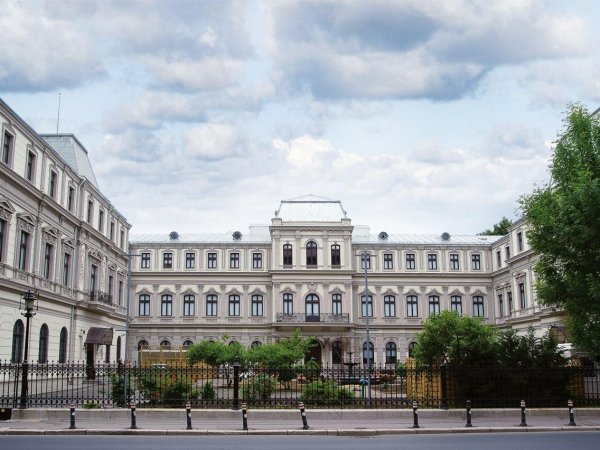
In the center of Bucharest, on Calea Victoriei, there is one of the most elegant and historically rich buildings of the city: the Romanit Palace. Although today it is mainly known as the headquarters of the Museum of Art Collections, its story begins long before the appearance of this museum. The building is a true witness to the political, social and cultural transformations through which the Capital has passed during the last two centuries. Built at the beginning of the 19th century, the palace was, over time, a boyar residence, the place of aristocratic balls, the headquarters of the Princely Chancellery, an administrative institution and later the building of the Ministry of Finance. Each stage left traces in the architecture and in the history of the edifice. Today, the Romanit Palace is not only a valuable museum space, but also a historical monument that tells the story of an era in which Bucharest was beginning to take the shape of a modern city.
The construction of the palace and its beginnings
The history of the Romanit Palace begins in the year 1812, in a period when Bucharest was still dominated by wooden constructions and narrow streets. A dramatic event that had taken place a few years earlier would influence the way buildings were erected in the city. The devastating fire of 1802 destroyed numerous houses and buildings, most of them built from fragile materials.
Following this disaster, the authorities established new rules regarding the quality of constructions. Important buildings had to be erected from solid materials, resistant to fire, in order to prevent the repetition of such tragedies. In this context the Romanit Palace was also built, which from the very beginning was designed as an imposing residence.
The first owner of the palace was the boyar Constantin Faca, a member of the aristocracy of the time. He began the construction of the building with the intention of creating a sumptuous dwelling in the center of the city. Unfortunately, the boyar did not manage to see his project completed, because he died before the works were finished.
After his death, the heirs decided to sell the building. Thus, in the year 1823, the palace was bought by the treasurer Grigore Romanit, a representative of a wealthy family of Greek origin. Although the new owner did not live here for very long – he died in 1834 – his name would remain permanently connected to the building. From then until today, the edifice is known as the Romanit Palace.
Aristocratic balls and headquarters of the Princely Chancellery
In the first part of its existence, the Romanit Palace was a place of the social life of Bucharest. The building impressed through the luxurious interior arrangements, which reflected the taste of the aristocracy of that era. The spacious salons and elegant decorations made the palace an ideal space for social events.
Prince Grigore Dimitrie Ghika, a good friend of Grigore Romanit, organized here several sumptuous balls. These events represented some of the most important meetings of the political and social elite of Wallachia. During those evenings, the salons of the palace were filled with music, conversations and dances, and the building became a symbol of aristocratic refinement.
After the death of Romanit, the destination of the palace began to change. The building was used for a period as the headquarters of the Princely Chancellery of the ruler Alexandru Dimitrie Ghika, the brother of Grigore Dimitrie Ghika. Thus, the palace passed from the role of private residence to an administrative one, becoming part of the governing mechanism of Wallachia.
This transformation reflected the evolution of Bucharest, which was beginning to organize itself more and more according to the model of the great European capitals. The imposing buildings of the aristocracy were often transformed into headquarters of state institutions, contributing to the shaping of a modern administrative infrastructure.
The transformation of the palace into an administrative headquarters
In the year 1836, Alexandru Dimitrie Ghika decided to buy the Romanit Palace from the heirs of the treasurer. Once it entered the property of the state, the edifice was to receive a new administrative function.
The ruler ordered the carrying out of important repair and modernization works. These were coordinated by the architect Michel Sanjouand, also known for the construction of the Stirbey Palace. The interventions of the architect had the role of adapting the building to the requirements of an official institution, but also of strengthening its structure.
The works were completed in the year 1838, the moment when the Romanit Palace became the headquarters of the Administrative Court of Wallachia. During this period, the building was integrated into the institutional structure of the state, becoming an important center of the administration.
This stage contributed to the consolidation of the status of the palace as a representative edifice for Bucharest. Located in a central area and having an elegant architecture, it had become one of the urban landmarks of the city.
The expansion of the palace after the Union of the Romanian Principalities
An important moment in the evolution of the building took place after the year 1859, when the Union of the Romanian Principalities was achieved. The political and administrative transformations that followed determined the reorganization of the institutions of the state.
During this period, the Romanit Palace was assigned to the Ministry of Finance, an institution that needed a suitable headquarters for its activity. However, the existing space was not sufficient for the efficient functioning of the ministry, which was constantly expanding its responsibilities.
In order to solve this problem, the ministry purchased the land located to the north of the palace. On this space were built, between the years 1881 and 1884, two new wings of the building. These extensions modified the initial shape of the edifice, which became one in the shape of U, as it is preserved today.
The expansion project was carried out by the architect Nicolae P. Cerchez. The chosen style was one very appreciated in that era: neoclassical, enriched with neobaroque elements. This architectural combination gave the building a monumental and elegant appearance, suitable for a state institution.
Through these transformations, the Romanit Palace became not only more spacious, but also more representative. The new architectural structure reflected the ambitions of modern Romania, which was in full process of administrative and political consolidation.
From public institution to museum
For several decades, the Romanit Palace continued to be used by the Ministry of Finance. Only in the second half of the 20th century was the change of the destination of the building decided.
In the 1970s, the Romanian state initiated an ambitious cultural project: the establishment of a Museum of Art Collections. The idea was to gather in a single space the numerous collections donated over time by collectors and artists.
For this project the Romanit Palace was chosen, the building being considered suitable both through its dimensions and through its historical value. Before the opening of the museum, restoration and rearrangement works were carried out, meant to adapt the interior spaces to the function of museum.
In the year 1978, the Museum of Art Collections was officially opened to the public. It functioned as a section of the National Museum of Art of Romania and offered visitors access to an impressive variety of art objects.
The exhibited collections included painting, sculpture, graphics and decorative art, made both by Romanian artists and by foreign creators. Most of the pieces came from the donations of passionate collectors, who wished to leave to the Romanian cultural heritage the works gathered throughout their lives.
Modern restorations and the reopening of the museum
At the beginning of the 2000s, the building of the Romanit Palace entered a new process of consolidation and restoration. The works were carried out between 2002 and 2006 and had as their purpose the strengthening of the structure and the conservation of the original architectural elements.
Subsequently, a wide project of restoration and reorganization of the museum spaces was initiated. The specialists aimed both at the protection of the architectural heritage and at the modernization of the exhibition conditions for the works of art.
After the completion of these complex works, the Museum of Art Collections was reopened to the public in the year 2013. The event marked the return into the cultural circuit of one of the most interesting museum spaces in Bucharest.
Today, the palace hosts more than 30 permanent collections, each having a distinct identity. Visitors can discover here valuable works that reflect the evolution of Romanian and European art.
A museum that deserves to be discovered
At present, the Museum of Art Collections represents one of the most interesting places for lovers of art and history in Bucharest. Visitors discover not only valuable works, but also a building that is part of the historical heritage of the city.
The museum can be visited on Monday, Tuesday and Friday between 10:00 and 18:00, and on Saturday and Sunday between 11:00 and 19:00. On Wednesday and Thursday the institution is closed. Those who wish to visit the museum individually do not need a reservation.
In the case of groups that wish guided tours, it is necessary to send an online request at least seven days in advance, to the address: secretariat@art.museum.ro. This procedure allows the organization of visits in optimal conditions and offers the possibility of detailed explanations about the exhibited collections.
A visit to the Museum of Art Collections is a complete cultural experience. While admiring paintings, sculptures or decorative objects, visitors can also reflect on the fascinating history of the Romanit Palace. The building itself is a work of art, and its past illustrates the evolution of Bucharest from the Phanariote city to the modern capital of today.
The Romanit Palace thus remains not only one of the oldest buildings of the Capital, but also a symbol of cultural continuity. From boyar residence and headquarters of the Princely Chancellery to a museum dedicated to art collections, this edifice continues to be a space where the past and culture meet.
We also recommend: The Royal Palace in Bucharest, between monarchy and art. How it became the most beautiful museum in the Capital