STB Museum, brief history: exhibitions, visiting hours, ticket prices
- Articles
- 08 APR 26
In a city undergoing constant transformation such as Bucharest, the memory of public transport represents an essential part of its urban identity. Trams, trolleybuses and buses are not only means of transportation, but also witnesses of the capital’s evolution over decades. In this context, Bucharest Transport Company has initiated an important effort to preserve the heritage of urban mobility: the creation of an exhibition space dedicated to the history of public transport. Although less known to the general public, this place represents a true journey into the city’s past, bringing together objects, photographs and stories that would otherwise have been lost. The STB Museum is a bridge between generations, a space where the past symbolically travels alongside the present.
Establishment and role of the museum in preserving urban memory
The STB Museum was established in 2011 as an initiative to preserve the history of public transport in the capital. The space is organized into seven rooms, each illustrating a different stage or theme from the evolution of urban mobility.
Although not all historical vehicles could be preserved in this space, the exhibition brings together a valuable collection of documents and objects. The absence of original trams and trolleybuses—many of which were scrapped or dispersed across various locations—is compensated by visual materials and heritage items saved from destruction.
This initiative plays an important role: preserving the memory of a transport system that has shaped the daily life of the city for generations.
Exhibitions: objects, photographs and scale models with historical value
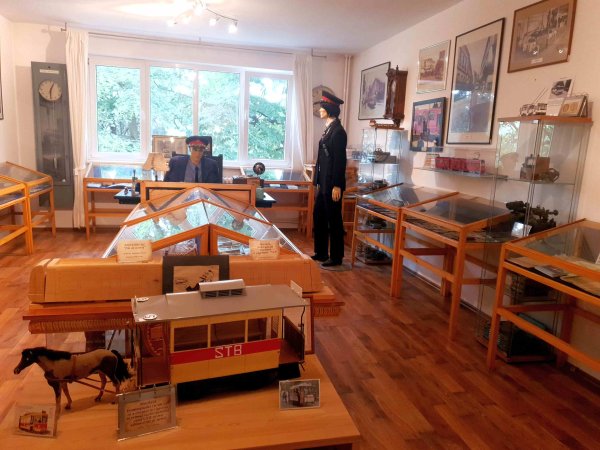
The exhibition inside the museum is diverse and rich in content. Visitors can discover salvaged parts from scrapped vehicles, technical components and elements that were once part of the public transport infrastructure.
A special place is held by vintage photographs, many of them glass plate images, which capture rare scenes from old Bucharest. These photographs illustrate not only vehicles, but also the atmosphere of the city in different historical periods.
The collection also includes old postcards, reflecting the evolution of public transport and urban space. These visual documents are essential for understanding how the capital has changed over time.
Another impressive element is the collection of handmade scale models, created with great patience and passion. These models faithfully reproduce trams and other vehicles, sometimes depicted as if waiting at a traffic light for the signal to change. Each model reflects hours of work and a deep passion for transport history.
The collection is completed by donations from individuals who understand the importance of preserving heritage. These contributions play a key role in the continuous development of the exhibition.
An atypical museum still in a provisional administrative form
Although commonly referred to as a museum, this space does not yet have official legal status as a museum institution. As a result, the exhibition operates under a flexible regime, allowing adjustments depending on resources and availability.
This situation does not diminish its cultural value. On the contrary, it gives it a living character, constantly evolving. The exhibition is the result of the passion and involvement of those who sought to save important fragments of Bucharest’s transport history.
Being located within the STB Sports Complex also contributes to its unconventional nature, as well as to its limited public visibility.
Location and access to the museum
The museum is located at 4 Trapezului Street, Sector 3, inside the STB Sports Complex. Access is provided through the company’s sports base, making it less visible to the general public but well integrated within the internal structure of the transport operator.
Visits are possible only by prior telephone appointment at 031.425.04.82. The museum can be visited daily between 10:00 and 15:00, although the schedule may vary depending on organization and availability.
This controlled access system allows better management of visitors and enables personalized tours.
Visiting schedule and its flexibility
The visiting schedule is relatively simple but flexible. Visits are available every day, but only with prior booking. This organization reflects the special status of the space, which does not operate like a traditional museum with fixed hours and constant visitor flow.
The flexibility of the schedule allows adaptation to the needs of different groups, whether school groups, urban history enthusiasts, or researchers interested in the evolution of public transport in Bucharest.
This personalized approach contributes to a more intimate and tailored visitor experience.
Tickets and free access
An important and appreciated aspect is that access to the exhibition is free of charge. There is no entry fee and no photography fee, making the experience accessible to everyone.
This open policy reflects the desire to encourage public interest in urban transport heritage and to facilitate access to information and culture.
By removing financial barriers, the exhibition becomes an inclusive space, open to anyone interested in the city’s history.
Importance of the museum for Bucharest’s heritage
The STB Museum plays an important role in preserving the urban memory of the capital. Each object, photograph or model tells a story about how Bucharest Transport Company has evolved over time.
In a city where modernization is constant, such spaces are essential for preserving historical identity. They provide context, education and an emotional connection to the past.
For visitors, the experience is not only informative but also nostalgic. It is a journey through time that helps better understand the evolution of a complex and dynamic capital city.
A window into the history of Bucharest transport
The STB Museum represents more than just an exhibition. It is a heartfelt project built on passion, dedication and the desire to keep the memory of urban transport alive.
Although it does not yet have official museum status and operates within a special administrative framework, its cultural value is undeniable. Through its exhibits, rare photographs and carefully crafted models, this space manages to tell the story of a constantly moving city.
For anyone wishing to discover a lesser-known side of Bucharest, a visit here is a fascinating journey into the past of public transport and the evolution of a modern European capital.
We also recommend: The CFR Museum in Bucharest and the history of the Romanian railway network. What fabulous exhibits you can visit here