Romulus Porescu House — One of the Most Beautiful Art Nouveau Buildings in Bucharest. Where to Find It and What's the Story Behind It
- Articles
- 20 APR 26
One of the Most Beautiful Art Nouveau Houses in Bucharest. Where to Find It and What's the Story Behind It
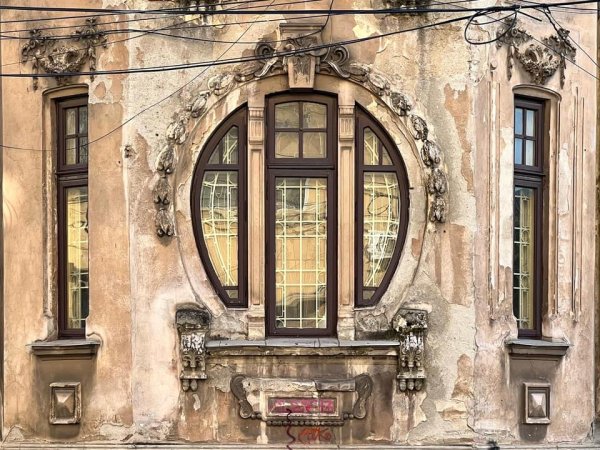
At the corner of Negustori and Paleologu streets, in the heart of a neighborhood that has seen better days, stands a house with a round window. It's not just a detail — it's almost a statement of intent. The circular eye looks straight into the intersection like an elegant monocle, and behind its glass hides stained-wood with floral motifs, best seen in the evening, when the lights inside bring them to life.
The Romulus Porescu House, built in 1905, is one of the very few genuinely Art Nouveau buildings in Bucharest.
The Man Behind the House — the Architect
The architect who signed the project, Dimitrie Maimarolu (1859–1926), earned his diploma at the École des Beaux-Arts in Paris in 1885, after studying under Professor Julien Guadet. At the time, he was one of the most active and respected architects in the capital.
Maimarolu was no niche practitioner. The Military Circle Palace is his work, designed in the eclectic neoclassical style — a synthesis of classical antiquity, the late Renaissance, and the neoclassicism of the French school. He also contributed to the Patriarchate Palace and the Armenian Church, buildings that still define the skyline of central Bucharest. The Porescu House is, by comparison, a more intimate side of the same architect: the same sense of proportion, a different scale, a different language.
Who Was Romulus Porescu
The honest answer is that nobody knows for certain. Historians who have looked into the house searched for traces of the owner in the documents of the era, without success. In the 1937 and 1938 telephone directories, there is only one Porescu — Florian, on Ștefan Mihăileanu Street — with no clear connection established to the original owner of the house on Paleologu. Romulus remains a name on a façade: a bourgeois Bucharestian of 1900 who had the taste and the means to commission a beautiful home, and who otherwise dissolved into anonymity.
That, in a way, makes the story more interesting. The Military Circle Palace carries great names — generals, ministers, architects with marble busts. The house on Negustori–Paleologu carries only a family name and a round window.
What Makes This House Special
In architecture, Art Nouveau finds its expression in the curved, supple lines of buildings — façades adorned with wrought-iron plant motifs, stained glass, and floral decorations on pillars, walls, and ceilings. The Porescu House respects all of these principles, but gathers them into a small, residential volume, without any pretension.
The circular corner window surprises with the eye that looks straight into the heart of the intersection. Beyond its three-part structure, the stained glass with plant motifs is best admired after dark, when the interior lights come on.
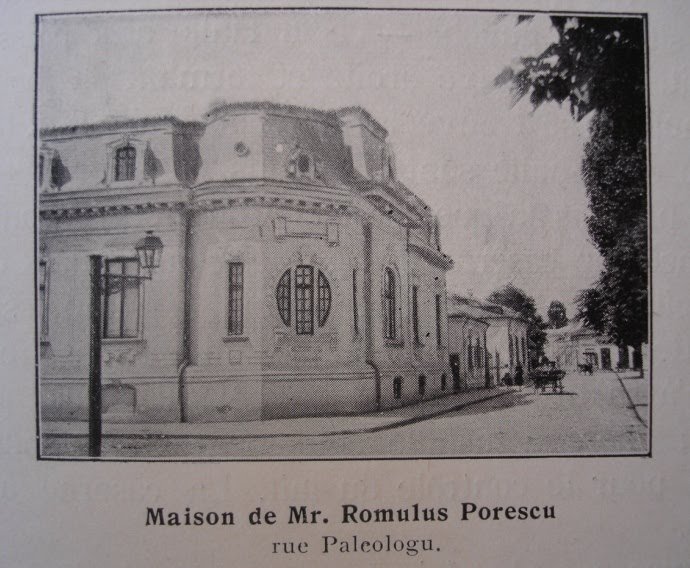
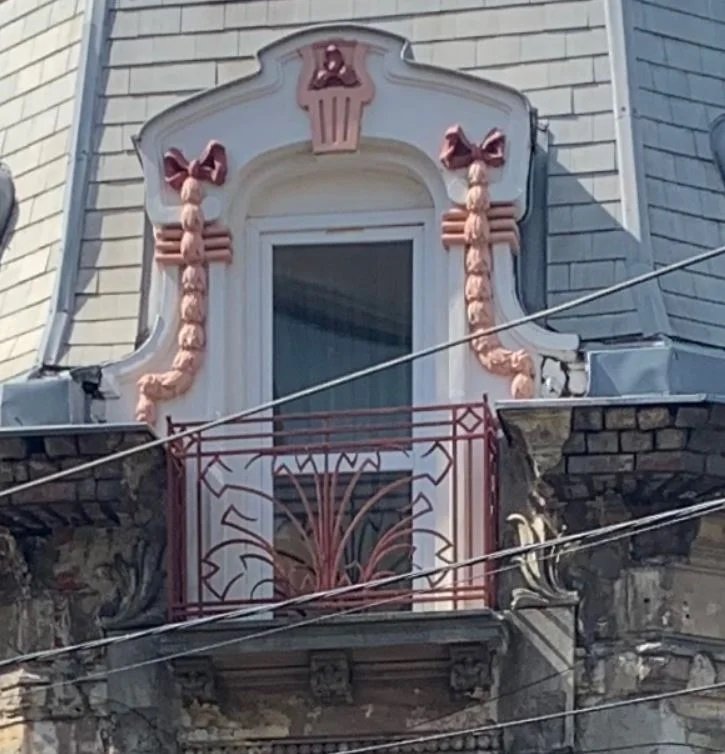
The main façade doesn't face the street directly — an unusual architectural choice for Bucharest, which gives the building a slightly withdrawn, almost discreet air. A small balcony added later, with pink ribbon ornaments in its décor, brings a whimsical, domestic note — a sign that someone truly lived here and wanted to leave a personal mark on the wall. The plant ornaments on the exterior continue the interior logic of the stained glass: nature stylized into decoration, unmistakably Art Nouveau.
A Landmark in 1906 Bucharest
The house was already being noted as an architectural gem at the very moment the city was hosting it. On Paleologu Street, the house appears as "a small jewel" in Frédéric Damé's volume Bucarest en 1906 — the French journalist and historian who left the most detailed monograph of the capital at the turn of the twentieth century. The volume, unfinished and published posthumously in 1907, was translated into Romanian and reissued in 2007 by Paralela 45. That a small private house should become a landmark in a monograph of an entire city says something about its visual power.
Context: a Bucharest in Full Transformation
When Maimarolu was designing the Porescu House, Bucharest was a city building its identity at a feverish pace. Maimarolu belongs to the generation of architects who left behind the string of palaces raised at the turn of the nineteenth and twentieth centuries, when Bucharest was known as the "Little Paris."
Art Nouveau arrived here in a more fragmentary way, however. Bucharest is an interesting province of the movement, located at the geographical periphery of the style's expression — Art Nouveau elements appear mostly in fragments and pieces on buildings that are otherwise in conservative historicist styles. That is precisely why a house like the one on Negustori–Paleologu carries so much weight: it is a coherent, complete example of this visual language.
How It Looks Today
The house still stands, though the surrounding neighborhood has endured decades of neglect. The façade bears the marks of time, and certain later interventions — PVC windows, small additions — have partially altered the original image. The round window has remained. The stained glass has remained. The plant ornaments have remained.
For those who know how to look, that is enough.
The house is located at the corner of Negustori and Paleologu streets, in the Moșilor area — a central neighborhood, but one largely overlooked by the usual tourist circuits of the capital. It's worth a walk, especially in the evening.
Also recommended 10 Art Deco Buildings in Bucharest and Their Impressive History