Padel is taking over Bucharest. The urban sport that turned the court into a place for socialising
By Raluca Ogaru
- Articles
- 30 JUN 26
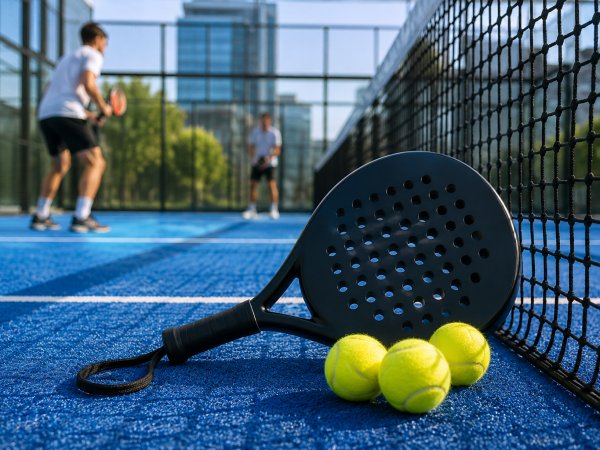
Bucharest has a new urban sport that is growing quietly, but visibly: padel. It is not tennis, it is not squash, but it borrows something from both and adds a component that makes it very suitable for city life: socialising. It is usually played in doubles, on a court smaller than a tennis court, enclosed by glass walls and metal fencing, and the ball can also be played after bouncing off the walls. The result is a fast, spectacular sport that is accessible enough to attract both former athletes and people who simply want a more entertaining form of exercise.
In recent years, padel has started to appear more often in Bucharest, in sports clubs, private facilities and spaces where movement is combined with post-match relaxation. It is not hard to understand why it is catching on: it does not require the technique of classic tennis from the first training session, it is learned relatively quickly, it is played in teams and it has a rhythm that makes it attractive even for those who do not follow performance sports. In a city where people are increasingly looking for after-work activities, padel fits exactly into that space between sport, hobby and meeting friends.
What padel is and why it caught on so quickly
Padel is a racket sport played on a court 10 metres wide and 20 metres long, according to the rules of the International Padel Federation. The court is divided by a net and surrounded by walls that are part of the game, which completely changes the dynamics compared with tennis. The ball can rebound, rallies are longer, and positioning and communication between partners matter enormously.
This combination is exactly what makes it attractive to beginners. In tennis, the first lessons can be frustrating: the serve is difficult, the ball often goes out, and progress requires a lot of patience. In padel, the feeling of actually playing appears more quickly. Even without perfect technique, you can enter a rally, laugh, make mistakes without completely ruining the rhythm of the game and feel that you are doing sport from the very first session.
For Bucharest, this accessibility matters a lot. The city already has a strong culture of gyms, running in parks and recreational sports, but padel brings something different: a more social setting. Most of the time, you need four people, which turns the game into a group plan. You do not come only to exercise, but also to spend time with your people, in a more active way than going out for coffee or dinner.
Padel also fits well with an urban lifestyle. A match can last about an hour, it can be scheduled after work, it does not require complicated equipment at the beginning, and many clubs offer racket rental. For those who want to try it without a large initial investment, the entry threshold is lower than in other sports.
Bucharest and the new map of padel courts
The capital is beginning to have more and more places where padel can be played, from premium clubs to specialised sports facilities. Among the names mentioned in the local ecosystem are Pescariu Sports & Spa, Padel One, Padel World, PadelMania, Magic SMASH Club and other spaces that have introduced dedicated courts. Some are in the northern part of the city, others in areas more accessible to western or southern neighbourhoods, and this shows that padel is no longer just a curiosity for a narrow audience.
Pescariu Sports & Spa presents padel as a mix between tennis and squash, suitable for all ages and skill levels. Padel One is located in the Pipera area, with dedicated courts, while Padel World mentions two locations, one on Progresului Street and another in the Domnești area. Magic SMASH Club presents itself as an indoor padel club in Sema Parc, with panoramic courts, which can be an important advantage for those who want to play regardless of the weather.
This spread says something about the way the sport is starting to settle into the city. At first, padel seemed like a niche activity, linked to private clubs and small communities. Now, it is becoming more visible, easier to book and more present in conversations about movement. Booking apps, clubs with extended hours and indoor courts make it compatible with the routines of Bucharest residents.
For a crowded city, indoor courts can be a major advantage. In summer, when temperatures make outdoor sports difficult at midday, or in winter, when the weather limits options, padel can remain a constant activity. In Bucharest, where many people organise their exercise around work schedules and traffic, the fact that you can book an hour in the evening becomes very important.
Why padel is more than a club trend
Padel does not attract people only because it is new. It attracts them because it answers a very current need: people want to exercise, but they do not always want solitary workouts. They want to move, but also to socialise. They want competition, but not necessarily the pressure of performance. In this sense, padel works as a community sport.
For beginners, the advantage is that the game can be enjoyable from the first attempts. For those who have played tennis, squash or badminton, padel offers a familiar area, but with new rules and reflexes. For companies, it can become a good team-building activity, because it is played in pairs, requires collaboration and is dynamic enough to create group energy.
There is also a lifestyle component. Padel clubs are not just courts. Many try to create an experience around the game: good changing rooms, relaxation areas, terraces, coffee, events and small amateur competitions. This brings it closer to the model of modern urban sports, where movement is connected to leisure, belonging and community.
For Bucharest, this can be important. The city needs more spaces where sport is not perceived only as a health obligation, but as an enjoyable activity. Padel fits exactly into this category: it is demanding enough to count as exercise, but playful enough not to feel like a chore.
Romania enters the international padel map
The growth of padel is visible not only in Bucharest, but also nationally. The Romanian Padel Federation is the organisation that coordinates and develops this sport in the country, and Romania already appears in the structures of the International Padel Federation. According to the FIP page, the Romanian Padel Federation has been affiliated since 2025, which shows that the sport is entering a more organised stage.
Another important sign is the appearance of international competitions in Romania. For September 2026, FIP Gold Bucharest is announced at Năstase & Marica Sports Club, an event that promises international-level players and elite matches. For the public in the capital, this may be the moment when padel moves from being a sport practised by amateurs to a sporting spectacle watched from the stands.
The fact that Bucharest is set to host such an event matters for local visibility. People discover a sport more easily when they can see it played at a high level. And padel works very well as a spectacle: rallies are fast, the walls are part of the game, points can become spectacular, and the public understands quite quickly what is happening on court.
For the city’s clubs, such events can bring a new wave of interest. After watching a good match, the temptation to try the sport increases. This is exactly how urban sports communities are built: first comes curiosity, then the first booking, then the group of friends with whom you start playing weekly.
How much a padel match can cost in Bucharest
Prices differ a lot depending on the club, time slot, indoor or outdoor court and included services. In general, padel is more expensive than running in the park, but it can become reasonable if the court price is split between four people. For beginners, the initial cost may include court rental, racket rental, possibly balls and, where needed, an hour with an instructor.
Some clubs use booking apps, and rates may vary between peak hours and quieter intervals. There are also subscriptions or packages for those who want to play regularly. For someone trying the sport occasionally, the best option is to go for the first time with a group, rent the equipment and see whether they enjoy it before buying their own racket.
A padel racket should become an investment only after a few sessions, when the player understands their level and preferred style. At the beginning, equipment is not what makes the difference, but rhythm, positioning and the way you communicate with your partner. This is precisely why padel is friendly to people who do not want to spend a lot from the start.
For Bucharest, where many leisure activities have become increasingly expensive, padel should be viewed realistically: it is not the cheapest form of sport, but it is not inaccessible either if played in a group and booked carefully. In addition, for one hour of intense movement, socialising and friendly competition, many Bucharest residents may see it as an alternative to a classic night out.
Who padel is suitable for
Padel is suitable for active adults, former tennis players, people who want a group sport, couples, office colleagues and even teenagers, if they have access to instructors or adapted sessions. It does not require great strength, but it does require attention, reaction and constant movement. For those who want to lose weight or improve endurance, it can be a good option if practised regularly.
It is not completely risk-free, however. Like any sport with quick changes of direction, it can put pressure on the knees, ankles and back. That is why warming up before the game, wearing proper footwear and choosing an intensity level adapted to your ability matter. For people with medical issues, caution is recommended and, where appropriate, advice from a specialist.
READ ALSO:
Sports facilities and activities in Bucharest – from fitness and crossfit to running in the park
For a beginner, the best way into the sport is a session with an instructor or a relaxed match with people of a similar level. If you go straight into a very advanced group, the experience can become frustrating. If you start at the right pace, padel can quickly become one of the most enjoyable sports habits of the week.
In the end, the success of padel in Bucharest says something about the city today. Bucharest residents are no longer looking only for gyms and individual workouts, but for movement experiences that bring people together. Padel meets exactly this need: sport, energy, friends, light competition and one hour in which the phone stays, at least for a while, on the side of the court.