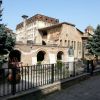
Mihai Viteazul Monastery, saved from demolition on railway tracks. Where the church can be found today
By Raluca Ogaru
- Articles
- 31 JUL 26
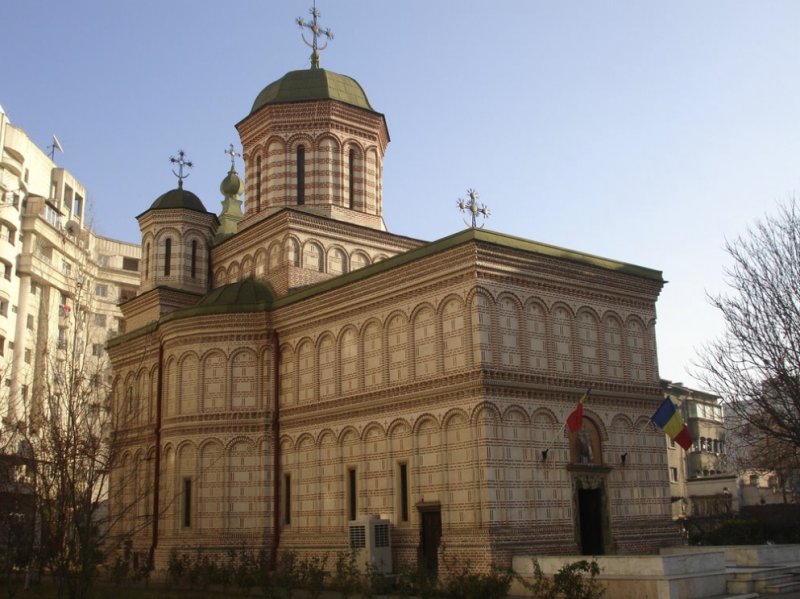
Hidden behind several apartment blocks along Splaiul Independenței, a short distance from Izvor Park, stands one of the oldest surviving buildings in Bucharest. The church of Mihai Vodă Monastery was built more than four centuries ago, but the place where it can be seen today is not the site originally chosen by its founder.
In 1985, the church and its bell tower were separated from Mihai Vodă Hill and moved several hundred metres to prevent their demolition alongside the rest of the monastic complex. The operation, coordinated by engineer Eugeniu Iordăchescu, involved moving structures weighing more than 3,000 tonnes downhill to their current location on Sapienței Street.
Only the church and the bell tower survived from the former monastery. The cells, enclosure walls, State Archives buildings and the entire hill on which the complex had stood disappeared during the construction of the Civic Centre and the area surrounding the Palace of Parliament.
The monastery built by Mihai Viteazul before he became ruler
Mihai Vodă Monastery was built in the early 1590s, before Mihai Viteazul ascended the throne of Wallachia. Construction was completed around 1594, and the monastery was dedicated to Saint Nicholas.
A legend recorded by chroniclers links the foundation of the monastery to a moment when Mihai was allegedly threatened with execution by ruler Alexandru cel Rău. On his way to the place where he was to be killed, Mihai is said to have asked permission to enter a church and promised Saint Nicholas that he would build a monastery if his life were spared.
The monastery was erected on a hill located outside the city at the time, close to the Dâmbovița River. The complex included the church, monastic cells, princely and abbots’ residences, kitchens, vaulted cellars and a bell tower incorporated into the defensive walls. With its fortified appearance, Mihai Vodă Monastery resembled a small citadel.
Over the following centuries, the monastery buildings served several purposes. The complex was temporarily used as a princely residence, as a hospital for the Russian and later Romanian armies, while between 1855 and 1862 it housed the School of Medicine. Following the secularisation of monastic estates, the complex became the headquarters of the State Archives.
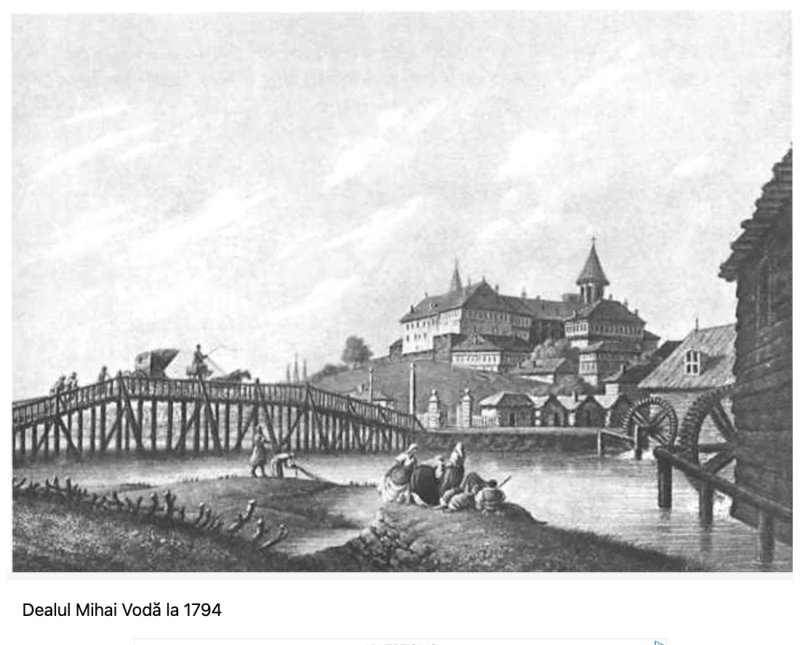
Buildings intended for the storage of historical documents were later erected within the former monastery courtyard. Important architects including Cristofi Cerchez, Alexandru Băicoianu and Petre Antonescu contributed to the architectural reorganisation of the complex.
A historic hill erased from Bucharest’s map
The monastery stood on Mihai Vodă Hill, later also known as Archives Hill. The elevation had remained part of the cityscape following successive changes to the course of the Dâmbovița River and overlooked the area now occupied by Izvor Park.
The site was significant not only because of its medieval buildings, but also because of archaeological discoveries. Investigations carried out before the demolitions revealed traces of ancient habitation, including prehistoric and Dacian remains.
Early plans for the new Civic Centre would reportedly have allowed the Mihai Vodă complex to remain near the future House of the Republic. This option was later abandoned, and in January 1985 the authorities ordered the evacuation and demolition of the complex.
The State Archives buildings, monastic cells, walls, cellars and auxiliary structures were demolished. The hill was then levelled, completely changing the landscape of the area. The former site of the monastery is now located in the eastern part of Izvor Park, close to the Palace of Parliament.
The church and bell tower were moved together
Initially, the entire monastery was due to disappear. However, petitions submitted by intellectuals, heritage specialists and representatives of the Church helped save the church and bell tower. The rest of the complex could not be preserved.
The operation was entrusted to engineer Eugeniu Iordăchescu, who had developed a method whereby buildings could be detached from their foundations, placed on a rigid platform and moved along a system similar to railway tracks.
The church and bell tower were moved together. The structures followed a downhill route involving several changes of direction before reaching their new location. According to the most frequently cited figures, the church was moved 289 metres and lowered by 6.2 metres from the level of the former hill.
Historical sources provide different figures for the exact weight of the church, ranging from approximately 3,100 to 3,700 tonnes. What is certain is that, together with the bell tower, the operation involved moving a complex weighing more than 3,000 tonnes and was considered one of the most difficult projects of its kind carried out in Bucharest.
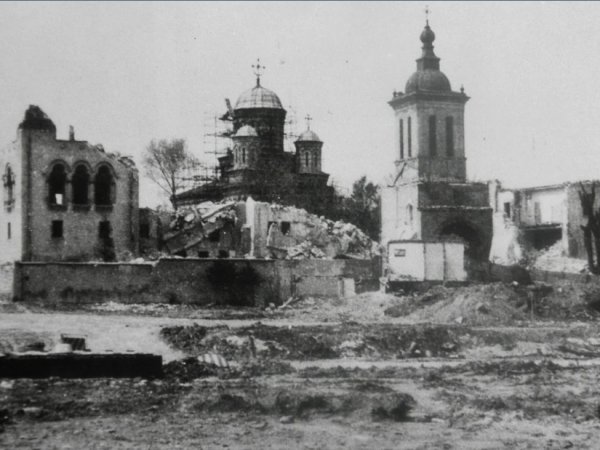
The relocation took place in the autumn of 1985. Archive photographs show the church during the move, surrounded by metal structures and the technical platform used to transport it.
Saved from the bulldozers, but hidden behind apartment blocks
The new location protected the church from demolition, but completely altered its relationship with the city. From a hilltop where it had once been visible from a distance, the building was moved into a narrow space surrounded by apartment blocks constructed to conceal it from the main avenues of the Civic Centre.
Today, people walking along Splaiul Independenței can pass very close to the church without noticing it. Access is from Sapienței Street, through a passage between the apartment blocks, near Mihai Vodă Bridge and Izvor Park.
After the relocation, the church remained closed for almost ten years. It reopened for worship in 1994, and its murals and interior elements were subsequently restored.
Only the church and bell tower remain from the former complex. Seen from the present courtyard, the two buildings appear detached from their original setting: the fortified walls, cells and Archives buildings that once formed one of Bucharest’s most imposing historic ensembles no longer exist.
Mihai Vodă Monastery was reactivated in 2026
The year 2026 brought an important change in the history of the religious complex. Monastic life was officially re-established on May 1, more than a century and a half after it had been interrupted following the secularisation of monastic estates.
The site became a convent, and nun Cipriana Tănase was installed as abbess on May 9, 2026. The occasion marked 435 years since the monastery’s foundation and 425 years since the death of Mihai Viteazul.
The Archdiocese of Bucharest has also announced plans to build a new monastic complex, including cells and spaces for receiving pilgrims. The future buildings are expected to incorporate architectural elements inspired by the old enclosure demolished in the 1980s.
The reactivation restores part of the original purpose for which the building was created. For more than 160 years, the former monastery served as an administrative headquarters, parish church or historic monument isolated from its original context.
Where Mihai Vodă Monastery can be found today
Mihai Vodă Monastery is located at 4 Sapienței Street, District 5, behind the apartment blocks along Splaiul Independenței. The nearest major landmark is Izvor Park, while the closest metro station is Izvor, served by lines M1 and M3.
The monastery can also be reached by buses 104, 123, 124, 205 and 385, trolleybus 63 or tram 32. Public transport routes should be checked before visiting, as they may be subject to change.
READ ALSO:
The church can no longer be seen on its original hill above the Dâmbovița River or at the centre of the vast complex founded by Mihai Viteazul. It nevertheless remains close to its original site, hidden between the apartment blocks of the Civic Centre, as one of the few surviving witnesses to the neighbourhood demolished for the construction of the House of the People.
Photo: Adevarul.ro