Bucharest rents before autumn: where studios are still available for under €350 and how much one-bedroom apartments cost
By Raluca Ogaru
- Articles
- 19 AUG 26
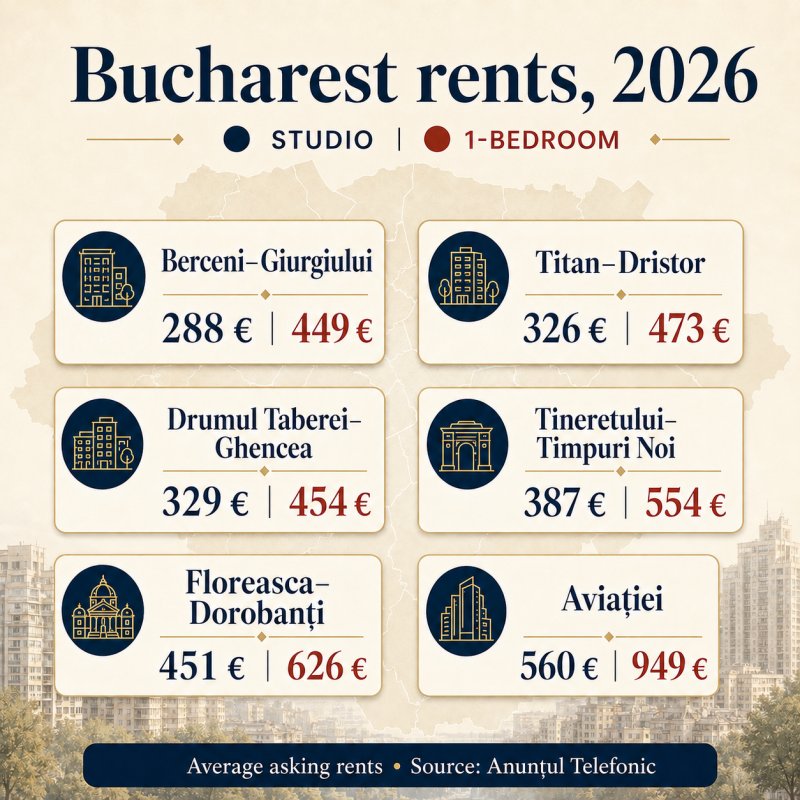
A studio apartment is listed at an average of €288 in the Berceni–Giurgiului area and €560 in Aviației. The difference is even greater for one-bedroom apartments: €449 in Berceni compared with €949 in Aviației. The same city, but almost double the budget.
The figures appear in the 2026 statistics published by Anunțul Telefonic and are calculated using rental listings available on the platform. They do not necessarily represent the final amounts paid after negotiation, nor do they compare homes that are identical in size, age or amenities. However, they provide a clear picture of the differences between neighbourhoods just before the busy period at the end of summer and beginning of autumn.
Storia’s data for June 2026 completes the picture. The average asking rent in Bucharest for properties ranging from studios to two-bedroom apartments was €593, up 2% from June 2025. Prices have not surged, but prospective tenants are already becoming more active.
Demand is growing faster than prices
At national level, the average rent in June 2026 was €531, unchanged from June 2025. This apparent price stability conceals an increasingly active market: listing views rose by 6% compared with May, while the number of enquiries increased by 12%, according to the Storia analysis.
Bucharest remained the most expensive rental market among the major Romanian cities included in the analysis, with an overall average of €593. The capital was followed by Cluj-Napoca, where the average reached €580, and by Brașov and Constanța, both at €500.
“The 12% increase in enquiries compared with the previous month suggests that users are actively searching and assessing their options,” said Monica Dudău, Head of Marketing Real Estate Europe at OLX Group.
 Rental prices in Bucharest in August 2026
For tenants, this change has a straightforward consequence. A good apartment, with convenient metro access and a fair asking price, can attract several interested people within a short period. A stable market average does not mean that every attractive listing will remain available long enough for prolonged negotiations.
READ ALSO:
Neighbourhoods where studios are still listed for under €350
Statistics published by Anunțul Telefonic indicate an average rent of €350 for studios across Bucharest. Several large neighbourhoods familiar to budget-conscious tenants remain below this threshold.
The lowest figure in the table is found in Berceni–Giurgiului, where the average stands at €288. It is followed by Pantelimon at €321, 1 Mai–Domenii at €322, Titan–Dristor at €326 and Colentina–Obor at €327.
Drumul Taberei–Ghencea has an average of €329, followed by Ștefan cel Mare–Tei at €337, Rahova–Sebastian at €341 and Iancului–Mihai Bravu at €342. The figure rises to €365 in Bucureștii Noi–Dămăroaia and €367 in Vitan.
These numbers alone do not determine whether a listing represents good value. In Berceni, Drumul Taberei or Titan, the distance to the nearest metro station can decisively affect a property’s appeal. A studio that costs €30 less but adds another 25 minutes to the journey may prove an expensive compromise in everyday life.
READ ALSO:
The areas in Bucharest with the best rent–transport–safety ratio
One-bedroom apartments: from around €450 to almost €1,000
For one-bedroom apartments, Anunțul Telefonic calculates a citywide average of €533. Areas below €500 include Berceni–Giurgiului at €449, Pantelimon at €450, Drumul Taberei–Ghencea at €454, Iancului–Mihai Bravu at €472 and Titan–Dristor at €473.
The average in the 13 Septembrie area is €494, while Rahova–Sebastian is slightly above the threshold at €501. Militari and Crângași–Giulești both have an average of €533, while Tineretului–Timpuri Noi reaches €554.
Budgets rise in central and semi-central areas. The average rent for a one-bedroom apartment is €576 in Victoriei–Romană, €588 in both Moșilor–Dacia and Universitate–Kogălniceanu, and €599 in Unirii. Floreasca–Dorobanți reaches €626.
The premium northern districts operate on an entirely different scale. Băneasa has an average of €708 for a one-bedroom apartment, while Aviației reaches €949. The €500 difference between Berceni and Aviației is almost equivalent to the cost of renting another apartment in a more affordable neighbourhood.
This does not mean that every one-bedroom apartment in Aviației costs €949 or that every such property in Berceni can be rented for €449. The northern market includes more apartments in recently built residential developments, properties with parking spaces, newer furniture and quick access to major office buildings. The composition of the listings pushes the average upwards.
Sector 1 remains the most expensive, but administrative boundaries do not tell the whole story
Storia’s data confirms Sector 1’s position at the top of the market. In June 2026, the average asking rent was €449 for a studio, €670 for a one-bedroom apartment and €1,150 for a two-bedroom apartment.
At the other end of the market, the lowest average for studios was recorded in Sector 2, at €375. Sector 4 had the lowest average for one-bedroom apartments, at €500, while Sector 6 was the most affordable for two-bedroom properties, with an average of €600.
Administrative boundaries can, however, conceal major differences. Sector 1 includes premium areas such as Aviației and Floreasca, as well as neighbourhoods where more affordable listings may be available. Sector 2 likewise contains very different rental markets, including Pantelimon, Colentina, Iancului, Tei and Moșilor.
Neighbourhood-level figures are useful precisely because they bring the analysis closer to the tenant’s actual daily routine. People do not rent “in Sector 2” in the abstract. They rent in a particular neighbourhood, at a specific distance from the metro, their workplace, university or their children’s school.
READ ALSO:
How rental prices evolved in Bucharest in 2025, by sector
What could happen to the market as autumn approaches
The rise in enquiries recorded in June shows that prospective tenants have begun searching more actively. However, the available figures do not justify the claim that rents will definitely increase in August or September. Such a conclusion would require data for the following months.
Seasonal pressure nevertheless exists. Students who do not obtain places in university halls, employees changing jobs after the summer holidays and people moving to Bucharest before the beginning of the academic year generally search for the same types of property: studios and one-bedroom apartments, preferably close to a metro station.
Those looking for a home before autumn should compare the total cost rather than focusing only on the advertised rent. The deposit, agency fee, winter maintenance bills, the presence of an individual heating system or the state of the district heating supply, parking costs and the time needed to reach the metro can all substantially change the monthly budget.
Checking the rental agreement and the property’s actual condition is equally important. Photographs can conceal noise, plumbing or electrical problems, damp and the true distance to public transport. A good listing is not necessarily the cheapest one, but the property that remains affordable after all costs and compromises have been taken into account.
Bucharest is approaching autumn with generally stable rents but increasingly active demand. Studios are still available for under €350 in several areas, while one-bedroom apartments can be found around the €450–€500 threshold in a number of neighbourhoods. In the premium northern districts, however, the same type of property is already approaching €1,000 per month.