A Sweet Nostalgia: The desserts of 1970s and '80s Bucharest
By Eddie Țone
- Articles
- 24 APR 26
Going to a confectionery in the Bucharest of the '70s or '80s was an act that went beyond simply satisfying a craving. It was a small escape, an incursion into a parallel universe where the ashen gray of the apartment blocks and planned daily life was replaced by the gloss of chocolate fondant, the immaculate white of whipped cream, and the bright red of the jelly atop a savarină.
Going to the cake shop was a social ritual, a reward, and often the only accessible form of opulence. This journey back in time is an archaeology of taste and an exploration of flavors that defined childhoods, marked anniversaries, and built a sweet, persistent collective memory filled with an almost tangible nostalgia.
Sanctuaries of Sugar: Confectioneries in the Capital's Center
Before reaching the cakes themselves, we must stop at the temples where they were venerated. The confectioneries in central Bucharest were institutions with personality—stages of urban life where, alongside amandine and eclairs, people consumed gossip, plans, and small personal dramas.
Without a doubt, Capșa was the dean in terms of age and prestige. Founded in 1852 by the Capșa brothers, the shop on Calea Victoriei had survived world wars, lived through the monarchy, and adapted with aristocratic dignity to the new communist order. To enter Capșa was to walk in the footsteps of Eminescu or Caragiale. Urban legend has it that the famous Joffre cake was born here, created in honor of French Marshal Joseph Joffre during his visit to Bucharest. Even in the years of late communism, Capșa retained an aura of bourgeois elegance, with its small marble tables and an air of history floating among the scents of vanilla and chocolate.
Not far away, on Magheru Boulevard, stood Casata. More modern, more functional, and lacking the historical weight of its illustrious neighbor, Casata was renowned for one specific product: the profiterole—a masterpiece of socialist confectionery served in a glass bowl straight from the refrigerated display. The atmosphere here was more alert, less formal, a place where you stopped for a quick break on your way to Piața Romană.
Other names completed the sweet map of the center. Scala, near the cinema of the same name, was a landmark for pre-movie meetings. Republica (formerly Nestor) on Calea Victoriei was another constant point of attraction, with a loyal clientele and slight variations of classic recipes. Going to a confectionery meant choosing a side—having a favorite spot where the savarină seemed a bit more syrupy or the cream in the diplomat a bit smoother. Then, of course, there were the neighborhood cake shops.
The Display of Wonders: The Pantheon of Communist Cakes
Until the mid-'80s, a confectionery display was a standardized but fascinating visual spectacle. The same cakes, with minor differences in execution, could be found almost everywhere, forming a canon of Romanian dessert. Each had its own story and personality.
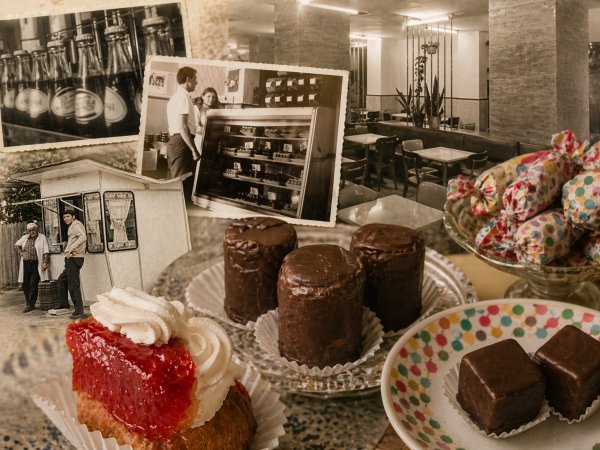
The Savarină was the uncrowned queen of the display. A fluffy "sweet bread" (cozonac) soaked in thick rum syrup (or rather, rum essence), generously sliced and filled to the brim with whipped cream. The climax was the "dollop" of red jelly or jam that sat like a jewel atop the immaculate white. Eating a savarină required strategy: you started with the spoon directly in the cream, then attacked the succulent base, ensuring every bite perfectly combined the three textures.
The Amandină and the Joffre represented the chocolate camp. The amandină was a solid, dense cube with abundantly soaked layers and a cocoa-butter cream, all wrapped in a glassy fondant glaze. It was the serious, powerful dessert that hit you with an overdose of sugar and cocoa. The Joffre, by contrast, was the aristocrat. A cylinder of chocolate mousse—airier and finer—set on a thin base, a refinement that recalled its origins at Capșa.
The Diplomat was the cosmopolitan choice, a cake suggesting travel and exoticism through pieces of canned fruit (pineapple, oranges, candied cherries) suspended in a fine cream based on whipped cream and gelatin. The ladyfinger-lined edges gave it the look of a miniature festive cake. Alongside it, the Boema, often featuring chocolate or coffee cream and garnished with a glazed coffee bean, was the more sober, mature version of a festive cake.
The category of "supporting characters" included the Indiana, with two fluffy sponge domes joined by cream and powdered with sugar—an airy, childhood favorite—and the Mascota, a small energy bomb, a ball of chocolate cream with walnuts or candied fruits wrapped in glaze. The Eclair, with its elongated shape and vanilla or chocolate filling, was a universal classic adapted to local tastes, while the Hamburg brought the German flair of chocolate-covered grapes. Also precious were the Violeta cakes—small jewels covered in purple fondant with a distinct floral taste—or the complex Ora 12, a multi-layered cake with a whipped cream peak, which was somewhat rarer.
Ration Snacks and Recess: The Portable Sweets of the Era
Beyond the ritualistic experience of the confectionery, the sweet universe of the era also had a "pocket" component—quick snacks that fueled school breaks and the walk home.
Eugenia was (and still is) the supreme biscuit. A nutritional constant for generations. That sandwich made of two simple but crumbly biscuits squeezing a thin layer of cocoa cream with an unmistakable rum aroma functioned for decades as the measurement of satiety for students during big break and workers ending their shifts. Its slightly greasy and intense taste is one of the strongest anchors of Romanian gustatory memory.
CIP candies (an acronym for Corrective, Hygienic, Perfumed – appearing in 1970) were more like edible toys. The tiny spheres of colored sugar, packed in round plastic boxes with a minuscule hole, represented a challenge. Getting them out one by one by shaking the box with a special technique was part of the charm. The taste was secondary; the experience was everything.
Pufarine offered an airy pleasure. Puffed wheat glazed in a thin layer of pink, yellow, or green sugar, it was the perfect snack for a walk in Cișmigiu Park. You were practically convinced you were eating something light and almost healthy, even though your fingers quickly became sticky from the melting glaze.
Caramels were also present on confectionery counters alongside other sugar-heavy candies. Tasting of coffee or, of course, caramel, these would stick to your teeth after being removed from their thin and equally... sticky packaging.
Domestic Refinements and Fairground Pleasures
Certain delights blurred the line between the elegant confectionery, the market stall, and the living room at home.
Sherbet (șerbet) was the ultimate symbol of old-fashioned hospitality, a custom inherited from the Phanariot world and sacredly preserved in many homes. Served on a silver or nickel-silver tray alongside a glass of very cold water, sherbet was a fine delicacy. A teaspoon of that dense, flavored paste followed by a gulp of water created an explosion of taste. Rose or lemon were common, but the great delicacy—a rarity found only in luxury shops—was pistachio sherbet.
At the opposite pole was Halviță (nougat). White, dense, elastic, and full of walnuts, halviță was a product of fairs and markets. It was sold by the piece, cut from a massive block with a cleaver wielded with dexterity by the vendor—a spectacle in itself. Its sticky texture and intense honey-and-walnut flavor were a robust, popular pleasure.
The "Polar" Ice Cream was a summer institution. That parallelepiped package wrapped in waxed paper contained a block of ice cream that had to be sliced at home with a knife dipped in hot water. It was sliced and served as is or between two wafer sheets. The vanilla, cocoa, or pistachio flavor was synthetic, almost chemical, but in a child's mind, it reached divine perfection, especially when it melted slightly at the edges and became creamy. There were, however, other types of ice cream sold in the famous kiosks, from the small Doina to the grand cake versions.
And, of course, "Gumela" chewing gum. The only local variant, the famous Gumela was famous for two things: it lost its flavor after about 30 seconds of intense chewing and, despite this flaw, it somewhat did its job for blowing bubbles that popped loudly.
Liquid Sugar: The Refreshing Nectar of the Communist Years
Thirst was quenched with an arsenal of domestic soft drinks—"fizzy" drinks that colored countless festive tables.
Brifcor (an acronym for Indigenous Soft Drink Manufactured with Orange Concentrate) was the star (appearing a bit later, in the '80s). Originally produced at Buftea, this soda with a vague orange aroma and vibrant color was the symbol of any child's birthday. Having bottles of Brifcor at a party was a status symbol.
Cico, its older, more popular, and more widespread brother, was the everyday version. It had the same citrus profile, perhaps a bit less intense, but was omnipresent at Sunday lunches and picnics. Its specific bottle is an artifact of the era.
In the ideological battle of carbonated drinks, Quick Cola was the Romanian answer to the capitalist giant from across the ocean. Its taste was completely different—strong, with notes of medicinal herbs and a carbonation that "stung" the tongue in a memorable (and not entirely pleasant) way. It was a cola that didn't try to imitate, but strongly asserted its own distinct identity.
And Bem-Bem, with an intense yellow color that stained glasses, was pear or apricot juice, depending on the producer's inspiration that year. It was sweet, syrupy, and loved by children precisely for its aromatic and chromatic intensity.
I have saved Pepsi for last. Yes, Pepsi-Cola had a special, quasi-diplomatic status in communist Romania. Unlike Coca-Cola, which remained an inaccessible capitalist symbol, Pepsi had managed to penetrate the Iron Curtain through a commercial agreement signed in 1966, following Richard Nixon's visit to the USSR and a clever negotiation involving the exchange of Pepsi concentrate for Stolichnaya vodka on Western markets.
Romania, which maintained commercial relations with the Americans especially during the Ceaușescu years, benefited from these agreements. Pepsi appeared sporadically in luxury shops, hotels for foreigners, and—rarely—in ordinary stores starting in 1966. In that same year, the famous drink began production at the Ovidiu cannery near Constanța, in a specially built section producing 7,000 tons annually.
The bluish bottle with the red-white-blue label contained an effervescent brown liquid that seemed to come from a parallel world. Children and youth dreamed of Pepsi, adults offered it to important guests, and diplomatic staff bought it from special shops. The taste was sweeter than Quick Cola, more refined, with balanced acidity and fine, persistent bubbles. To drink Pepsi in the Bucharest of the '70s and '80s meant having access, connections, or extraordinary luck: the bottle became a trophy, tangible proof that the world beyond the borders did indeed exist, at least in liquid, bottled, and refreshing form.
These cakes, juices, and pocket sweets represent time capsules—carriers of memories and emotion—that compose an affective map of a Bucharest which, despite limitations and imposed grayness, always found resources to produce small but intense moments of sweet joy. Their taste, whether real or amplified by nostalgia, remains a fundamental part of the city's unwritten story.
You may also like: Gluten-Free dining in Bucharest: five spots that get it right