Bucharest's Population. The city that gained a million people in a century and lost them in a few decades
- Articles
- 16 APR 26
A look at Bucharest's population, from medieval trading post to 21st-century capital
Somewhere in the second half of the 15th century, Bucharest appears in documents as a modest waystation and market town in Wallachia. Nobody at the time could have imagined that this settlement on the banks of the Dâmbovița river would, a few centuries later, hold within its borders nearly a tenth of an entire country's population. And yet, that is exactly what happened.
A town that kept growing, whether anyone planned it or not
At the start of the 19th century, Bucharest was home to around 50,000 souls — a figure drawn from the records of an era when counting people was far from an exact science. A census register from 1810 documented 32,185 adult inhabitants, excluding children and foreigners, which puts the real total considerably higher. The city was the seat of Phanariot rulers, a place of trade, political upheaval, and recurring epidemics. The plague of Caragea, which broke out at the end of 1812 and was only extinguished in the summer of 1814, killed roughly 30,000 people from a population of around 80,000 — nearly half the city, in under two years. The earthquake of 1838 brought down hundreds of houses. The great fire of 1847 consumed almost 2,000 buildings.
And still, Bucharest grew. The French traveller Raoul Perrin noted in 1839 that the city had reached 130,000 inhabitants — a remarkable figure for a settlement in southeastern Europe at that time. With the proclamation of unified Romania's capital in 1862, the pace quickened further. Centralised administration, commerce, state institutions — all of them pulled people toward Bucharest like a quiet but steady magnet.
The Little Paris and the census that measured it
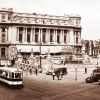
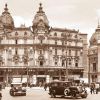
The 1912 census — the first truly systematic one — counted 321,000 residents. It was a city in full stride: electric trams, boulevards modelled on Paris, hotels, cafés, a university. The interwar period brought even more momentum. Greater Romania, with its expanded borders after 1918, turned Bucharest into a metropolis in the real sense of the word — with bourgeois families, workers, intellectuals, and a middle class buying apartments in Floreasca and villas in Cotroceni.
The 1930 census recorded 631,288 inhabitants. In less than twenty years, the population had doubled. The city was growing by around 30,000 people a year — a pace few analysts of the era would have predicted decades earlier. New neighbourhoods swallowed up suburban villages one by one, and the capital's administrative boundaries pushed steadily outward.
Then came the Second World War, with the bombings of 1944 and everything they brought with them — and after that, an entirely different world.
Communism and the city built on paper
The census of January 1948 found a Bucharest of 1,025,180 inhabitants. The city had just crossed the million mark for the first time in its history. But what was about to unfold over the following decades surpassed anything that had come before.
The communist regime, through five-year plans and decrees from the Central Committee, pushed through the forced industrialisation of the country. Factories needed workers. Workers needed housing. Housing went up across entire neighbourhoods — Ferentari, Bucureștii Noi, Floreasca, Berceni, Militari, Titan — poured from prefabricated concrete at a speed that left no room for aesthetics or adequate infrastructure. People came from Moldova, from Oltenia, from Transylvania, drawn or pushed from the countryside toward the city through a process of urbanisation that was dictated rather than organic.
The figures from communist-era censuses tell the whole story: 1,177,661 inhabitants in 1956; 1,366,684 in 1966; 1,807,239 in 1977. By the 1992 census — the first after the fall of the regime — Bucharest had reached its historic peak: 2,067,545 inhabitants.
Two million people. A number the city itself, with its infrastructure, its schools, its hospitals and its trams, carried with difficulty.
After 1989: the tide goes out
The collapse of communism in December 1989 set off demographic shifts that were massive and hard to anticipate. Some Bucharesters left for abroad — Italy, Spain, Germany, and beyond. Others chose something different: houses with gardens in Ilfov, in Voluntari, in Popești-Leordeni, in Chiajna. Suburbanisation emptied Bucharest of residents without emptying it of cars or problems.
The 2002 census recorded 1,926,334 inhabitants. The 2011 census — 1,883,425. The most recent one, carried out in 2022, produced a figure that surprised even demographers: 1,716,961 residents registered in the municipality — 166,400 fewer than in 2011, a drop of 8.8% in a single decade.
At the same time, Ilfov County had gained 153,900 inhabitants. The equation was clear: Bucharest had spilled beyond its administrative boundaries, and the people actually living in the capital's urban agglomeration far outnumber what the official figure suggests. Estimates for 2025 put the metropolitan area at around 1.76 million, with a gradual decline of roughly 0.5% per year.
What the numbers say beyond the numbers
Taken together, the data on Bucharest's population form a biography of modern Romania. The explosive growth of the interwar years reflects the optimism and energy of Greater Romania. The demographic surge under communism reflects an authoritarian modernisation project, with human and urban costs the city still carries today — in crumbling tower blocks, in neighbourhoods stripped of green space, in district heating networks designed for a larger population than the one that remains.
The decline after 1989 reflects something harder to quantify: freedom of movement, disillusionment, changed aspirations, a social contract renegotiated between citizens and the city they choose to stay in or leave.
2025: two figures, one city
Data published by the National Institute of Statistics in October 2025 adds a final layer to this story — and an important one. On 1 July 2025, the registered population of Bucharest Municipality stood at 2,113,039 people — 9.75% of Romania's total population, the largest demographic concentration in the country, at a significant distance from any other county.
And yet that figure conceals a substantial gap compared to the 1,716,961 residents recorded in the 2022 census. The difference — nearly 400,000 people — represents those who kept their official address in Bucharest while living elsewhere: in Ilfov, in another part of the country, or abroad. They are living proof of what statisticians call suburbanisation and emigration, but what an ordinary Bucharester experiences differently: as a building growing steadily emptier of familiar neighbours and fuller of cars arriving daily from outside.
Bucharest remains, whichever way you look at it, the most populated city in Romania. A city with two million souls on paper and one million seven hundred thousand in daily reality — and with a question, perpetually deferred, about what the balance between the two will look like in the decades ahead.