Who Was Vasile Gherghel and Why Does a Street in Bucharest’s Sector 1 Bear His Name?
- Articles
- 23 JUN 26
Bucharest is a city where numerous streets bear the names of personalities who contributed, in one way or another, to the development of Romania. Some of these names are very well known and associated with politicians, writers, or military heroes. Others, however, belong to figures less familiar to the general public, even though they played an important role in the history of the Capital. One such example is Vasile Gherghel, a cavalry officer and close associate of King Carol I, whose name is preserved today by a street in Sector 1 of Bucharest. For many residents of the city, Vasile Gherghel Street is simply a road located near Piața Domenii and Ion Mihalache Boulevard. However, behind this name lies the story of a military officer who was involved in the early stages of consolidating the Romanian monarchy and who left an important mark on the urban development of the Capital. Although he did not enter the gallery of great historical figures studied in school textbooks, his legacy continues to be visible today in the landscape of Bucharest.
A cavalry officer in the service of King Carol I
Vasile Gherghel belonged to the generation of military officers who served during a period of major transformations for the Romanian state. In the second half of the 19th century, Romania was strengthening its modern institutions, and the army played an essential role in this process.
Gherghel built his career within the cavalry, one of the most prestigious branches of the military at the time. Cavalry officers were considered representatives of the military elite and enjoyed a high social status. Their training required not only tactical and military knowledge but also an education that enabled them to represent the army in the highest circles of society.
The importance of Vasile Gherghel increased with his proximity to the Royal Household. Between 1869 and 1872, he held the position of royal aide-de-camp, a role of great responsibility within the entourage of King Carol I. This position involved direct collaboration with the monarch and participation in numerous official activities.
The period during which Gherghel fulfilled this role coincided with the first years of Carol I’s reign, a crucial stage for Romania’s future. The German-born monarch, who had ascended the throne in 1866, needed loyal and competent collaborators to strengthen the monarchical institution and gain the trust of both the political class and the population.
The role of royal aide-de-camp and his closeness to the monarch
In the 19th century, the position of royal aide-de-camp was far more important than it might seem today. The person occupying this role did not merely have administrative or ceremonial duties but was one of the sovereign’s trusted confidants.
Vasile Gherghel was part of King Carol I’s inner circle during a period when Romania was undergoing an intense process of modernization. The Romanian state was developing its institutions, administration, and military, while the Royal House was becoming a central element of political life.
As a major and later a colonel within the Royal Military Household, Gherghel had the opportunity to participate in numerous official activities and contribute to the efficient functioning of the military apparatus serving the monarch.
This closeness to Carol I provided him not only with prestige but also with a privileged position in a society undergoing profound change. The relationships he developed within administrative and military circles would later influence his activities, including his involvement in real estate transactions and the development of land in Bucharest.
How Vasile Gherghel became the owner of an important tract of land
While his military career made him known within circles close to the monarchy, another episode would secure him a place in the urban history of the Capital.
In 1869, the authorities organized auctions for the sale of land and properties located in Bucharest. During these proceedings, Vasile Gherghel acquired a significant area of land that would later become known as the Gherghel Subdivision.
At that time, Bucharest was undergoing a rapid process of expansion. Areas that had previously been considered peripheral were beginning to be integrated into the city’s urban structure. Investments in land represented an important opportunity for those who possessed both financial resources and a vision of the Capital’s future development.
The acquisition made by Gherghel proved to be an inspired one. The land eventually became part of an area that developed steadily alongside the growth of the city and the emergence of new residential neighborhoods.
As a result, his name began to be associated not only with military activity but also with the urban evolution of Bucharest.
What was the Gherghel Subdivision?
To understand why Vasile Gherghel’s name remained so present in the memory of the city, it is important to understand the concept of urban subdivision.
During the second half of the 19th century and the beginning of the 20th century, many of the large tracts of land located on the outskirts of Bucharest were divided into plots intended for construction. These projects contributed decisively to the city’s expansion and to the emergence of new residential areas.
The Gherghel Subdivision was one of these urban developments. Its name came directly from the landowner, and the area gradually became an integral part of modern Bucharest.
Over time, the plots were occupied by homes, institutions, and various buildings that contributed to transforming the area into a well-defined urban neighborhood. Although the original layout changed over the decades, the name continued to be used in documents and in local memory.
This type of urban legacy is frequently encountered in Bucharest, where numerous streets and neighborhoods bear the names of the owners who contributed to their development.
Vasile Gherghel Street and its importance in today’s Bucharest
The most visible way in which the memory of Vasile Gherghel has been preserved to the present day is the street that bears his name in Sector 1 of the Capital.
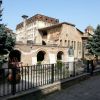
Located near Piața Domenii and Ion Mihalache Boulevard, this thoroughfare is part of one of Bucharest’s most appreciated residential areas. The neighborhood developed primarily during the first half of the 20th century and is known for its quiet atmosphere and valuable architectural heritage.
Over time, Vasile Gherghel Street has been home to important buildings from both a historical and administrative perspective. Among them is the former Preventive Health Center, an institution that played an important role in the Capital’s healthcare system.
The area is also associated with various cultural and administrative activities, which gives it a special value within Bucharest’s urban landscape.
Today, the street continues to be included in modernization and urban development projects, demonstrating that it remains relevant within the structure of the contemporary city.
Why his name remained in Bucharest’s memory
There are numerous historical figures whose names have faded over time. In the case of Vasile Gherghel, the situation is different. Although he was neither a famous politician nor a military commander who led armies in decisive wars, he managed to leave behind a tangible and visible legacy.
On the one hand, his activity within the Royal Military Household links him to one of the most important periods in Romania’s modern history, namely the consolidation of Carol I’s reign. On the other hand, his involvement in the development of land that contributed to the expansion of Bucharest secured him a place in the Capital’s urban history.
Today, few of those who walk along Vasile Gherghel Street know the story of the man behind the name. Nevertheless, the existence of this thoroughfare represents a discreet but important form of preserving historical memory.
A discreet yet important figure in the history of the Capital
Vasile Gherghel is not one of the celebrated figures of Romanian history, but his biography illustrates how people close to major events can influence the evolution of a community. A cavalry officer, royal aide-de-camp, and owner of lands that contributed to the development of Bucharest, he represents an example of the military and administrative elite from the early period of the Romanian monarchy.
His legacy is not found in grand monuments or extensive chapters of history textbooks, but in the very structure of the city. The Gherghel Subdivision and the street that bears his name are testimonies to an era when Bucharest was transforming from a Balkan town into a modern European capital.
Therefore, when we encounter the name Vasile Gherghel on a map, we are not simply looking at a street name, but at a page of urban history that connects the beginnings of the Romanian monarchy with the development of one of the Capital’s most important neighborhoods.
We also recommend: Who was Elena Clucereasa and why does she have a street named after her in Sector 1, Bucharest