Who Was Doctor Constantin Daniel and Why Is There a Street Named After Him in Central Bucharest?
- Articles
- 18 AUG 26
In Bucharest, there are streets named after personalities known to everyone, but also smaller streets dedicated to people whose contributions were important to Romanian culture, science, or medicine. Constantin Daniel Street, located in Sector 1, in the central area of the capital, is such an example. Near Piața Romană and several old Bucharest neighborhoods, the name of the street preserves the memory of Constantin Daniel, a psychiatrist, orientalist, translator, and researcher with a passion for the civilizations of the ancient Near East. Constantin Daniel was born on June 4, 1914, in Paris, into a Romanian family of intellectuals, and died in Bucharest on June 14, 1987. He had an unusually complex education for a physician of his generation. He studied medicine, sociology, and ancient languages, researched Egyptian, Phoenician, Assyro-Babylonian, Aramaic, and Hittite civilizations, and became one of the promoters of occupational therapy in Romania. Moreover, Constantin Daniel managed to combine medicine with Oriental studies in a rarely encountered way. He knew numerous classical and Oriental languages and left behind an impressive body of studies, translations, and syntheses. For this reason, his name became associated not only with Romanian psychiatry, but also with the study of the great civilizations of the ancient Near East.
A childhood in Paris and a family of intellectuals
Constantin Daniel was born in Paris, at the beginning of the First World War, into a family with strong intellectual roots in Romania. His father, Alexandru Daniel, was a urologist, while his mother, Elena Vălimărescu, was the daughter of the diplomat and minister Constantin Vălimărescu. The family environment in which he grew up provided him from childhood with contact with education and the intellectual world.
He completed his secondary education in France, at the famous Lakanal high school in Paris, an institution with an important academic tradition. He also took his baccalaureate examination there, after which his destiny was to become permanently connected to Romania. In 1934, Constantin Daniel returned to the country and enrolled at the Faculty of Medicine in Bucharest.
His university years were, however, much richer than the chosen specialization might have suggested. While preparing to become a physician, he also attended courses at the Faculty of Philosophy in Bucharest. This approach to philosophy and the humanities was to decisively change his intellectual path.
Medicine and his passion for Oriental studies
Constantin Daniel was attracted from a young age to the study of the civilizations and cultures of the ancient Near East. During his student years, his encounters with professors such as Nicolae Predescu, Mircea Vulcănescu, and Mircea Eliade played an important role in developing this passion. Each of these intellectuals, in his own way, offered him a perspective on the field of Oriental studies.
Daniel quickly realized that serious research into Oriental civilizations could not be conducted without knowing the languages in which the ancient texts had been written. Starting from his knowledge of Greek and Latin, he began systematically studying other languages.
In an autobiographical note, Constantin Daniel described his intellectual journey and explained that, after obtaining his degree in sociology, he began studying Ancient Greek, then Old Church Slavonic, Hebrew, and Aramaic. For Hebrew, he benefited from the guidance of Professor Meyer Halevy, while his interest in Egyptology developed under the influence of Professor Frenkian, a specialist in Ancient Egyptian.
In 1948, Constantin Daniel obtained his degree in sociology from the Faculty of Letters and Philosophy of the University of Bucharest, under the guidance of Professor Dimitrie Gusti. This dual education, medical and humanistic, was to become one of his defining characteristics.
A medical career that began at the “Gh. Marinescu” Hospital
Constantin Daniel’s medical activity began in 1937, when he worked as an intern at the “Gh. Marinescu” Hospital. He gradually advanced through the stages of an academic medical career, becoming a junior assistant and then an assistant at the Department of Psychiatry. It was a period during which he divided his time between clinical activity, teaching students, and his own research.
Even during his university years, he was also involved in the editorial activity of the journal “Spitalul,” serving on its editorial committee. This interest shows that for Daniel, medicine did not mean only a profession, but also research, documentation, and the transmission of knowledge.
In 1941, he obtained his doctorate in medicine and surgery, based on the thesis “Contributions to the Study of Infection Caused by Plasmodium ovale.” During the same period, he was a student and direct collaborator of Professor Petre Tomescu, an important figure in Romanian psychiatry.
His medical career was, however, seriously affected by the political changes that followed the war. Until 1946, his activity had taken place within a normal medical and academic framework, but afterward came a period of approximately 19 years during which he was not allowed to practice medicine in a hospital or outpatient clinic.
The years when he turned his professional ban into a period of study
For Constantin Daniel, the ban on practicing medicine did not mean abandoning his intellectual activity. On the contrary, those years were devoted to deepening his knowledge of the languages and civilizations that fascinated him. He methodically improved his knowledge of English, Russian, Ancient and Modern Greek, Turkish, Coptic, Aramaic, and Egyptian.
This period contributed to his development as one of the most erudite Romanian researchers of the ancient Near East. He accumulated information from extremely diverse fields, from history and religion to medicine, philology, and culture.
After his rehabilitation, in 1964, Constantin Daniel returned to the medical profession. He worked as a psychiatrist at the Post Office Hospital and later at the Batiștei Polyclinic. At the same time, he continued his research and his work as an author and translator.
An encyclopedist of the civilizations of the ancient Near East
Constantin Daniel’s contributions to Oriental studies are impressive in scope. He was a researcher interested in Egyptian, Phoenician, Assyro-Babylonian, Aramaic, Hittite, and Sumerian civilizations, as well as in other Oriental cultures and traditions.
His linguistic knowledge allowed him to work directly with ancient sources, not merely through modern translations. He mastered classical languages and several languages of Oriental civilizations, as well as five modern languages. This training allowed him to construct broad syntheses concerning the history and cultures of the ancient Near East.
His work can be regarded as an attempt to provide the Romanian public with a coherent picture of the ancient Oriental world. In this respect, his research has been compared in scope with the project of Gaston Maspero, one of the great scholars of ancient civilizations, who had set out to create a general history of the ancient peoples of the Near East.
The books that established his name
Constantin Daniel’s body of work is extensive and spans several decades. Among his works is “Alexandru Vodă Lăpușneanu,” an essay in pathography published in 1944, followed, after the long period during which he was unable to practice medicine, by volumes dedicated to the ancient world and the history of medicine.
In 1967, he published “Illustrious Figures from Antiquity,” while in 1970 he signed the chapter dedicated to Mesopotamian medicine in the volume “History of Oriental Medicine,” edited by Professor V.I. Bologa. This was followed by “Egyptian Thought in Texts,” “Maxims, Sentences and Aphorisms from Ancient Egypt,” “The Civilization of Ancient Egypt,” “Orientalia Mirabilia,” “Pharaoh Khufu and the Magicians – Tales of Ancient Egypt,” “The Phoenician Civilization,” “Scripta Arameica,” “The Assyro-Babylonian Civilization,” “Clay Tablets – Writings from the Ancient Near East,” and “The Sumerian Civilization.”
Among his final works are “Pages from Universal Military Thought,” “The Spiritual Culture of Ancient Egypt,” “The Mysteries of Zalmoxis,” and “In the Footsteps of Ancient Civilizations,” published in 1987. Through these books, Daniel contributed to popularizing and deepening the study of the ancient Near East within Romanian culture.
A special place is occupied by the work “Female Psychosomatics,” written together with Vasile Văleanu. Published in 1977, it sought to relate the concepts of psychosomatics to the particularities of female psychology and pathology and was presented as an important pioneering work in Romanian medical literature.
Occupational therapy and the connection between medicine and culture
One of Constantin Daniel’s important medical contributions was the promotion of occupational therapy in Romania. This approach involved the use of practical activities and organized work as part of the therapeutic and rehabilitation process, especially in the context of mental health.
His interest in psychology, psychiatry, sociology, and ancient cultures should not be viewed as a random collection of concerns. Constantin Daniel had a constant desire to understand human beings from as many perspectives as possible. Medicine offered him the biological and clinical perspective, sociology offered him the social perspective, while Oriental studies allowed him to follow the way ancient civilizations had constructed their own concepts of human beings, illness, society, religion, and destiny.
This combination largely explains the encyclopedic character of his work. Constantin Daniel was not merely a physician who devoted his free time to history, but an intellectual who attempted to bring different disciplines into dialogue.
Translator and collaborator of Romanian Orientalists
Constantin Daniel did not limit himself to his own research. He also contributed to the translation of Oriental texts and collaborated with other specialists. Among his collaborators was the priest and Orientalist Athanase Negoiță, for whose works he wrote introductory studies.
He also collaborated with Ion Acsan, together with whom he translated texts from Ancient Egyptian. Such projects were particularly important for Romanian culture at a time when access to the sources of ancient civilizations was much more difficult than it is today.
In 1976, Constantin Daniel became a member of the Romanian Writers’ Union and was also president of the Association for Oriental Studies. These positions reflect the recognition he enjoyed in Romania’s cultural and scientific world.
Why is there a Constantin Daniel Street in central Bucharest?
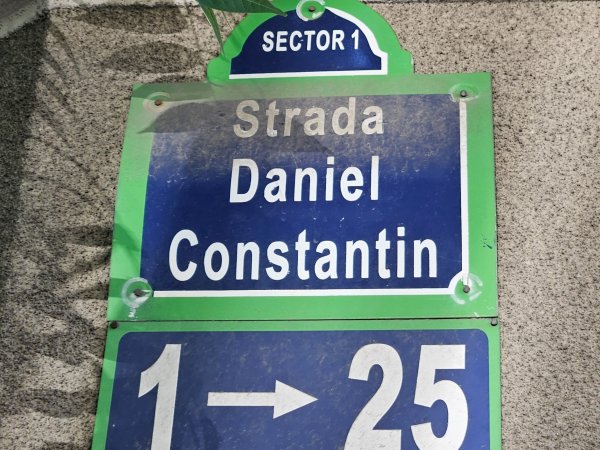
Constantin Daniel Street is located in Sector 1 of the capital, in the central area near Piața Romană. Current location data places it close to Povernei Street, I.C. Visarion Street, and Lascăr Catargiu Boulevard, just a few minutes’ walk from Piața Romană.
The name of the street is therefore a form of urban recognition of a personality who made a distinctive contribution to Romanian culture and medicine. Choosing the name of a physician and Orientalist for a street in central Bucharest is particularly interesting because Daniel was not a personality known exclusively in one field. He represented the type of encyclopedic intellectual, capable of simultaneously dedicating himself to medicine, sociology, philology, history, and the study of ancient religions and civilizations.
Today, the street bears his name in a densely populated urban area located near several important cultural and historical landmarks of Bucharest. Even though passersby do not always know the story behind the name, Constantin Daniel’s name recalls a Romanian scholar whose activity went far beyond the boundaries of a single profession.
The legacy of an intellectual with limitless curiosity
Constantin Daniel died in Bucharest on June 14, 1987, just ten days after turning 73. He left behind a body of work that impresses through the variety of its subjects and the breadth of his research.
He was a psychiatrist, one of the promoters of occupational therapy in Romania, a sociologist, Orientalist, translator, and author. He studied ancient languages in order to read the sources of the civilizations he researched and attempted to bring into Romanian culture information about Ancient Egypt, Mesopotamia, Phoenicia, the Aramaic world, and Sumerian civilization.
For this reason, the street that bears his name in central Bucharest does not commemorate merely a physician. It preserves the memory of an intellectual for whom specialization was not a limitation, but a starting point. Constantin Daniel viewed human beings through the perspectives of medicine, culture, and history and attempted to connect worlds that, at first glance, seemed very distant from one another.
In a Bucharest where many streets tell stories about rulers, artists, writers, politicians, or scientists, Constantin Daniel Street is one of those small lessons in urban history worth discovering. Behind the name on the street sign lies the story of a physician fascinated by vanished civilizations, a researcher who learned ancient languages in order to reach primary sources, and an encyclopedist who transformed an extraordinary intellectual curiosity into a body of work of lasting importance for Romanian culture.
We also recommend: General Ioan Emanoil Florescu, founder of the Romanian Army, has a street bearing his name in the center of Bucharest