Where Politehnica Students Live, and What Their Dorms Look Like Today
- Articles
- 11 AUG 26
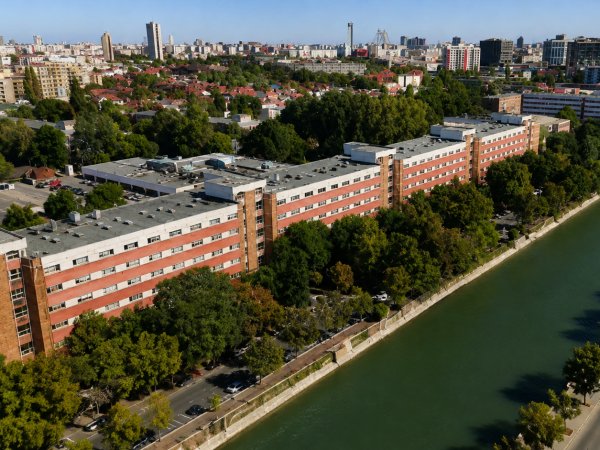
On Splaiul Independenței, at number 290, sits Bucharest's largest student neighborhood: 27 dormitories, a cafeteria, a laundry, a medical office, and its own police station. This is the Regie complex, the heart of student life at Politehnica, built over six decades ago on land that had been, until the 1940s, covered in the horticultural plantations of the Grozăvești boyar estate.
From vegetable fields to 2,070 beds
The first buildings in Regie opened in 1960: five dormitories, with two- and three-bed rooms, totaling 2,070 beds. The complex expanded steadily through 1968, and in 1980-1981 a second wave of construction was added — twelve dormitories built specifically for the 1981 Universiade, when Regie became the Olympic village of the world university games. Alongside it, between 1963 and 1969, the Rectorate building of the Polytechnic Institute went up, a structure topped with a lenticular dome that earned it the nickname "the spaceship" among generations of students.
Today, Regie has 27 dormitories (26 belonging to Politehnica, one — P20 — to the University of Medicine), plus the Leu complex on Iuliu Maniu Boulevard, with two more buildings: A Leu and C Leu, home mainly to students from Electronics, Telecommunications, and Information Technology.
What a room looks like, depending on the dormitory
Not all of Politehnica's dormitories offer the same type of accommodation. There are three clear categories:
- P1-P11: four-bed rooms, with a private bathroom in the room.
- P13, P14, P17, P18: also four-bed rooms, but with a washbasin in the room and shared bathrooms at the end of the hallway.
- P15, P16, P21-P27: two-bed rooms, with a washbasin in the room and shared bathrooms on the hallway.
Dormitories P12 and P19 have a different arrangement: two-bed rooms with a private bathroom, reserved for married students, young faculty, and international students on European programs such as Erasmus+.
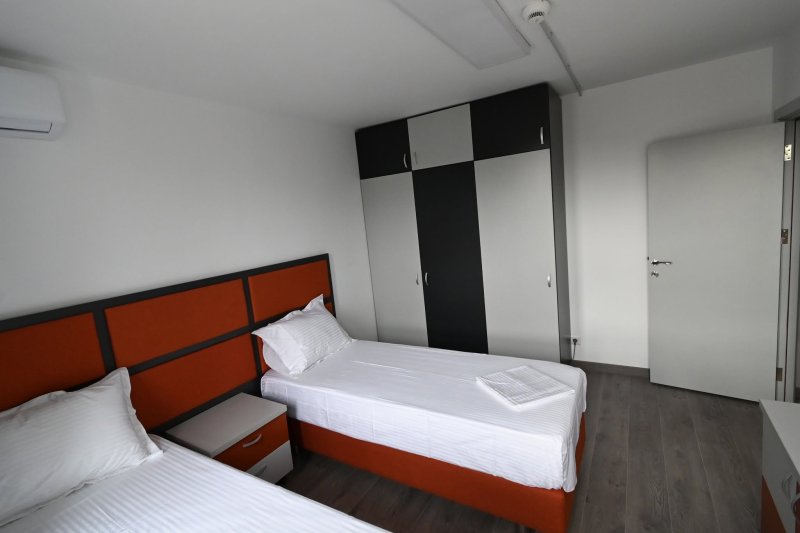 P19, part of the Regie student complex
At Leu: A Leu has three-bed rooms with a private bathroom, while C Leu offers two-bed rooms, with a washbasin in the room and shared bathrooms on the hallway.
Dormitory assignments by faculty are set annually by the housing committees and can vary from year to year; Electrical Engineering students, for instance, are consistently housed in P7 and P24.
Renovations, internet, and surveillance cameras
In recent years, all the dormitories have undergone major renovations: the furniture — beds, wardrobes, study desks, chairs — and bedding are new, and every dormitory now has a reading room. Structured internet networks were installed, so resident students have permanent access to fast connections. The university has also planted over 1,500 trees and shrubs across the complex's green spaces.
Safety has been a declared priority since 2005: intercoms at entry doors, video cameras at dormitory entrances and exits, and surveillance at the complex's entrance, all feeding into a monitoring center run around the clock by UPB's Security Service, together with the Regie Police Station.
Over 90% of housing requests are approved, including for first-year students. Required documents vary from year to year, so they're worth checking directly against each faculty's current housing announcement.
A new dormitory, under construction right now
The Regie complex hasn't stayed frozen in 1960s architecture. In late February 2026, Politehnica launched the "Campus Regie Student Dormitory" project, co-financed with EU funds through Romania's National Recovery and Resilience Plan (PNRR): a new building, with a constructed area of nearly 5,900 sqm, designed for 170 beds, with a completion deadline of August 31, 2026. Total investment exceeds 38 million lei, close to €7.5 million, of which the non-reimbursable portion comes to around €6.7 million. The beds will go primarily to students from disadvantaged backgrounds.
For those looking for housing, dormitory fees vary by building, depending on room type and available amenities, and are set annually by UPB's Board of Directors before the start of the academic year. The distance to campus remains a hard advantage to beat: Grozăvești metro station, on line M1, is a few minutes' walk from the dormitories, and bus lines 105, 162, 163, and 178, plus trolleybus 90, run right through the area, with a stop directly in front of the complex.