The story of artist George Grigoriu. The star of Trio Grigoriu launched Angela Similea and Stela Enache
- Articles
- 05 JAN 26
George Grigoriu is one of those personalities without whom the history of Romanian light music cannot be fully understood. Composer, orchestrator, mentor and talent scout, he managed to combine artistic creation with the training of entire generations of performers. His impressive activity, carried out over more than five decades, left a profound mark on Romania’s musical culture.
The roots of a passion for music
George Grigoriu was born in Brăila on April 8, 1927, into a family where music was part of everyday life. His father, Radu Grigoriu, a professional violinist, played an essential role in his son’s artistic formation, instilling in him a love for sound, harmony and musical discipline. From an early age, George showed a special sensitivity to music, an inclination that was to define his entire existence.
His education was built on solid foundations, being guided by important figures of Romanian musical life such as Ioan D. Chirescu and Mircea Basarab. Although his training was academic, his artistic destiny led him, starting in 1950, toward light music, following the advice of Sile Dinicu, a decisive step that opened the path to recognition.
The birth and affirmation of Trio Grigoriu
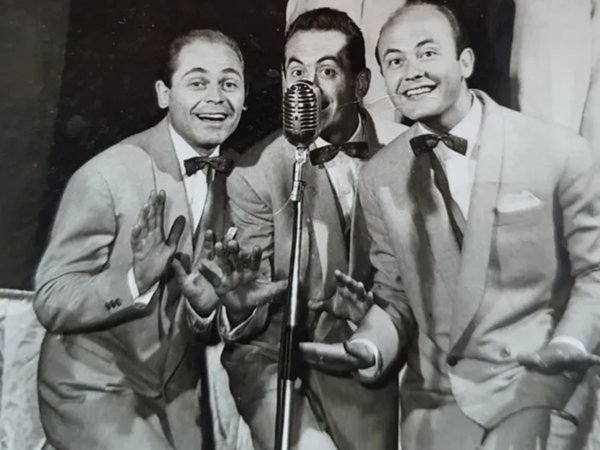
Together with his brothers, Angel and Cezar, George Grigoriu laid the foundations of one of the most beloved vocal groups in Romania: Trio Grigoriu. Their official launch took place in 1946 through National Radio, and success did not take long to appear. The audience was won over by the impeccable vocal harmonies, the diversity of the repertoire and the refinement of the interpretations.
Trio Grigoriu naturally approached light music, jazz, as well as humorous or lyrical pieces, many of them composed and orchestrated by George himself. The collaboration with Horia Ropcea brought an extra touch of modernity and expressiveness, and the group’s style quickly stood out on the Romanian music scene.
Trio Grigoriu and the revue theatre stage
An important moment in the career of the three brothers was their debut on the stage of the “Constantin Tănase” Theatre in 1953, in the musical comedy “Și Ilie face sport!”. This appearance opened a long-term collaboration with revue theatre, where Trio Grigoriu became a constant and appreciated presence.
Shows such as “București 500”, “Vitamina M… Muzica” or “Jos pălăria!” benefited from the complex talent of the Grigoriu brothers. George stood out as an orchestrator and composer, while Angel and Cezar contributed as director and lyricist. In 1957, the trio released an LP record at Electrecord, which included songs that quickly became popular, among them the famous “Broscuța Oac”, a true evergreen of Romanian music.
The composer and the diversity of his creation
George Grigoriu did not limit himself to stage activity or to the success of Trio Grigoriu. He was an extremely prolific creator, signing the music for 18 revue shows, four operettas and over 30 film soundtracks. Among the landmark cinematic productions is “Actorul și sălbaticii”, an emblematic title of Romanian cinema.
His musical creation covered a wide range of emotions and styles. From cheerful, energetic songs such as “Broscuța Oac” to pieces with dramatic depth, like “Eternitate” or “Speranțe, vis, speranțe, flori”, George Grigoriu’s music always reflected the complexity of human experiences.
The mentor of the great voices of Romanian music
One of George Grigoriu’s most important contributions remains his role as a mentor. He had an extraordinary instinct for discovering and shaping artists who would become landmarks of Romanian music. Among the voices he launched or supported are Angela Similea, Stela Enache, Margareta Pâslaru, Mihaela Mihai, Luminița Dobrescu, Marina Florea, George Nicolescu, Cristian Popescu and Paul Surugiu.
His relationship with these performers was not limited to simple artistic collaboration. George Grigoriu was a true teacher, a guide who knew how to shape careers, offer confidence and create favorable contexts for affirmation, including participation in international festivals and prestigious competitions.
National and international recognition
The value of George Grigoriu’s creation was recognized both at home and abroad. He represented Romania on the juries of international music competitions held in Sochi, Sofia, Prague, Malta, Berlin, Athens, Sopot and the USSR. In 1967, he received the Prize of the Union of Composers of the USSR, an important distinction for a Romanian artist of that time.
At national level, he was rewarded with no fewer than 13 prizes at the Mamaia Festival between 1964 and 1987. In 1962, he became a member of the Union of Composers of Romania, where he was actively involved in the leadership of the light music section, supporting young creators such as Marius Țeicu, Ionel Tudor and Marcel Dragomir.
Artistic legacy and the human dimension
In addition to his activity as a composer and mentor, George Grigoriu was also a keen observer of the musical phenomenon, collaborating with the specialized press and signing articles and reviews. In 1965, his contribution was essential to the success of the “Tănase” Theatre in Paris, on the stage of the Olympia, where the show “Grand Music-Hall de Bucarest” impressed the French audience.
He composed hits that permanently entered the collective memory, such as “Două inimi cântau”, “Chemarea mării”, “Iubire, tu”, “Serenada tinereții” or “Doar băieții sunt de vină”. The lyrics of many of these songs were written by his brother, Angel Grigoriu, or by his daughter, Andreea Andrei, adding an intimate and familial dimension to his creation.
George Grigoriu passed away on February 23, 1999, in Bucharest, leaving behind an impressive body of work and a lesson in professionalism, passion and dedication. His music continues to be listened to and loved, and his name remains synonymous with excellence in Romanian light music.
We also recommend: The stars of interwar Bucharest: Nae Roman, “baptized” by the great Constantin Tănase, refused to join the Communist Party