Symbols of Bucharest: Colțea Church, the Capital’s oldest functioning building
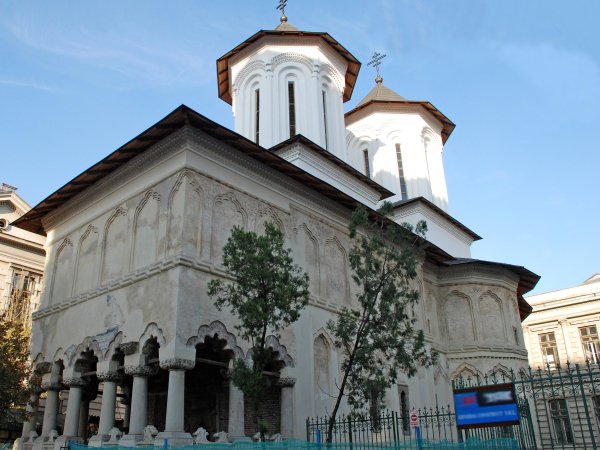
In the heart of Bucharest, just a few steps from University Square and the busy I.C. Brătianu Boulevard, a church more than three centuries old continues to serve the purpose for which it was built. Colțea Church, also known as the Church of the “Three Hierarchs,” is considered one of the oldest functioning buildings in Bucharest and one of the few monuments in the capital that preserves a direct link between the city of the early modern period and contemporary Bucharest. Its presence is all the more important because the area in which it stands has undergone radical transformations. The old Colțea Monastery complex has almost entirely disappeared, the Colțea Tower was demolished in 1888, and modern buildings and thoroughfares have gradually emerged around the church. Yet the church remains a living witness to the city’s past, and its walls tell the story of a capital that has changed countless times without completely losing its memory.
Where the name Colțea comes from
The history of the church begins before the construction of the present stone building. On the site of the current Colțea complex, there was a wooden church attributed to the boyar Udrea, known in historical documents as Udrea Doicescu. The National Archaeological Record dates this first construction probably to around 1641–1642. After Udrea was killed during the Seimeni uprising of 1655, the church and the surrounding properties remained under the care of his brother, Colțea Doicescu, a great clucer. The name of the church and the neighborhood would later derive from him.
Colțea Doicescu entrusted the old church to the Metropolitan See of Wallachia, and the land subsequently came into the possession of the great spătar Mihail Cantacuzino. He decided to build an extensive religious and social complex here. It was not simply a place of worship, but a large-scale project for Bucharest at the beginning of the 18th century, which would include a hospital, chapels, monastic cells, residences and other buildings necessary for the functioning of a monastery.
The present church was built around 1701–1702, while its first certain documentary mention dates to October 18, 1702, in a patriarchal charter. Its main patronal dedication is to the Holy Three Hierarchs – Basil the Great, Gregory the Theologian and John Chrysostom – together with the protection of Saint Pious Parascheva. The church therefore preserves in its structure the memory of a period when religious architecture in Wallachia was deeply influenced by the Brâncovenesc style.
The monastery built by Mihail Cantacuzino
The church was only the center of a much larger complex. Mihail Cantacuzino endowed Colțea Monastery with numerous properties and sources of income, while buildings with religious, medical and educational functions were erected around the church. These included three chapels, monastic cells, residences for the monastery’s staff and a hospital intended especially for the poor. A Romanian school also operated in the monastery cells, and during the 18th century the complex played an important cultural role.
Colțea Hospital, associated with the same project, initially had 24 beds and is considered the first hospital in Bucharest intended for the poor. The complex thus became more than a monastery in the strict sense, developing into an important social center of the city. This association between the church, medical assistance and education explains why the name Colțea has remained so strongly connected with the history of Bucharest.
Mihail Cantacuzino did not live long enough to witness the full development of the complex. Following political changes and conflicts within the Cantacuzino family, the founder met a tragic fate. He was executed by the Ottomans in 1716, and after his death the monastery came under the care of the rulers of the time. According to the church’s official history, the original inscription on the church was erased after the death of its founder.
The Colțea Tower, Bucharest’s lost landmark
For more than a century, the appearance of the complex could not be separated from the Colțea Tower. Built during the development of the monastery, the tower initially served as a bell tower and later as a fire-watch tower. Erected at the entrance to the complex, it became one of the most recognizable buildings in Bucharest and remained for a long time the tallest structure in the city.
The tower’s fate, however, was different from that of the church. After being damaged by earthquakes and subsequently repaired, the Colțea Tower was demolished in 1888, amid the urban transformations intended to modernize and widen the central thoroughfares. Some of its stone elements were recovered and reused, while several ornamental stone finials from the tower were later placed between the columns of the church during restoration works supervised by architect Gheorghe Mandrea.
The disappearance of the tower permanently changed the appearance of the area. The church became, in effect, the last major visible witness to the old monastery complex. Today, it is difficult for a passerby looking toward Colțea to imagine the former complex, dominated by walls, monastic cells, the hospital, chapels and the monumental tower. Nevertheless, the church still preserves its proportions and many of the characteristics that reveal its age.
Fires, earthquakes and transformations of the church
Colțea Church did not reach the present day without major interventions. On February 27, 1739, a fire affected the entire complex, including the main church. The roof and interior were rebuilt that same year. In 1770, the logothete Necula Măinescu added a small porch in front of the original one, an intervention that would be removed at the end of the 19th century.
Several earthquakes during the first half of the 19th century, particularly those of 1802, 1829 and 1838, affected the church’s structure. In 1841, repair works were carried out according to plans by architect Faiser, with Conrad Schwink serving as contractor. In 1871, the interior was repainted by Gheorghe Tattarescu. On that occasion, the two original towers, which had been damaged by earthquakes, were not rebuilt.
At the end of the 19th century, the church entered another stage of transformation. Beginning in 1895, the works were supervised by architect Gheorghe Mandrea. The porch added in 1770 was removed, while stone elements from the Colțea Tower were incorporated between the church’s columns. Thus, even after the disappearance of the tower, fragments of the old urban landmark continued to survive, discreetly integrated into the architecture of the church.
The church survives wars and communism
Another important intervention took place between 1938 and 1941, when the church was restored under the supervision of the Civil Hospitals Eforia, with the involvement of architect Horia Teodoru. At that time, the bell tower above the narthex was reconstructed. The works were followed by further repairs after the 1944 bombings, which particularly affected the northern side of the building.
One of the most difficult periods in the church’s recent history came after the earthquake of March 4, 1977. Although a restoration project had been prepared, the communist authorities effectively abandoned the intervention, and the church was closed in 1986. The restoration project was not completed, and the fate of the monument became uncertain.
The church nevertheless regained an important role during the days of the December 1989 Revolution. On the night of December 21–22, priest Sandi Mehedințu rang the church bells and opened its doors, while the church provided shelter to some revolutionaries and people wounded in the area around University Square. Later testimonies and accounts of those days confirm the role of Colțea Church as a refuge near the clashes in the center of the capital.
How Colțea Church was saved
After 1989, the monument entered a new stage. Consolidation works resumed in 1998, and during the interventions the drum of the dome over the nave was discovered, preserving original fresco painting attributed to Pârvu Mutu. The discovery was particularly important because it provided specialists with new information about the church’s original artistic appearance.
Between 2001 and 2005, extensive consolidation, restoration and volumetric remodeling works were carried out. The interior painting was restored, while archaeological campaigns took place in the churchyard in 2006 and 2008. The excavations identified the foundations of the old church and 127 medieval graves, together with coins and pieces of jewelry. The discoveries contributed to a better understanding of the history of the area before and during the development of the Colțea complex.
Today, Colțea Church is a listed historic monument, LMI code B-II-m-A-18220.01, and continues to function in the center of Bucharest. Its presence is all the more valuable because the city has lost numerous historic buildings over the past two centuries. Streets, buildings and urban perspectives have changed around it, yet the church has survived and continues to serve as a place of worship.
Colțea Church is not merely an old building, but one of the few structures in Bucharest to have crossed more than three centuries of transformations while remaining in use. It has survived fires, earthquakes, bombings, urban redevelopment and the communist period, and in December 1989 it briefly became a refuge for people caught in the streets. This continuity is precisely what gives it its status as a symbol of Bucharest: in a city where many historic landmarks have disappeared, Colțea Church continues to stand, to be seen and, above all, to fulfill the function for which it was built more than three hundred years ago.
We also recommend: Symbols of Bucharest: Colțea Tower – History, Disappearance, and Legend