How Bucharest was decorated for Christmas in the past. From interwar shop windows to Father Frost and the first modern Christmas markets
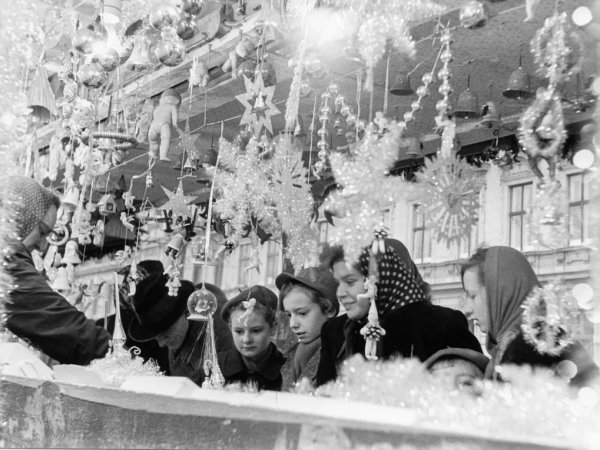
In interwar Bucharest, Christmas was most visible in shop windows, markets and people's homes. During the communist era, the city still had decorated trees and winter ornaments, but the religious holiday disappeared from official celebrations. It was only after 1989 that the Romanian capital began to rediscover Christmas as a public event, with markets featuring dozens of wooden stalls, concerts and festive lights gradually becoming a familiar tradition.
The history of Bucharest's winter holidays is also the story of how the city itself has changed. From department store advertisements in the 1930s to celebrations featuring Father Frost and elaborate light displays in the 2000s, every era had its own way of bringing the festive season into the streets.
Interwar Bucharest: sparkling shop windows, toys and Christmas shopping
In December 1929, the magazine Ilustrațiunea Română described a bustling Bucharest, where Christmas shopping brought street vendors, parents carrying parcels and children fascinated by toy shop windows onto the city's streets. The atmosphere captured by the publication bears a striking resemblance to the shopping rush that fills Bucharest every December today.
The capital's major department stores advertised their products through newspaper promotions and seasonal window displays. One documented example was the store known as "La Vulturul de Mare cu Peștele în Ghiare", whose Christmas advertisements appeared in newspapers in 1935. Toys, decorations, clothing and gifts were already an established part of the festive shopping season.
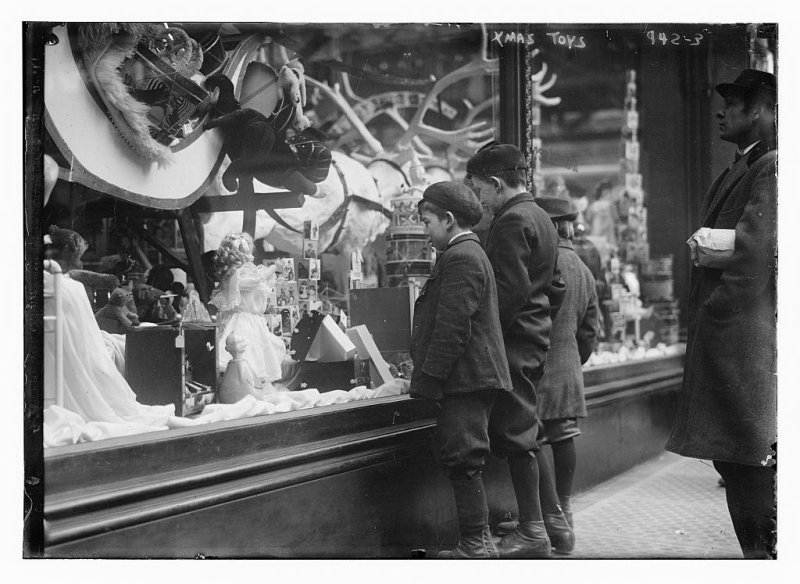 Archival photograph – Interwar Bucharest. Department store window displays attracted passersby during the holiday season. Photo source and attribution: Tudor Chira / SkyscraperCity collection.
Decorated Christmas trees could be found in many households, while Santa Claus had become a familiar figure to children. Interwar photographs and advertisements show how local traditions coexisted with Western influences, particularly in urban areas.
That does not mean, however, that Bucharest had street decorations comparable to those seen today. Nor can Christmas markets featuring wooden stalls, concerts and tourist attractions be described as an established interwar tradition in the capital.
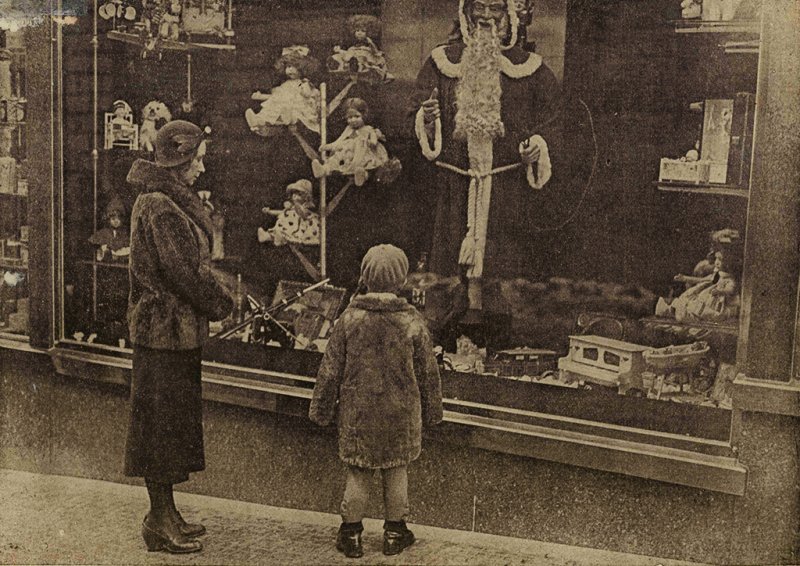 Photograph by Iosif Berman. Source: Ilustrațiunea Română, December 25, 1929.
Christmas under communism: the city prepared for New Year's Eve, not December 25
After the communist regime came to power, Christmas was removed from the official festive calendar. December 25 and 26 became ordinary working days, while the authorities promoted winter celebrations stripped of their religious significance.
In official celebrations, Santa Claus was replaced by Moș Gerilă, the Romanian version of Father Frost, while the Christmas tree became the "winter tree". Festive events were organized in schools, kindergartens, factories and public institutions, usually around New Year's Eve. Children recited poems and received presents, while many families continued to observe Christmas traditions privately at home.
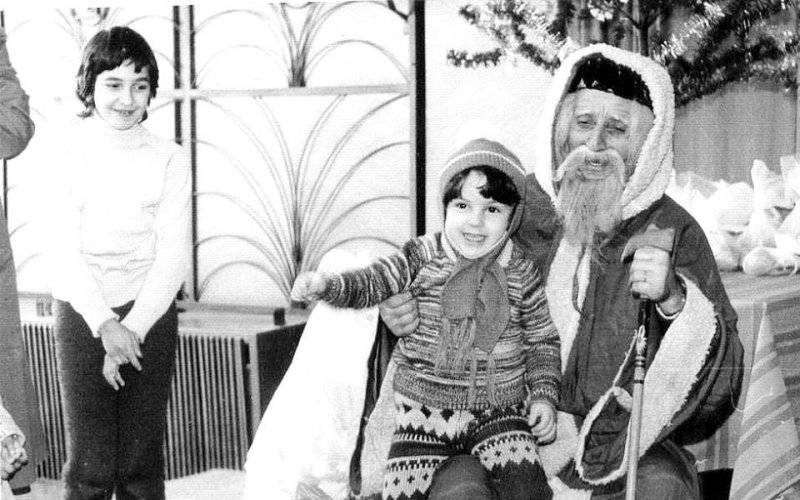 Historical photograph – Father Frost (Moș Gerilă), the figure officially promoted during winter celebrations under the communist regime. Image source: Le Télégramme. The photograph has not been confirmed as having been taken in Bucharest.
Bucharest was not entirely without decorations, however. During the 1980s, festive lights could be seen along Calea Victoriei, near the National Museum of Art of Romania, while the Children's Town amusement park featured seasonal decorations and appearances by Father Frost. These celebrations were associated with the end-of-year festivities rather than Christmas as a religious holiday or the Christmas markets familiar to visitors today.
At home, Christmas trees were decorated with glass baubles, tinsel, handmade ornaments and sweets. The availability of decorations varied, and shortages in shops during the final decade of communist rule also affected preparations for the festive season.
The transformation of Christmas under the communist regime and the role of official propaganda are explored in How Santa Claus became Father Frost in communist Romania.
The 1990s: Santa Claus returns, but modern Christmas markets have yet to emerge
After the Romanian Revolution of 1989, Christmas regained its place in public life. Santa Claus returned to advertisements, shop windows and children's celebrations. Stores gradually began offering a wider variety of baubles, festive lights and decorations as Western products became more accessible.
The transformation did not happen overnight. Bucharest in the 1990s did not yet have today's extensive network of shopping malls, and large Christmas markets held in public squares had not become an annual tradition. The festive atmosphere developed through commercial initiatives, local events and an increasing number of seasonal decorations.
Changes in the capital's public life during this period are also reflected in the story of where Bucharest residents celebrated Romania's National Day in the 1990s and how the city's winter traditions evolved.
The first modern Christmas markets: eight wooden stalls in 2006 and a giant tree in Unirii Square in 2007
By the mid-2000s, Bucharest was beginning to organize Christmas events that increasingly resembled those held today. In December 2006, Bucharest City Hall announced performances outside the National Theatre, alongside a gift market featuring eight wooden stalls. The programme included carol singers, performers and opportunities for children to meet Santa Claus.
A year later, in 2007, Unirii Square became the centre of large-scale festivities. Newspapers reported plans for a giant artificial Christmas tree, described at the time as the tallest in Europe, along with approximately 500,000 LED lights and ornaments intended to decorate the capital's main roads. A Christmas market and an ice rink were also planned for the square.
By 2008, Christmas markets had expanded to several parts of the city. Obor Park hosted an event called "Christmas at Obor", featuring 35 wooden stalls, traditional products, decorations, concerts and a light projection show. Other festive events took place in Unirii Park, Tineretului Park and elsewhere in Bucharest.
Christmas markets in Bucharest therefore did not first appear in 2012. Events organized by local authorities already existed, although their formats, locations and sizes varied considerably.
From 2012 onwards, Bucharest Christmas Market becomes a festive landmark
The year 2012 marked the launch of Bucharest Christmas Market in its official format.
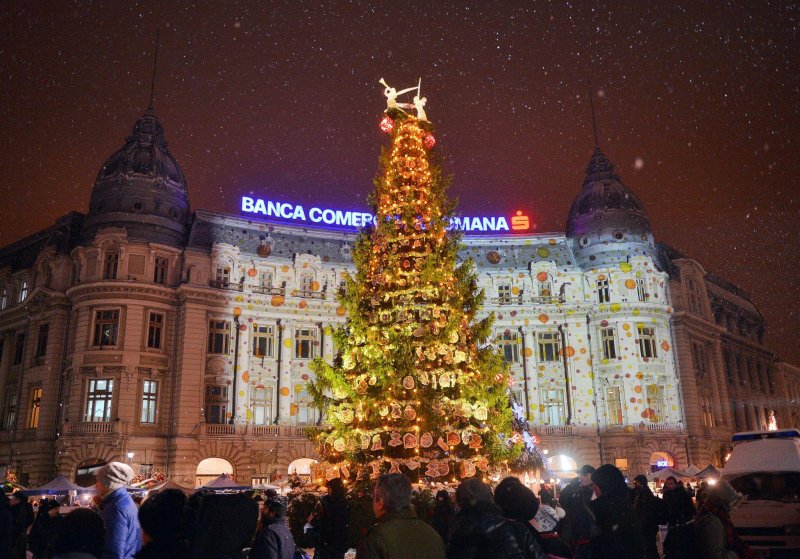
The decorations included a 17-metre Christmas tree, more than 3,000 coloured lights, approximately one kilometre of illuminated garlands and ten tonnes of fir branches. Visitors could explore more than 65 wooden stalls selling traditional products, toys, ornaments, sweets and food. The programme also featured performances, Christmas carols and activities for children.
 Mihailescu / AFP
Bucharest Christmas Market, University Square, December 2012. Photograph from the first official edition of the Christmas market. Photo: Daniel Mihailescu / AFP.
Subsequent editions established this format as a recurring attraction. In 2013, the market featured 65 stalls, while in 2014 it took place in both University Square and Cișmigiu Park, with approximately 100 stalls. Festive lighting, projections onto buildings and concerts became central elements of the experience.
Over time, Christmas markets also spread to other parts of Bucharest, including repurposed industrial buildings. One example is Laminor Hall, whose transformation is explored in the article about the history of Laminor Hall, from the Malaxa factories to today's Christmas markets.
Looking back, the difference is striking. Almost a century ago, Bucharest residents admired toys and gifts displayed in shop windows. During communism, public winter celebrations centred on New Year's Eve. Today, the city's squares and boulevards become places for entertainment and social gatherings for several weeks each winter.
Christmas never disappeared from the lives of Bucharest residents, but the way the city has celebrated it in public has changed dramatically.