School Supplies at the Start of the Year: How to Save Money if You Live in Bucharest
- Articles
- 24 AUG 26
We already broke down what a Bucharest parent actually pays at the start of the school year: somewhere between 400 and 900 lei just for supplies and clothes, plus a few hundred more if tutoring enters the picture. The good news is that number isn't fixed. Part of it comes down to how early you move and how many sources you check before buying.
State aid, for those who qualify
Few parents know there's a national program that gives free school supplies to children from low-income families. The program, set out under Law no. 126/2002, covers students from kindergarten prep year through eighth grade, from families where net monthly income per member doesn't exceed 50% of the national gross minimum wage. For last year, 2025-2026, that threshold worked out to 2,025 lei, based on a minimum wage of 4,050 lei. Since then, the gross minimum wage has risen to 4,325 lei, which would theoretically push the threshold toward 2,160 lei — but as of this writing, the Bucharest School Inspectorate hadn't yet published the official figure for 2026-2027, so it's worth confirming directly with the school secretary's office before drawing conclusions. The application goes to the child's school, within five days of the start of classes, along with proof of income. The aid itself has stayed, in recent years, at 65 lei for primary school students and 75 lei for middle schoolers — modest sums, but ones that cover part of the notebooks and writing tools.
At the city level, there's also a separate program run through the Bucharest General Directorate for Social Assistance (DGASMB). Starting September 1, 2026, low-income parents can file for financial support of 450 lei per child, meant to cover part of the cost of school supplies and books for the new year. The support is granted once per school year, to families with income under 1,900 lei per member, against an invoice for books from the required reading list, textbooks, workbooks, or supplies — pens, notebooks, pencil cases, backpacks. The filing deadline is June 30, 2027, and applications go by mail or courier to the institution's office.
It's also worth checking whether the family qualifies for the social voucher program for supplies and clothing, which offers 500 lei once per school year, on an electronic card usable only at affiliated retailers.
Supplies: where money leaks out without you noticing
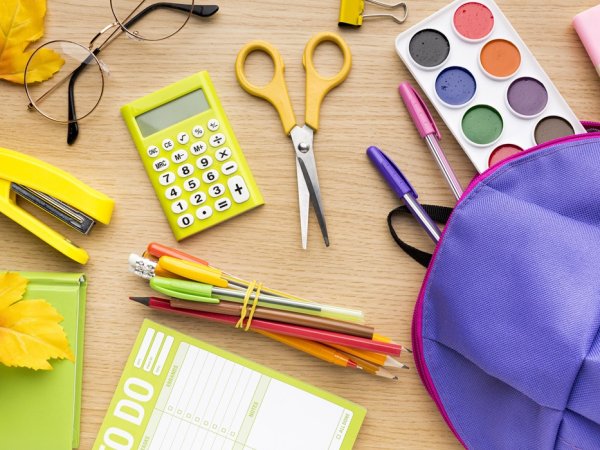
The price gap between a hypermarket and a specialty bookshop can run 20-40% for the same products. Carrefour, Kaufland, and Lidl tend to be the cheapest options for notebooks, pens, and basic items; specialty bookshops carry a wider range, but at higher prices.
A few concrete choices cut the bill without giving up anything that matters:
Romanian-made notebooks cost less than international brands, at a quality difference that's barely noticeable. Backpacks featuring cartoon characters cost nearly double a plain model of the same technical quality — the difference is pure licensing, not materials.
Shopping at least two to three weeks before September 1 catches normal prices. In the final week before school starts, stock thins out and prices climb, especially for backpacks and pencil cases.
The simplest way to save, though, remains checking what's still usable from last year — a backpack that still holds up, a complete pencil case, unused geometry tools. Every reused item takes a concrete sum off the total, not a symbolic one.
Clothes and shoes: the secondhand market, more active than ever
For the opening-ceremony outfit or the uniform some schools require, the market for barely-worn or once-worn kids' clothes has moved almost entirely online. Vinted and Facebook groups dedicated to swapping children's clothes fill up, especially in August, with near-unworn uniform sets — kids grow fast, and many families resell right at the end of a school year. OLX remains the go-to for backpacks and sports shoes in good condition, at half the price of a new item.
At schools where the uniform is mandatory, it's worth asking directly whether there's an organized swap among parents at year's end — many schools already have a class or school Facebook group used exactly for this.
Transport: the one guaranteed saving, if you don't put it off
The free STB pass for students in Bucharest and Ilfov costs nothing, but it doesn't activate on its own either. The paperwork — a stamped student ID plus a birth certificate or ID card — has to go through the Bilet TB app before classes start. Anyone who puts this off pays full fare, 3 lei per ride, until the free pass gets approved. For a family with two kids commuting to school daily, a month's delay easily adds up to over 100 lei paid for nothing.
Tutoring: where negotiating actually matters
An individual tutoring session in Bucharest starts at 70-90 lei an hour, but mini-groups — usually 2 to 5 students — cost noticeably less per person, since the tutor splits their time across several kids. If two or three parents from the same class need the same subject, a group session arranged directly with the tutor can bring the per-student cost down significantly compared to an individual session.
Many tutoring platforms — BUKI, Superprof, local education centers — offer a first session free or at a reduced rate, specifically so you can test the fit with a tutor before committing to a monthly package. Worth using even when your mind's already made up, since it avoids the risk of paying for a subscription with a tutor who doesn't click with your kid.
Online sessions tend to run somewhat cheaper than in-home ones, without a fixed gap between the two — but they automatically save the cost of travel, which matters especially for families in outlying neighborhoods.
What you can realistically cut from the total
For a middle-school student, combining early shopping, choosing Romanian products, reusing what's still good from last year, and activating the STB pass on time, the initial 400-900 lei budget can drop toward 250-500 lei — without the school noticing any difference. The savings don't come from one big decision, but from five or six small ones, made early.