What Bucharest Parents Actually Pay at the Start of School, in a "Free" Education System
- Articles
- 21 AUG 26
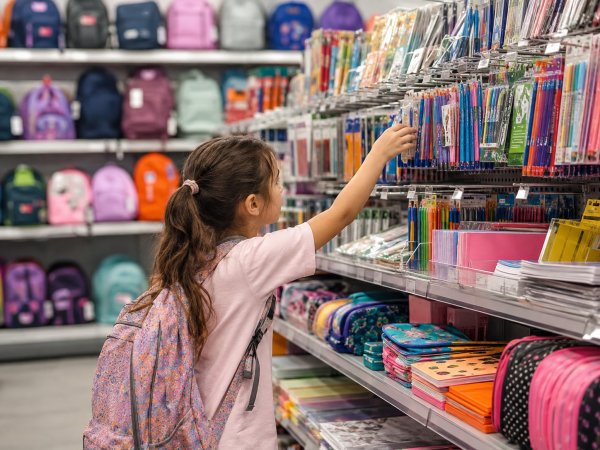
Romania's constitution guarantees free state education. The school-supply list tells a different story. The 2026-2027 school year starts on September 7, and until then, families across Bucharest go through the same routine: lists handwritten by teachers, queues at Diverta or Cărturești, prices compared on a phone while the kid picks out markers. Here's what each category actually costs, broken down so you know the number before you're standing at the register.
What's actually free: a spot at a state school, tuition, official textbooks for grades I through XII. Everything else — everything that keeps a kid equipped Monday through Friday — falls entirely on the parent.
School supplies: the category with the widest range
The amount depends brutally on the grade.
For first grade, a fully equipped backpack — pencil case, notebooks, colored pencils, watercolors, scissors, glue — runs between 400 and 800 lei. The backpack alone can cost 150-350 lei, a complete pencil case 50-100 lei, and a set of 10-15 notebooks between 30 and 50 lei. Basic A5 notebooks with 48 pages start at 3 lei each; premium ones with sturdier covers go up to 7-15 lei. A first-grader's fountain pen costs between 33 and 45 lei.
For fifth grade, the first year of gimnaziu, the budget drops slightly if last year's backpack still holds up: 300-600 lei, backpack not included. This is where geometry sets (20-40 lei), subject-specific notebooks — usually 15-20 of them — running 45-70 lei, plus a geography atlas (40-60 lei) and a dictionary (30-50 lei) come in.
By high school, the list shrinks to notebooks, folders, and basic writing tools, totaling 150-300 lei. The exception is technical or arts tracks, where specialized rulers or technical drawing sets get added.
One tip that genuinely cuts the bill: Romanian-made notebooks hold up just as well as international brands, at 30-40% less. And backpacks featuring cartoon characters cost nearly double a plain model of the same quality.
Uniforms, or the opening-ceremony outfit
This part is genuinely unsettled, and it's worth saying so plainly. School uniforms aren't mandatory nationwide in Romania — the decision sits with each individual school, and no student can be barred from class for not wearing one. A bill is pending in the Senate that would introduce a mandatory standard uniform in state education, with subsidies for lower-income families, but it's still under debate and hasn't taken effect for the school year that's about to start.
In practice, many parents buy new clothes and shoes for the opening ceremony anyway, even where no uniform is required. Costs range from 30 lei for a simple shirt to several hundred lei where a school enforces a standardized model bearing its badge. Many prestige high schools and private schools keep uniforms for other reasons — a sense of belonging, less pressure around fashion — and there, costs can pass 500-1000 lei a year, depending on the materials.
Transport, the one category with good news
Students enrolled at an accredited school in Bucharest or Ilfov county ride STB (the city's public transit) for free. The exemption is granted through a transport card loaded with a metropolitan pass, via the Bilet TB app (formerly YouthTB). The process requires a student ID stamped by the school for the current year, plus a birth certificate or ID card, with the student's data verified directly by the Ministry of Education.
The catch: the free pass doesn't activate on its own. Anyone who puts off registering in the app risks paying full fare — 3 lei per ride, valid 90 minutes across any line — until the paperwork clears. Worth doing in the first week of September, not later.
Tutoring, the expense that sneaks into the budget
Not every family starts tutoring right in September, but many begin early prep for the national exam or the Baccalaureate, or simply to close gaps left over from last year.
In Bucharest, an hour of tutoring in math, Romanian, or English costs between 70 and 120 lei, averaging around 85-90 lei. In smaller cities — Iași, Craiova — the same hour drops to 50-80 lei; the difference comes down to cost of living and higher demand in the big cities. Established tutors in Bucharest reach 150-160 lei. Less sought-after subjects — biology, history, computer science — start a bit higher, from 80 lei, precisely because fewer tutors offer them. Online sessions tend to run cheaper than in-home ones, though there's no fixed gap between the two formats.
For a family opting for four sessions a month in a single subject, the math is simple: at an average of 85 lei an hour, the first month of tutoring costs around 340 lei.
What it adds up to
For a middle-school student, with a parent who skips the premium products and skips tutoring: supplies 300-600 lei, plus new clothes and shoes 100-300 lei, transport 0 lei if the STB pass gets activated on time. Total: somewhere between 400 and 900 lei just to get the school year started.
Add September tutoring, and the total easily clears 1000 lei for the first month, especially for an eighth or twelfth grader facing exam pressure.
The biggest difference comes down to what's still usable from last year. A backpack that still holds, a pencil case that isn't falling apart, last year's clothes that still fit — each one shaves a few hundred lei off the total, without the kid going without anything they actually need.
The textbook is free. The pencil case isn't. Somewhere between the two sits the real September budget of a Bucharest parent.