In Bucharest, you can see planets through a telescope. What happens during an evening at the astronomical observatory, and how much does it cost?
- Articles
- 11 NOV 26
For just 20 lei, you can see Saturn and its rings through a telescope, right in the heart of Bucharest. The experience is available at the Admiral Vasile Urseanu Astronomical Observatory, located at 21 Lascăr Catargiu Boulevard, where visitors can observe planets, stars and other celestial objects on clear evenings. In November 2026, Saturn is the main attraction for astronomical observations, according to information published by the institution.
The observatory is open Tuesday to Saturday, from 2:00 p.m. to 10:00 p.m., but nighttime telescope observations only take place after dark and when weather conditions allow. Last admission is at 9:00 p.m.
You don't need any knowledge of astronomy or your own telescope. All you need is a suitable evening and an understanding that what you will see depends on the planets' positions, the time of year and, above all, the clouds.
What happens during a visit to the Admiral Vasile Urseanu Astronomical Observatory?
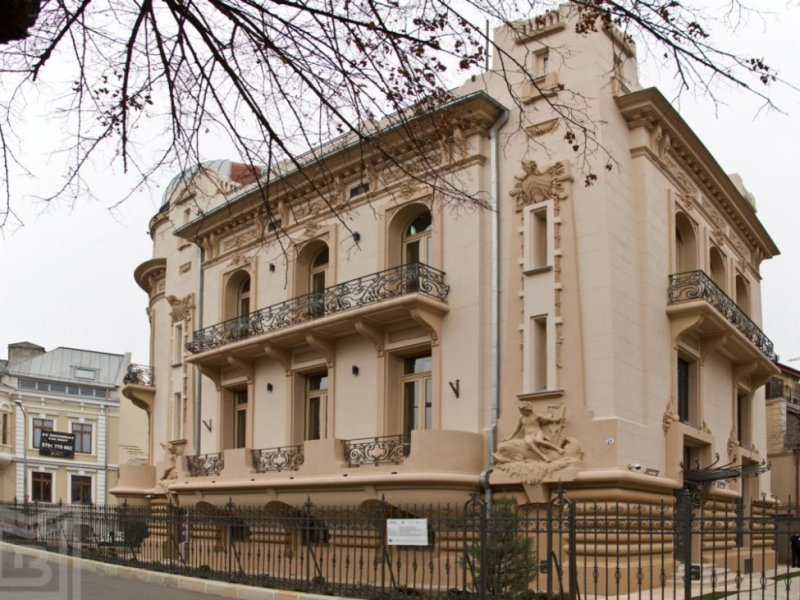
The observatory occupies a historic building between Piața Romană and Piața Victoriei. It is part of the Bucharest Municipality Museum and describes itself as the only astronomical observatory in the capital permanently open to the public.
A visit can begin with the astronomy exhibition, arranged across three rooms. Visitors can explore information about the Universe, astronomical instruments and how humans have come to study celestial objects. The observatory's dome can also be visited during the day.
In the evening, if the sky is clear, visitors head up to the outdoor terrace, where telescopes are set up for astronomical observations. Access generally takes place at intervals of approximately 30 minutes. When the observatory is busy, waiting times may be longer.
The observatory's staff point the telescopes towards celestial objects visible that evening. Specialists provide explanations and answer questions, so the experience involves more than simply taking a quick look through an eyepiece.
One detail worth knowing is that observations take place outdoors, on the terrace. On cold November evenings, warm clothing is a good idea, especially if you need to wait for your turn.
Which planets can you see through a telescope in November 2026?
Not all planets are visible every evening. Some are below the horizon during opening hours, while others only appear after midnight or shortly before sunrise.
According to the observatory's official astronomical bulletin for November 9–15, 2026, Saturn can be observed in the evening and throughout the night. The planet is in a favourable position for observation from Earth, and its rings and some of its moons can be seen through a telescope.
The observatory explains that Saturn can be viewed from its terrace after 7:00 p.m. Around 8:00 p.m., the planet is towards the southeast, moving into the southern part of the sky by approximately 10:00 p.m.
The situation is different for Jupiter and Mars. During the week of November 9–15, the two planets rise at approximately 12:30 a.m. and 12:45 a.m., respectively, after the observatory has closed. According to the institution, Jupiter will become visible again during public observation hours in January 2027, while Mars will return in February 2027.
Venus can be observed in the morning, before sunrise, but not during the observatory's usual evening visiting hours.
So, if you visit in November specifically to see Saturn, a clear evening may give you the opportunity. If you want to observe Jupiter or Mars, you will need to choose another time of year.
When is the best time to observe the Moon, and why isn't a full Moon necessarily ideal?
The Moon is one of the most spectacular celestial objects to observe through a telescope. Its craters, surface features and darker regions become much easier to distinguish than with the naked eye.
Surprisingly, a full Moon is not the ideal time to examine its details. Sunlight falls almost directly onto the visible surface, reducing the shadows that reveal its terrain. The intense brightness can also make looking through a telescope less comfortable.
In its official visitor's guide, the observatory recommends the period around the first quarter Moon, when shadows along the boundary between the illuminated and dark portions highlight lunar craters and mountains.
For the week of November 9–15, 2026, the observatory reports that the Moon begins to reappear in the evening sky after the new Moon on November 9. Its visibility during observation hours depends on the chosen date and its position in the sky.
Besides the Moon and planets, the observatory's instruments can be directed towards double stars, star clusters and certain nebulae. Galaxies are more difficult to observe from central Bucharest, where urban lighting reduces the visibility of very faint celestial objects.
How much does admission cost, and what are the opening hours in 2026?
According to the admission prices published on the observatory's official website, based on information verified by the institution in January 2026, a standard ticket costs 20 lei, while pupils, students and pensioners pay 10 lei. Children under the age of seven enter free of charge.
The observatory is open Tuesday to Saturday, from 2:00 p.m. to 10:00 p.m. It is closed on Sundays and Mondays. Last admission is at 9:00 p.m., and the exhibition closes at 9:30 p.m.
Tickets can be purchased directly at the observatory, including by card, or online through the Booktes platform. The institution specifies that tickets purchased online do not provide priority admission.
Individual visitors are not required to make a reservation for regular visits. However, organised groups of more than 20 people are asked to contact the institution in advance.
There is also a useful clarification for anyone who comes across outdated information online: the observatory explicitly states that it does not offer free admission on the first Saturday of the month, although this claim still appears on some event websites.
Why a clear evening matters more than a powerful telescope
You may arrive at the observatory during its regular opening hours and still be unable to look through a telescope. The reason is simple: optical instruments cannot reveal planets through a thick layer of clouds.
The observatory explains on its website that observations do not take place when it rains, snows, is foggy or when the sky is completely overcast. If only a few areas of the sky are clear, observations depend on whether the celestial objects are visible through those openings.
For November, the institution's guide indicates that observations begin at around 7:00 p.m. This makes the colder months convenient for an after-work or after-school visit, without having to wait until late at night for darkness.
However, a cloudless evening does not guarantee that you will see the particular planet you have in mind. Before visiting, it is worth checking the observatory's Astronomical Week section, which provides updates on planets and astronomical phenomena visible during the relevant period.
The observatory building has a history spanning more than a century
The experience is not limited to telescopes. The Admiral Vasile Urseanu Astronomical Observatory operates in a building constructed at the initiative of Admiral Vasile Urseanu, an astronomy enthusiast who financed its construction.
According to the history published by the Bucharest Municipality Museum, the observatory was established in 1910. That same year, a Zeiss refracting telescope with a diameter of 150 millimetres was installed inside its dome.
Over time, the institution acquired increasingly powerful instruments. In 2008, it received a telescope with a diameter of 300 millimetres, and since 2016 it has also had a 400-millimetre telescope.
The observatory serves more than an educational purpose. Its specialists also conduct astronomical observations that can contribute to research, including measurements of the positions of asteroids and comets and monitoring changes in the brightness of certain stars.
For those looking for other unusual indoor activities in the capital, there is also the article “Experiențe în București pentru cei cărora nu le plac muzeele”, featuring experiences ranging from creative workshops to escape rooms and virtual reality.
At the observatory, however, no two evenings offer exactly the same spectacle. The sky changes from month to month, and what you can see through a telescope depends on when you visit. In November 2026, a clear evening could give you the chance to see Saturn's rings with your own eyes, without ever leaving Bucharest.