Piața Victoriei, the site of Bucharest’s protests: a brief history. How the Government building changed over time
By Raluca Ogaru
- Articles
- 15 SEP 26
Piața Victoriei, or Victory Square, is one of the most recognisable public spaces in the Romanian capital. Major roads, two metro lines, cultural institutions and the headquarters of the Romanian Government converge here. The square has also hosted some of Bucharest’s largest protests since 1989.
Its current identity developed gradually. Before becoming the administrative centre we know today, the area stood on the outskirts of the city and was known as “Capul Podului” — “the Head of the Bridge”. Victoria Palace appeared much later, and the building visible today no longer fully preserves the appearance originally designed before the Second World War.
From “Capul Podului” to Piața Victoriei
The history of the area is closely connected to Podul Mogoșoaiei, the road built during the reign of Constantin Brâncoveanu to link central Bucharest with the ruler’s estate at Mogoșoaia. The road was covered with wooden beams, which explains the use of the Romanian word “pod”, meaning “bridge”, for several important streets at the time.
The northern end of the road became known as “Capul Podului”. For a long time, it marked one of Bucharest’s boundaries, a point of passage between the city and the roads leading north. The development of Șoseaua Kiseleff during the first half of the 19th century increased the area’s importance and transformed it into a major traffic junction.
Following the Romanian War of Independence, the Romanian Army entered Bucharest in triumph on 8 October 1878, travelling along Podul Mogoșoaiei. The road was subsequently renamed Calea Victoriei, or Victory Avenue, while the square at its northern end became Piața Victoriei.
During the communist period, the space was also known as Piața Victoriei Socialismului — the Square of the Victory of Socialism. After the December 1989 Revolution, it returned to the name by which it is known today.
Le-aș introduce după secțiunea „From «Capul Podului» to Piața Victoriei” și înaintea istoriei Palatului Victoria. Am corectat două detalii: noul palat guvernamental nu a fost finalizat în 1937, ci atunci a început construirea lui, iar Monumentul Eroilor Corpului Didactic a fost demontat în 1940, nu distrus în 1945.
Before Victoria Palace, the square was dominated by Sturdza Palace
Long before Victoria Palace became the architectural landmark of the square, another imposing building housed Romania’s Ministry of Foreign Affairs. Sturdza Palace was commissioned as a private residence by Prince Grigore M. Sturdza and designed by architect Ion D. Berindey, whose work also includes some of Bucharest’s most elaborate buildings from the late 19th and early 20th centuries.
Construction began in 1897 and was completed in 1901. Grigore Sturdza died shortly afterwards, and the palace subsequently became the headquarters of the Ministry of Foreign Affairs, known at the time as the Ministry of Foreign Affairs or Foreign Affairs Ministry. Its elaborate architecture, with richly decorated façades and a striking silhouette, contrasted sharply with the restrained modernism later adopted for Victoria Palace.
As the ministry expanded, Sturdza Palace no longer provided enough space for its departments and staff. The authorities therefore decided to build a new headquarters nearby. Construction of Duiliu Marcu’s building began in 1937, meaning that the two palaces represented, for several years, two very different architectural visions of state power: the decorative style of the late 19th century and the monumental sobriety of the interwar period.
Sturdza Palace was damaged during the Second World War and demolished in 1946. Some specialists later argued that restoration might have been possible, but the building disappeared from the square. Its construction and demolition dates are also recorded in the postcard collection administered by the National Heritage Institute’s cIMeC database.
The monuments that disappeared or were moved from the square
Buildings were not the only elements that vanished from Piața Victoriei. The square’s monuments also changed according to the political priorities of successive regimes. One of the most significant was the Monument to the Heroes of the Teaching Profession, unveiled in 1930 in the area between Șoseaua Kiseleff and Bulevardul Aviatorilor.
Created by sculptors Ion Jalea and Cornel Medrea in collaboration with painter Arthur Verona, the monument paid tribute to teachers who died during the First World War. Its central group depicted three Roman legionaries carrying a fallen comrade. The work linked the sacrifice of contemporary educators with imagery inspired by ancient history.
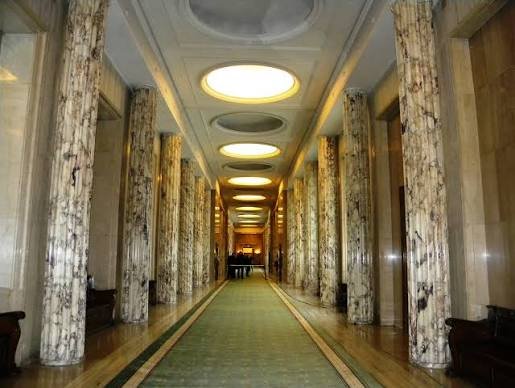 Victoria Palace, interior view
The monument was dismantled in 1940 because the authorities initially intended to place an equestrian statue of King Ferdinand I on the site. The royal monument was eventually installed elsewhere, while the separate components of the memorial dedicated to teachers disappeared in the following years. This chronology is documented by the specialist publication Arhitectura.
The vacant site was later occupied by the Monument to the Soviet Soldier, created by sculptor Constantin Baraschi and installed shortly after the Second World War. Rising from a tall pedestal, it became one of the most visible political symbols in the square during the communist period.
In the mid-1980s, officially in connection with construction work on the Piața Victoriei metro station, the Soviet monument was moved to the first roundabout on Șoseaua Kiseleff. After 1989, it was relocated again, this time to the Soviet Military Cemetery on Șoseaua Pipera, where it was placed on a much smaller pedestal.
This succession of monuments shows how Piața Victoriei was repeatedly reshaped not only through urban planning, but also through political symbolism. Each regime attempted to leave its own mark on the space, while removing or relocating the symbols inherited from its predecessors.
READ ALSO:
Before the sectors, Bucharest was divided into plăși. What other subdivisions did it have?
Victoria Palace was designed for the Ministry of Foreign Affairs
The building that dominates the square was designed by Duiliu Marcu, one of the most important Romanian architects of the interwar period. Construction began in 1937, and the building was originally intended to house the Ministry of Foreign Affairs.
Its architecture is defined by symmetry, monumental proportions and restrained lines. The façade is organised into horizontal sections, while the vertical pillars emphasise the building’s official character. Victoria Palace belongs to a period when public institutions sought to convey authority and stability through architecture.
By 1944, construction was nearly complete. At that time, the building had a more decorative appearance than it does today. The façade was clad in Carrara marble and featured sculpted panels. The interiors had also been conceived in a more elaborate style.
The chronology of its construction and subsequent transformation is available in the official history of Victoria Palace.
The 1944 bombings changed the appearance of the building
The palace was severely damaged during the bombings of 1944. Reconstruction resumed after the war, and the building was completed in 1952. The restoration, however, did not attempt to reproduce every element of the original design.
The Carrara marble covering the façade was replaced with travertine, the material that continues to define the exterior of Victoria Palace. The decorative panels were removed, while the interiors were simplified. The building therefore acquired a more austere appearance than the one envisaged in the interwar project.
During its early years, the building housed the Ministry of Foreign Affairs and the Council of Ministers. After the 1989 Revolution, Victoria Palace became the headquarters of the Romanian Government. In 2004, the building was officially listed as a historical monument.
These changes explain why photographs and architectural drawings produced before the war show a different façade. The building’s main volume and monumental composition survived, but its materials, decorations and some of its interior spaces were altered.
How Piața Victoriei became the stage for major protests
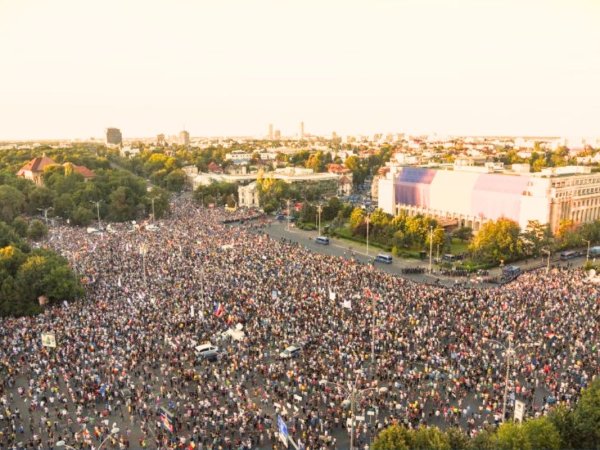
The location of the Government headquarters turned the square into a natural destination for demonstrations directed at the executive branch. The space is highly visible, easily accessible and large enough to accommodate public gatherings. Several major roads connecting northern and central Bucharest also meet here.
Over the years, Piața Victoriei has hosted demonstrations by trade union members, teachers, doctors, transport workers, farmers, pensioners and civic organisations, as well as citizens opposing various political or administrative decisions.
A defining moment came in February 2017, when protests against Emergency Ordinance No. 13 brought very large crowds in front of the Government building. The demonstrations turned the square into a symbol of civic mobilisation and produced images that circulated widely in the international media.
On 10 August 2018, the Romanian diaspora protest ended with the intervention of law-enforcement officers, the use of tear gas and numerous people requiring medical assistance. The events remain a sensitive point in the square’s recent history and in the broader debate over the limits of public-order interventions.
Piața Victoriei continues to be used for demonstrations. On 15 September 2026, an unauthorised protest involving farmers and livestock breeders led to traffic disruptions and confrontations between some participants and gendarmes.
READ ALSO:
Top 10 historical landmarks in Bucharest – a walk through time
The right to protest and the rules that must be followed
Freedom of assembly is guaranteed by the Romanian Constitution, provided that demonstrations remain peaceful and participants do not carry weapons. Public assemblies are regulated in greater detail by Law No. 60/1991.
For demonstrations held in squares, on public roads or in other open spaces, organisers are generally required to submit prior notification. They must appoint people responsible for coordinating the gathering and cooperate with the authorities to protect participants and maintain public order.
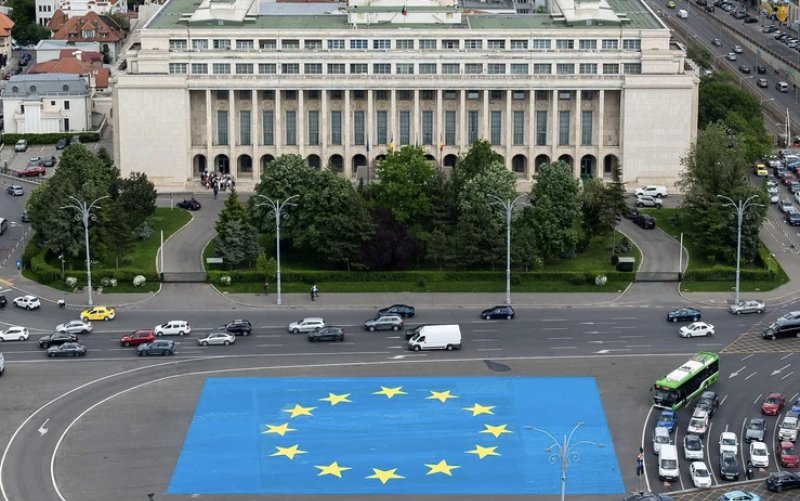 Victoria Palace, viewed from the outside
The law also sets out the responsibilities of law-enforcement agencies, including the use of warnings and formal orders before an intervention. Exceptions apply when violence occurs or an imminent threat exists. The current version of the legislation can be consulted on Romania’s official Legislative Portal.
These rules are intended to protect both the right to public expression and the safety of those attending a demonstration, passing through the area or working in nearby institutions.
What Piața Victoriei represents in Bucharest today
Piața Victoriei is more than the space in front of the Government building. Nearby attractions include the “Grigore Antipa” National Museum of Natural History, the National Museum of the Romanian Peasant and the National Geology Museum. The square is also one of the capital’s most important transport hubs.
At the same time, the area preserves several layers of Bucharest’s history: the former outskirts of the city, the ceremonial route along Calea Victoriei, the administrative projects of the interwar period, post-war reconstruction and the public demonstrations of recent decades.
Victoria Palace is the most visible witness to these transformations. Its present façade is not the one originally designed by Duiliu Marcu, while the surrounding square bears little resemblance to the former “Capul Podului”.
Together, the building and the public space tell the story of a city that has repeatedly changed its boundaries, institutions and forms of civic expression.