Mental Health in Bucharest: Why the Capital Has So Many Psychotherapists
By Eddie Țone
- Articles
- 22 OCT 26
In Bucharest, you can find a psychotherapist much the same way you can find a specialty coffee shop: open your phone, choose a neighborhood, and start comparing. Cognitive behavioral therapy, psychoanalysis, systemic therapy, integrative therapy, Adlerian therapy, Jungian therapy, couples therapy, therapy for burnout, trauma, anxiety, ADHD. Sometimes it feels as though the only thing the city hasn't put on Glovo yet is the 50-minute therapy session.
And that inevitably raises the question: why are there so many psychotherapists in Bucharest? The easy answer would be that Bucharest residents are stressed. Which, admittedly, they rather are. But the explanation is far too simple.
The large number of therapists reflects several things at once: money, education, urbanization, changing relationships, shifting attitudes toward mental health and, not least, the inability of Romania's public healthcare system to provide enough psychotherapy. Bucharest has thus become an interesting laboratory: the city generates stress, but it also generates the market that tries to treat it.
The first surprise: we can prove concentration, but not "the highest density"
Before getting too excited about the statistics, a clarification is in order: there is currently no easily searchable official public database ranking Romanian cities by the number of psychotherapists per 100,000 inhabitants. The Romanian College of Psychologists maintains the National Register of Psychologists Licensed to Practice, and the law requires its publication. However, the publicly available data are not presented as a comparable "psychotherapists per 100,000 inhabitants" indicator for each city.
So the statement "Bucharest has the highest density of psychotherapists in Romania" would look great in a headline and considerably less impressive under fact-checking.
But we can demonstrate something else: Bucharest has by far the largest concentration in absolute numbers on the main private specialist platforms.
In September 2026, ROmedic displayed more than 300 results in the psychotherapy category for Bucharest, compared with 70 for Cluj and 62 for Iași. Another platform, Pasul, listed 129 psychologists and psychotherapists in Bucharest, compared with 25 in Cluj-Napoca and 20 in Brașov. These platforms do not constitute a professional census. Listings depend on each platform's business model and whether therapists choose to appear on the site. Still, the difference in scale is hard to ignore.
A more accurate statement would be that Bucharest is Romania's largest psychotherapy market. Whether it also leads the country in therapists per capita is something we would need better data to establish.
And the very absence of those data says something about mental health in Romania.
Romanian psychotherapy largely operates within the private economy
The most important explanation is not found in a study of the Bucharest resident's personality, but in the structure of the healthcare system.
The OECD's 2025 report on Romania's healthcare system is quite direct: psychotherapy and counseling exist in both the public and private sectors, but their availability in the public system is almost nonexistent because of staff shortages. As a result, patients turn to private providers and face substantial out-of-pocket expenses, a fact that changes the picture entirely.
Bucharest's many therapy practices are not simply evidence of a society that has discovered the benefits of introspection. They are also the private market's response to a service that the public system fails to provide adequately.
According to the OECD, Romania continues to have a mental healthcare system heavily focused on hospitals and psychiatric treatment, while community services and psychosocial interventions remain underdeveloped. There are 52 community mental health centers, concentrated mainly in urban areas, and access becomes even more difficult in rural communities.
In other words, if you live in Bucharest and have enough money, the market offers you dozens of options. If you don't have the money, the equation becomes considerably more complicated.
Bucharest has exactly the kind of population that creates a market for therapy
Private psychotherapy requires two rather mundane things: demand and the ability to pay.
The Bucharest-Ilfov region is an economic anomaly within Romania. Eurostat data show that in 2023 the region had a net disposable income of 28,500 PPS (purchasing power standards) per inhabitant, the fourth-highest level among the European Union regions analyzed. Bear in mind that we are talking about the Bucharest-Ilfov region, not strictly the city itself, and that PPS measures purchasing power, not the amount sitting in someone's bank account. Still, the overall picture is clear: a disproportionately large share of Romania's higher incomes is concentrated here.
The city also has a substantial population of university graduates working in services, IT, finance, advertising, consulting, corporations and liberal professions. These are precisely the social groups in which psychotherapy has become normalized more quickly.
That does not mean people on lower incomes don't experience anxiety, depression, family conflicts or trauma. Of course they do. It simply means that psychological suffering becomes economic demand only when people also have the resources to pay for therapy sessions.
Fees currently advertised on specialist platforms frequently start at around 150–200 lei and reach 300–350 lei or more per session.
For a well-paid professional living in northern Bucharest, this may be a manageable monthly expense. But for someone struggling to make ends meet, four sessions a month are a luxury.
Which brings us to one of the great contradictions of mental healthcare in Bucharest: there is plenty of supply, but that does not automatically make access equitable.
And yes, Bucharest certainly knows how to generate stress. It would be ridiculous, however, to leave the city itself out of the equation.
Bucharest is noisy, congested and often exhausting, even on days when nothing particularly remarkable happens. Sometimes, all you need to do is try to get from Pipera to Drumul Taberei at 6 p.m., and you'll discover things about your own character that you probably never intended to learn. Even more so since the autumn of 2026, when the city turned into one enormous construction site.
The data confirm at least part of this impression. In the European Commission's 2023 survey on quality of life in European cities, only 30% of Bucharest respondents said they were satisfied with noise levels in the city. That was the lowest percentage among the cities surveyed. In Piatra Neamț, by comparison, satisfaction stood at 76%.
Things were hardly more cheerful when it came to air quality: only 20% of Bucharest respondents said they were satisfied, the second-lowest result in the relevant table, after Skopje.
Traffic makes its own contribution to urban psychology. TomTom estimates that in 2025, a driver traveling during rush hour in Bucharest lost approximately 171 hours over the course of the year because of traffic congestion. The average time needed to travel ten kilometers during the evening rush hour exceeded 45 minutes.
Of course, none of this proves that traffic "causes depression" in any particular individual. That would be a gross oversimplification. But international research has long shown that the urban environment can affect mental health.
A longitudinal analysis published in Health & Place found associations between urban planning and depression or common mental disorders, while other reviews have identified links between mental health and factors such as noise, air pollution, housing quality, green spaces and neighborhood characteristics. These relationships are complex, and researchers caution that they are not necessarily causal.
A now-famous study published in Nature in 2011 even observed differences in how the brains of city residents process social stress. The findings do not turn the metropolis into a disease, nor do they allow us to diagnose a Bucharest resident based on their postal code. They do, however, suggest that the urban environment is more than just the backdrop to our lives. It can become part of the mechanism itself.
The paradox of loneliness in a city of millions
Big cities offer something seemingly contradictory: huge numbers of people and very little genuine social intimacy.
You can spend an entire day surrounded by hundreds of people in all sorts of places — the subway, office, supermarket, gym, restaurant — without having a single conversation that goes beyond something like... "Will you be paying by card?"
As early as 1903, German sociologist Georg Simmel observed in his famous essay on the metropolis that big-city residents develop protective mechanisms against the constant barrage of stimuli. What we now call detachment, overstimulation or social withdrawal was not invented along with Teams and Slack notifications. The metropolis was exhausting people even when telephones were still attached to walls.
Modern Bucharest, however, adds some new ingredients: professional mobility, internal migration, families living hundreds of kilometers apart, relationships maintained over the phone, hybrid working arrangements, professional competition and an impressive amount of time spent staring at screens.
And so the therapist sometimes comes to occupy a space that the city no longer offers quite so easily: fifty minutes without a phone, without a boss, without a partner who answers before you've finished your sentence, and without someone honking behind you.
Having many therapists doesn't mean Bucharest is "sicker"
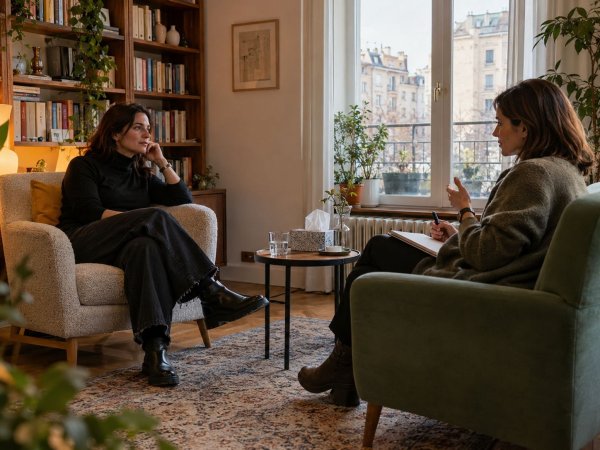
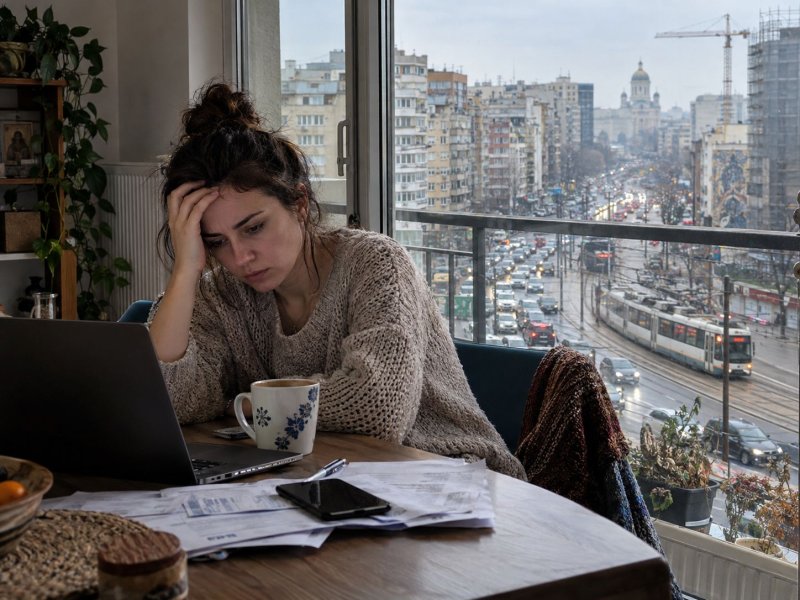 Image created with AI, for editorial illustration purpose.
Here's another trap. A big one. A city with more psychotherapists is not necessarily a city with more mental disorders.
It may simply be a city where people can afford treatment. A city with universities, professional training programs and therapy practices. A city where stigma has diminished more quickly. A city where people are better able to recognize anxiety, depression or burnout and seek help before things reach the point of hospitalization.
From this perspective, a psychotherapy practice can be interpreted in precisely the opposite way: not as an indicator of a less healthy community, but as evidence of one in which problems are becoming more visible.
Romania offers an excellent example of how misleading statistics can be when taken too literally. The OECD notes that the reported prevalence of mental health problems is relatively low compared with the organization's average, but warns that this may reflect underdiagnosis, limited access and stigma, rather than exceptionally good mental health among the population.
Moreover, at the national level, more than 80% of the respondents cited by the OECD believed that people with mental health problems are treated differently by society. Also nationwide, cost was the main barrier for a significant proportion of people with unmet mental healthcare needs.
Sometimes, a country with fewer diagnoses isn't a healthier country. It's simply one that measures less.
The psychotherapist has also become a familiar figure in urban life
Two or three decades ago, telling your colleagues you were going to see a psychologist could produce that brief moment of silence in which everyone politely tried to work out just how serious the situation was. Today, at least in certain parts of Bucharest, saying "I've got therapy at six" can be about as dramatic as saying "I'm going to the dentist."
And that, let's admit it, is a significant change. Psychotherapy has gradually moved beyond the strictly medical sphere and entered conversations about relationships, personal boundaries, parenting, burnout, careers and the search for meaning. Sometimes this leads to the excessive trivialization of psychological terminology (the internet has somehow managed to turn half the world's ex-boyfriends into "narcissists"), but the normalization of seeking help is, in itself, a major social transformation.
Romanian law regulates the profession of licensed psychologist, and psychotherapy is explicitly included among the regulated psychological services. Individual practices and other professional structures must be registered in accordance with the relevant legal and professional framework.
That is why it also matters who is behind the door marked "therapy." The popularity of the field does not eliminate the need for accreditation, training and verification of professional competence.
Bucharest's real problem isn't that it has too many psychotherapists
Quite the opposite. The interesting problem is that a city with hundreds of therapists can simultaneously have residents who cannot afford to see a single one. We are dealing with two overlapping versions of Bucharest.
In one, people choose their therapist based on therapeutic approach, experience, online availability and personal compatibility. In the other, people depend on scarce public services, NGOs, referrals from doctors or simply never receive psychotherapy at all.
And this is where the discussion stops being about lifestyle and becomes a matter of urban policy in the broadest sense: what does genuine access to healthcare mean in a city? Is it enough for a service to exist somewhere on the map, or should you also be able to afford it?
The OECD warns that Romania's mental healthcare system remains too dependent on institutions and insufficiently focused on community services, prevention and early intervention. Bucharest compensates for part of this shortfall through its private market. But the market only solves the problems of those who can afford to participate in it.
So what does the large number of therapists actually tell us about Bucharest?
It tells us that the city has changed. That it is wealthier than the rest of the country, more educated, more familiar with Western mental health terminology and large enough to support numerous professional niches. At the same time, it is noisy, crowded, competitive and exhausting. It creates opportunities with one hand and sends you the bill for stress with the other.
But perhaps the most interesting thing is something else. Years ago, mental health problems were something to hide. Today, at least in certain parts of urban society, they can be discussed, scheduled for Tuesday at 6:30 p.m. and entered into the calendar.
We still don't have enough data to say that Bucharest has the highest density of psychotherapists in Romania.
But we do have enough to say that the country's most visible psychotherapy market has emerged here, at the precise intersection of two stories about the capital: a city that has become prosperous enough to pay for mental healthcare and demanding enough to force us to talk about it.
And that is the urban indicator truly worth watching.
You may also like: The history of the first pharmacies that appeared in Bucharest, with the private apothecaries that contained “the herbs useful for medicines”