How the Little Girl from Olarilor Slum Became the First Revolutionary of the Forty-Eighters. Ana Ipătescu, the National Heroine Without a Grave
- Articles
- 20 FEB 26
The history of the 1848 Revolution in Wallachia is most often told through the perspective of the great political and intellectual leaders of the time. Names such as Ion Heliade Rădulescu or Nicolae Bălcescu are frequently invoked when speaking about the ideals of the Forty-Eighters. And yet, at the center of one of the most dramatic episodes of those turbulent days stood a woman. A woman who defied the social conventions of her era and entered history with two pistols in her hands. Her name is Ana Ipătescu.
Childhood in Olarilor Slum and the Formation of a Strong Personality
Considered the national heroine of the 1848 Revolution, Ana Ipătescu remains a symbol of courage and devotion to the ideals of freedom. Although she played a decisive role in saving the revolutionary government, her later destiny was marked by discretion and oblivion. She died alone, in 1875, and her grave could not be identified, although her wish had been to be buried at Pasărea Monastery, near Bucharest. Her story is one of contrasts: from the girl in Olarilor Slum to the spontaneous leader of a crowd that changed the course of history.
Ana Ipătescu was born in 1805, in Bucharest, bearing at birth the name Ghiulerasă. She came from Olarilor Slum, a district of the Capital inhabited by craftsmen and small merchants. Her father, Atanasie Ghiulerasă, was part of the emerging bourgeoisie of the end of the Phanariote period (1716–1822). He had been a princely official and commander in the light cavalry, and later became a café owner and prosperous trader.
The family context offered Ana a certain material stability, yet her life was not without difficulties. Her stepmother did not allow her to benefit from a complete elementary education, which, in a traditional society, could mean a major limitation. Nevertheless, Ana managed to attend the Normal School in Bucharest, where she received an education above the average standards of the time for a woman.
This intellectual formation played an essential role in shaping her personality. In an era when women were rarely involved in public life, Ana Ipătescu demonstrated not only culture, but also an unusual willpower. Her independent spirit would manifest itself from youth, including in her personal life.
Marriages, Losses, and the Approach to Revolutionary Circles
In 1828, Ana married the leaseholder Dimitrie Ivancea, nicknamed “Ulieru.” The marriage lasted only three years. In 1831, the two separated, and in the same year, Ana also lost her father. Left without support and in a difficult situation, she decided to remarry, this time to Nicolae Ipătescu.
This second marriage would decisively influence her destiny. The Ipătescu family was close to the Forty-Eighter revolutionary circles, and Nicolae Ipătescu was an official in the Treasury Department. Through him, Ana gained access to the meetings of the secret society “Frăția,” where she came into contact with the future leaders of the revolutionary movement.
In these circles, she met personalities who would become part of the provisional government installed after the outbreak of the 1848 Revolution in Wallachia, such as C. A. Rosetti and Nicolae Golescu. Although she did not hold an official position, Ana Ipătescu was the first woman about whom there is certain information regarding direct involvement in the 1848 Revolution in Wallachia.
The 1848 Revolution and the Moment of June 19
On June 9, 1848, the Wallachian revolutionaries adopted the Proclamation of Islaz, the program-document of the movement. Two days later, Prince Gheorghe Bibescu was forced to accept the revolutionary program and to recognize the Provisional Government, led by Metropolitan Neofit. Among its members were prominent figures of the Forty-Eighter movement. The prince left the country, taking refuge in Brașov.
The situation became critical on June 19, 1848, when Colonels I. Odobescu and I. Solomon organized a counterrevolutionary coup. The members of the provisional government were arrested, and popular enthusiasm was seized by fear. The crowd seemed ready to retreat.
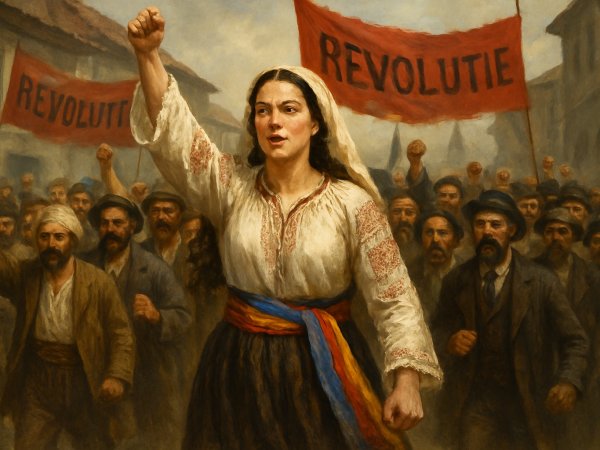
Then, from Podul Mogoșoaiei, a young woman with brown eyes appeared, armed with two pistols. It was Ana Ipătescu. Shouting “Death to the traitors! Young men, courage, save liberty!”, she rushed upon the princely guards. She was shot in the chest, but the wound was not fatal. Her courage electrified the crowd, which returned in force and freed the arrested government.
The moment was reported even in Western press. The Bavarian daily Allgemeine Osterreichische Zeitung described the scene of June 19 as an act of extraordinary heroism. Ana Ipătescu thus became the living symbol of the Bucharest revolution.
A Woman at the Head of the Crowd
Ana Ipătescu’s intervention was not an isolated gesture, but the culmination of active involvement in organizing and coordinating protest movements. She contributed to mobilizing resources and supporting the revolutionary fighters, assuming a role that the society of the time did not reserve for women.
Alongside her, contemporary documents also mention the confectioner Toma Gheorghiu, who tried to enter the palace to free the members of the government, as well as Captain A. Racotă and the firefighters who supported the crowd. Yet the figure that remained in collective memory was that of Ana Ipătescu, the woman who transformed hesitation into a new wave of revolt.
Through her gesture, Ana defied not only the authorities, but also social conventions. In an era dominated by patriarchal structures, she became the spontaneous leader of a popular movement, demonstrating that national ideals can transcend gender barriers.
The Shadow of Exile and the Disappearance from Public Life
Nicolae Ipătescu’s participation in the revolutionary movement did not remain without consequences. The suzerain power of the Ottoman Empire sentenced him to detention in an Ottoman prison. In 1850, two years after her husband’s arrest, Ana Ipătescu managed, through spectacular démarches, to obtain his release.
After this episode, her public presence entered into shadow. Historical documents no longer provide consistent information about her later activity. The woman who had saved the revolution withdrew discreetly from the forefront of history.
She wished to be buried at Pasărea Monastery, near Bucharest, yet her tombstone could not be identified. Ana Ipătescu died in 1875, alone, but with an impressive symbolic legacy.
A Heroine Without a Grave, but With a Place in History
Although she does not have a known grave, Ana Ipătescu has a well-defined place in the history of Romania. She represents not only the heroine of a revolution, but also a symbol of female emancipation in an era dominated by social restrictions.
The 1848 Revolution was a turning point, marked by the desire for reform, independence, and civic rights. In this context, Ana Ipătescu demonstrated that women’s participation in political and social life is not an exception, but a real possibility.
Her courage on June 19, 1848 saved, even if only temporarily, the revolutionary government and provided an example of rarely encountered determination. Today, when we look back at those events, we understand that history is written not only by political or military leaders, but also by people who, at a critical moment, choose to act.
Ana Ipătescu, the little girl from Olarilor Slum, became the first revolutionary of the Forty-Eighters and one of the most powerful female figures in the history of Romania. Even if her grave remains unknown, her memory continues to live through the deeds that changed the destiny of a nation.
We also recommend: Nicolae Bălcescu, the Forty-Eighters and the struggle for Romania’s political ideals. The most patriotic Bucharest native died at the age of 33 of tuberculosis