Nicolae Bălcescu, the Forty-Eighters and the struggle for Romania’s political ideals. The most patriotic Bucharest native died at the age of 33 of tuberculosis
- Articles
- 04 FEB 26
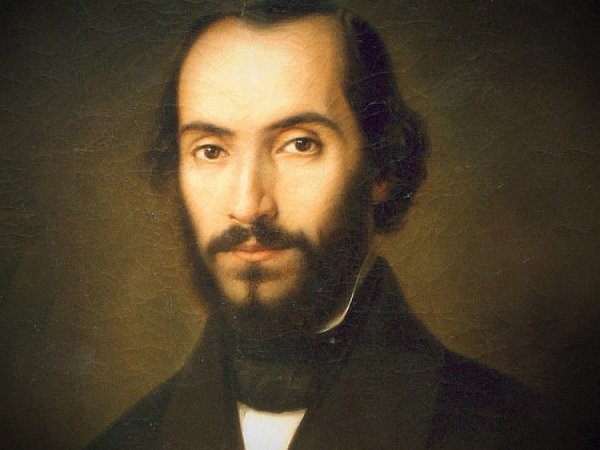
Nicolae Bălcescu remains one of the brightest and most tragic figures in modern Romanian history. A Forty-Eighter revolutionary, profound thinker, visionary historian, and tireless fighter for social justice, he embodied the ideals of a generation determined to fundamentally transform Romanian society. His life, short yet intense, was devoted entirely to the service of the nation, and his sacrifice became a symbol of patriotism carried to its ultimate limit. From his Bucharest childhood to his death in exile at only 33 years old, Nicolae Bălcescu lived with the belief that freedom, equality, and the dignity of the Romanian people were values worth fighting for until his final breath.
Family origins and childhood in Bucharest
Nicolae Bălcescu was born on June 29, 1819, in Bucharest, into a family of minor boyars with old roots. His father, Barbu Bălcescu, held the title of pitar, while his mother, Zinca Petrească Bălcescu, came from a middle-ranking family and bore the title of serdăreasă. The family name was connected to the Bălcești estate in Argeș County, a place that gave identity and prestige to the lineage.
Nicolae grew up in a large family, having two brothers, Costache and Barbu, both actively involved in the Revolution of 1848, and two sisters, one of whom, Sevasta, was especially close to him. The bond between Nicolae and Sevasta was so strong that she would later care for him during the last year of his life, in 1852, when illness had severely weakened him. The family environment, marked by an interest in culture and public life, played a decisive role in shaping his early civic spirit.
Education and intellectual formation
His first educational foundations were laid at home, under the guidance of a Greek tutor, as was customary at the time. Later, Nicolae Bălcescu attended the Saint Sava School, one of the most important educational institutions in Wallachia. There he studied under Ion Heliade Rădulescu, a figure who profoundly influenced his thinking and intellectual orientation.
School records show that in 1832 he was in the fifth grade, and between 1835 and 1836, at just 15 years old, he attended the complementary classes. His studies were remarkably extensive for his age: universal history, mathematics such as arithmetic, algebra, and geometry, trigonometry, formal philosophy, Romanian civil law, as well as the French, Greek, and Latin languages. This solid education provided him with the tools necessary to become not only a revolutionary but also a thinker of European stature.
Military experience and early disillusionment
Nicolae Bălcescu’s dream was to complete his education in Paris, but a lack of financial resources prevented him from fulfilling this aspiration. At the age of 19, he chose to enter the army as a cadet. He soon realized, however, that the military environment was incompatible with his temperament and aspirations. The rigid discipline and the intellectual indifference of his superiors deeply dissatisfied him.
Even so, during his military service, Bălcescu distinguished himself through educational initiatives. He requested the ruler to establish a school for soldiers and, for four months, taught writing, reading, arithmetic, and geography to the non-commissioned officers of Regiment No. 3 and to a cavalry squadron stationed in Bucharest. Although he encountered ignorance and disinterest among many officers, the experience strengthened his conviction that education was the key to the people’s emancipation.
Political initiation and secret societies
His political path began with his adherence to the “National Party” led by Ion Câmpineanu, an enlightened boyar who had freed the peasants on his estate and abolished corvée labor. Câmpineanu’s program called for the unification of all Romanians into an independent homeland, universal suffrage, and the abolition of feudal structures. However, the proposed solutions to the agrarian issue, which preserved large boyar estates, failed to satisfy Bălcescu.
In this context, he was drawn to the secret society organized by Mitică Filipescu in 1840. Influenced by the international situation, especially the weakening of the Ottoman Empire, the society aimed to overthrow Ottoman domination, abolish feudal privileges, and establish a democratic republic. Discovered by the authorities, the organization was dismantled and its members arrested. Nicolae Bălcescu, being a minor, was sentenced to three years of detention at the Mărgineni and Gorgani monasteries, but was released after only two years.
“Frăția” and the preparation of the revolution
After his release, Bălcescu became involved in the “Literary Society,” an apparently harmless framework that, in reality, gathered the future leaders of the 1848 Revolution. From this nucleus emerged the secret organization “Frăția,” founded by Nicolae Bălcescu, Ion Ghica, and Christian Tell. The three swore to dedicate their lives to the homeland and to fight for the emancipation and land ownership of the peasants, in the name of national solidarity.
In 1846, Bălcescu finally managed to reach Paris, where he met major figures of the Romanian exile: Kogălniceanu, C.A. Rosetti, the Brătianu brothers, and Ion Ghica. There he worked intensely on historical and political projects, convinced that a glorious past could inspire national unity.
The Revolution of 1848 and the agrarian issue
The French Revolution of February 1848 deeply inspired him, and when the revolutionary wave spread across Europe, Bălcescu believed the time was right for action in the Romanian Principalities. He played a decisive role in drafting the Proclamation of Islaz, based on principles such as individual freedom, the abolition of feudal privileges, and the land ownership of peasants.
Although the revolution broke out, one of the most sensitive issues, the agrarian question, encountered resistance even among the revolutionaries themselves. Bălcescu fought tirelessly for the recognition of peasants’ rights, but external pressures and Ottoman and Tsarist intervention led to the defeat of the movement and the establishment of an occupation regime.
Exile, work, and premature death
After the failure of the revolution, Bălcescu lived years of exile, unsuccessfully attempting to reignite the flame of national struggle. Gravely ill with tuberculosis, he died in Palermo in November 1852, at only 33 years of age.
His work, ranging from social and political studies to the monumental History of the Romanians under Mihai Viteazul, remains proof of his revolutionary thinking and his unwavering belief in justice for the Romanian people.
The legacy of an absolute patriot
Nicolae Bălcescu was more than a revolutionary of 1848. He was the living conscience of a nation in search of freedom. His life, sacrificed for political and social ideals, turns him into a symbol of Romanian patriotism carried to the point of self-sacrifice. Although he lived only briefly, he burned intensely, and his name remains permanently inscribed in the history of Romania.
We also recommend: The Frenchman Who Helped the 1848 Revolutionaries: Who Was Edgar Quinet and Why a Street in Central Bucharest Bears His Name