Easter Lamb in Bucharest: Where It Came From, Who Could Afford It, and What It Meant to Have It on the Table a Century Ago
- Articles
- 08 APR 26
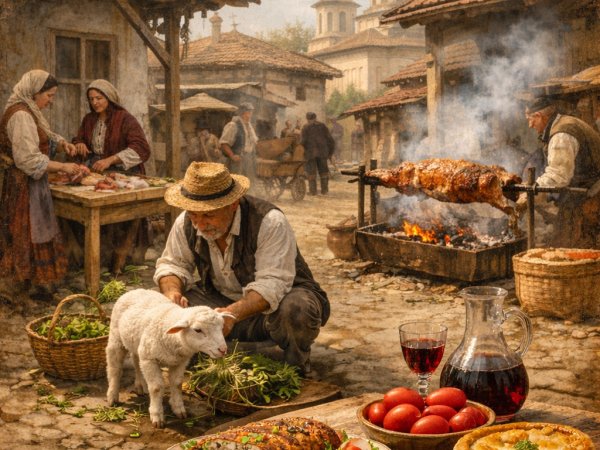
Before refrigerators, supermarkets or delivery apps existed, the Easter lamb was slaughtered in the yard. It was not a metaphor about tradition — it was a physical reality, loud and pungent, known to the entire neighborhood. In the Bucharest of the early nineteenth century, the slaughter of the lamb was a public act, carried out in courtyards and on unpaved streets a few days before the Resurrection. Those living in narrower neighborhoods did it on the doorstep or right outside the gate. It was a collective gesture more than a domestic one.
The city that did this looked nothing like Bucharest today. It had around eighty neighborhoods, each with its own church, its own small market, its own well-layered social hierarchy. And the lamb, across all these neighborhoods, was not the same animal.
The Rich Lamb and the Poor Lamb
The distinction was simple and stark. The spit roast was the festive version, reserved for boyar courtyards where there was space and servants to tend to it. A proper roast required room, good weather and a laborer to manage the fire for hours on end. It was food that was seen, smelled from a distance, that signaled the social standing of the household.
In the peripheral neighborhoods, the logic was different. The lamb's organs — liver, heart, lungs — were not discarded. They were finely chopped, mixed with fresh spring herbs and baked inside the animal's own caul fat. The drob that we know today as a traditional dish was, at its core, the solution of those who knew how to use the whole animal without waste. It followed the logic of total economy, specific to an era when waste was a luxury few could afford.
The Easter table in boyar houses bore the traces of two centuries of Phanariot influence. The wealthy Bucharest kitchen had absorbed Greek and Turkish ingredients, and by the mid-nineteenth century French refinements had made their way to the tables of the richest families as well. The lamb coexisted there with dishes seasoned with raisins, cinnamon and rose water. The outer neighborhoods ate more simply, but the ritual was just as exacting.
Obor and the Lamb's Road into the City
The lambs did not appear from nowhere. They came on foot or in carts from villages surrounding Bucharest and from more distant parts of Wallachia, and their destination was Obor — or, more precisely, what was then called the Târgul de Afară, the Outer Fair.
In 1786, by princely decree, Vodă Mavrogheni moved the livestock market from what is now the Batișta area — where the butchers' guild and their stalls had long been established — outside the city limits, for reasons of public health. The decision was sanitary in origin, but it created something more significant: a fixed, recognized place where Bucharest came to stock up.
The earliest document mentioning Obor Market dates from the seventeenth century, when it appears in the records of Stelea Monastery under the name Târgul de Afară. It was also known as the Cattle Market — the word obor meaning precisely the enclosure where a fair, usually a livestock fair, is held. To the south of the market lay what Bucharest residents called gura Moșilor, a noisy stretch full of taverns, pretzel sellers, bakeries and yogurt vendors. Before Easter, the activity in the area grew exponentially. Shepherds arrived with their flocks, middlemen set up along the roads, and the smell of live animals mingled with that of warm bread.
The neighborhoods that formed around Obor were those of traders and smallholders, a population entirely different from those in the city center. People there knew the price of a lamb the day after Lent began and knew which shepherds brought good animals.
Hanul lui Manuc and the Podul Mogoșoaiei
If the outer neighborhoods slaughtered the lamb at home, the moneyed Bucharest went out to eat. The most well-known gathering point of the capital in the early nineteenth century was Hanul lui Manuc, built in 1808 near the Old Princely Court. The inn had fifteen cellars, ten storerooms and kitchens, two large halls, 107 guest rooms, a coffee house and a garden. It was where merchants, diplomats and boyars met — and where, at Easter, food was prepared on a scale no private household could match.
The tables at inns and restaurants along Podul Mogoșoaiei offered something home cooking could not: social representation. Guests came not just to eat but to be seen eating. The Easter feast was also a form of assertion, particularly for the city's emerging middle class.
The Interwar Period: The Lamb Enters Modernity
By the interwar years, Obor had become something else. In 1936 construction began on the central market halls, designed by architects Horia Creangă and Haralamb Georgescu — a structure of welded steel wrapped in porous concrete, inaugurated in 1950. A serious architectural undertaking for a place the city had long treated as a fringe, even if an indispensable one.
Meanwhile, interwar Bucharest had discovered printed menus and the coffeehouse. Capșa, Nestor, the beer halls along the grand boulevards all ran special Easter menus. The lamb remained the backbone, but it had been refined: lamb broth replaced the rougher sour soups of the outer neighborhoods, cutlets appeared on elegantly typeset menus, and drob moved from the doorstep to plates with gilded edges.
The difference from the previous century was that now the urban middle class — the civil servant, the small trader, the schoolteacher — could also afford the lamb. Obor supplied live animals or already-cut meat, food markets had multiplied across the neighborhoods, and ice-cooled refrigerators had appeared in the better-off homes.
The Lamb Under Communism and What Was Lost
The installation of the communist regime reversed the clock in unexpected ways. Collectivization destroyed supply networks built over decades, the shepherds who had descended on Obor with their flocks disappeared as an economic category, and meat entered the state rationing system. The Easter lamb remained a tradition, but obtaining one had become a logistical problem. People searched through acquaintances, brought one from relatives in the countryside, slaughtered it discreetly on apartment balconies — a ritual compressed into impossible spaces.
The irony is that it was precisely during this period that the lamb gained in symbolic weight. When a tradition becomes difficult to practice, it becomes more charged with meaning. Easter was one of the few celebrations the state had not managed to deactivate entirely, and the lamb, for all the effort it required, had remained at the center of it.
What Obor Still Says in 2026
The halls built to Horia Creangă's design were demolished and replaced with a modern building — a move that sparked public outcry and ended a tradition several centuries old in its original physical form. What remained is harder to put into words.
Before Easter, Obor fills up again, with live lambs in the area outside the halls, with traders coming in from Ilfov, Călărași and Teleorman. Prices shift week by week as the holiday approaches, as they always have. People negotiate, weigh, compare. It is the same gesture Bucharest has been making for three centuries in the same place, even if the place now looks entirely different.
The Easter lamb has passed through every political regime, every urban planning project, every economic crisis the city has faced. It survived Phanariot rule, the forced modernization of the nineteenth century, two wars, communism and the years after. At each stage something changed — the price, the way it was sourced, where it was slaughtered, how it was cooked — but the core held. Easter without lamb remained, for Bucharest, a celebration with something essential missing.
Also recommended How Bucharest Celebrated Easter at the Table, Two Centuries Ago