How Bucharest Celebrated Easter at the Table, Two Centuries Ago
- Articles
- 06 APR 26
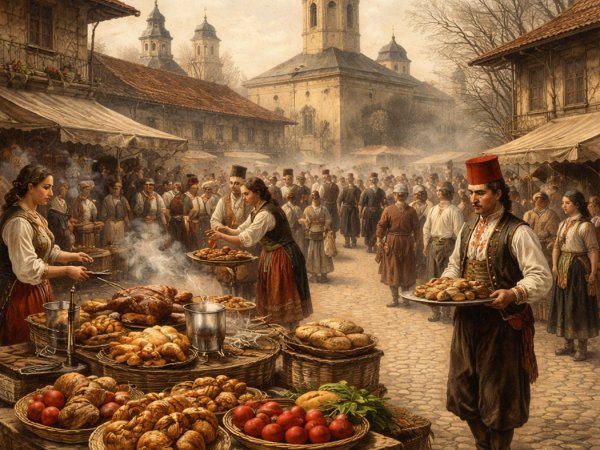
Bucharest, early nineteenth century. The forty-day fast was over, and the city — a sprawl of inns, shops, and boyar mansions surrounded by working-class neighborhoods — smelled of roasting lamb and rising dough.
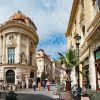
Easter was never just a day. It was an event prepared weeks in advance. From the moment Lent began and meat disappeared from households, a culinary countdown started: women took stock of their pantries, merchants along Podul Mogoșoaiei — today's Calea Victoriei — displayed spices and flour, and the city's markets filled with lambs brought in from the Wallachian plain.
The Bucharest of that era had two distinct gastronomic faces. Boyars and wealthy merchants already lived under the influence of Phanariot cuisine, enriched with Greek and Ottoman ingredients and, increasingly toward mid-century, French refinements. The working neighborhoods had their own table — simpler, but no less ritualized.
Also recommended Bucharest’s Calea Victoriei “breathes” history: the old Mogoșoaia Bridge was paved by Constantin Brâncoveanu with tree trunks
The Lamb, from Courtyard to Street
Lamb was, then as now, the backbone of the Easter meal. But in nineteenth-century Bucharest, slaughtering the animal wasn't a discreet affair handled behind closed doors — it was a public act, carried out in courtyards and on streets in the days before the Resurrection.
Spit-roasted lamb was the festive version, reserved for the estates of boyars who had the space and the servants. In more modest homes, it was prepared in a cauldron or baked whole in the oven, with garlic and olive oil. Stufat — a rich lamb stew with onions, slow-braised — was the version that democratized the holiday, accessible even to those without a proper kitchen.
Drob, as Romanians know it today, existed then too, though in slightly different forms depending on the neighborhood and the family's means. The offal — liver, heart, lungs — was never discarded. It was finely chopped, mixed with fresh spring herbs, and baked inside the lamb's caul fat. This was the logic of total economy, specific to an era when waste was a luxury few could afford.
The Boyar Kitchen and the Phanariot Influence
In the grand houses of central Bucharest, the Easter table was an exercise in social performance. The Phanariots, who had governed the Danubian Principalities through much of the eighteenth century, had left deep traces in the city's wealthy cuisine: dishes with raisins, cinnamon, and rose water appeared alongside traditional roasts.
By the middle of the nineteenth century, as Bucharest opened toward the West, French influences had begun entering the city's better households. In the grand restaurants of late nineteenth-century Bucharest, menus listed foie gras in aspic, imperial consommé, and liver tartines à la Strasbourg — proof that the city had rapidly absorbed European gastronomic fashion. But at the Easter table, local traditions held firm: lamb, pască, and red eggs remained untouched, regardless of what was eaten the rest of the year.
Pască and Cozonac — Desserts with a Paper Trail
For some dishes, historical records are scarce. For the Easter sweet bread and the cheese pastry, we have an exceptional source. In 1841, a book appeared in Iași: Carte de bucate boierești — 200 rețete cercate de bucate, prăjituri și alte trebi gospodărești ("Boyar Cookbook — 200 Tested Recipes for Food, Pastries and Other Household Affairs"), signed by two prominent intellectuals: Mihail Kogălniceanu and Kostache Negruzzi. The first cookbook written in Romanian, published just years before the 1848 revolution, is also the most precise document of the era's tastes.
Their cozonac recipe is revealing in its differences from what we know today. There was no filling — just a rich, sweet dough. Instead of modern flavorings, the recipe called for "fragrances": orange blossom water or rose water, pointing to a strong Oriental influence still present in Moldavian and Wallachian cooking at the time. Measurements were in oca, not grams. The oven was wood-fired. Kneading took hours and required physical strength.
Pască, with its origins most likely in Bucovina and Moldova, was prepared on Holy Thursday or Good Friday, alongside the sweet breads, then taken to church to be blessed on the night of the Resurrection. The Wallachian version — closest to what Bucharest would have known — favored less dough and more filling: fresh cow's cheese, eggs, and raisins, baked in a round pan.
Red Eggs and Their Old Logic
Dyeing eggs wasn't an aesthetic activity — it was a ritual rooted in the Christian symbolism of resurrection. In nineteenth-century Bucharest, natural dye was the only dye available: red onion skins for the classic crimson, a handful of plants for rarer shades. Natural techniques weren't a choice. They were the only option.
The tradition extended beyond the table itself. On the second day of Easter, Bucharest residents went out to the green — picnicking in public gardens, eating and celebrating until late at night, with the same menu: grilled meat, red eggs, pască, and cozonac. This outing, to Cișmigiu garden or along the Dâmbovița river, was part of the ritual. The Easter meal didn't end at the dinner table.
Manuc's Inn and the City's Feasts
The most famous gathering point in early nineteenth-century Bucharest was Manuc's Inn, built in 1808 near the Old Princely Court. The inn had fifteen vaulted cellars, ten storerooms and kitchens, two large halls, 107 guest rooms, a coffeehouse, and a garden. It was where merchants, diplomats, and boyars met — and where, at Easter, cooking happened on a scale no private household could match.
At inns and restaurants along Podul Mogoșoaiei, the Easter menu was a spectacle in itself: roasting spits, heavy stews, wine from the vineyards of Wallachia. Diners came not only to eat but to be seen eating — the Easter feast was also a form of social display, especially for the city's emerging middle class.
What Survived, What Didn't
Two centuries feel smaller than they are when you look at the Easter table. The lamb is the same. The pască, though it comes in new variations, keeps its original structure. The red eggs never went anywhere.
What changed is the context: the wood-fired oven became electric, the oca gave way to grams, rose water drifted into more exotic recipes. And dyeing eggs with onion skins — a practice of nineteenth-century Bucharest — has quietly returned in recent years. Not out of necessity, but out of nostalgia.
Also recommended The Great Fire of 1847 on Easter Day: A turning point in Bucharest’s history