Bucharest's Sector 4: 7 Things Most People Don't Know
- Articles
- 10 SEP 26
A few kilometers from Piața Unirii, under the apartment blocks of Berceni and Olteniței, sit an abandoned railway station, a ruined power plant, and a nature reserve with otters and wild swans. Sector 4 isn't just heavy traffic on Șoseaua Olteniței or the endless construction site at Unirii. It has a railway, industrial, and natural history that most people driving through it every day have no idea exists.
1. A delta in the middle of the concrete
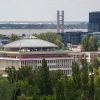
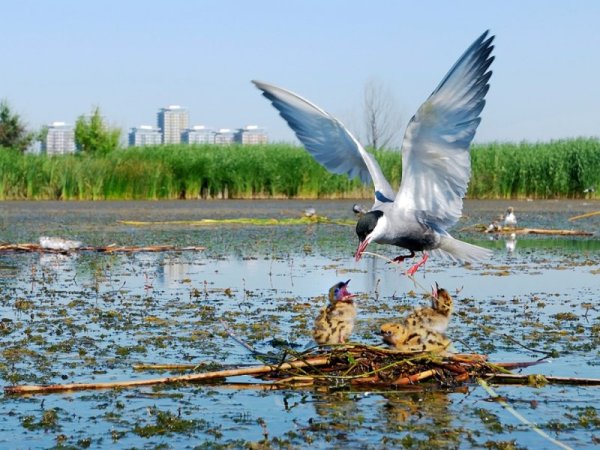
A few hundred meters from the Sun Plaza mall, between Calea Văcărești and Splaiul Dâmboviței, stretches Văcărești Nature Park, known informally as "Delta Văcărești" or "the delta between the blocks." The story behind it is unusual. In the 1980s, the Ceaușescu regime began building a dam and reservoir meant to protect southern Bucharest from flooding. The Revolution stopped the work halfway through. Water accumulated on its own behind the dikes, reeds and willows took over, and wildlife moved in without anyone planning it.
Today the park covers about 183 hectares of marshland, ponds, and dirt paths, declared a protected natural area in 2016 by government decision. Over 180 species of plants and animals live here, from waterfowl to foxes and, occasionally, otters. It's often described as the first urban nature park of its kind in Romania, though that exact claim isn't confirmed in the founding decree itself, it comes mostly from tourism sites repeating each other. The official entrance is on Lunca Bârzești street, next to the Asmita Gardens complex, and the marked trails (the "Urban Biodiversity Path" and the cycling routes along the Belvedere dike) can be walked in an hour or two.
2. Bucharest's first railway station became a bus terminal
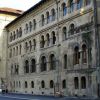
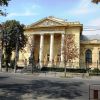
On Filaret Hill, across from Carol Park, stands the old Filaret railway station. It opened on October 31, 1869, for the inauguration of the first railway line in the United Principalities, the one connecting Bucharest to Giurgiu. The honorary train that day was named "Mihai Viteazul" and carried Prince Carol I as a passenger. He was still "Domnitor" at the time, not yet king. Romania wouldn't be declared a kingdom, and Carol its king, until 1881.
The station operated until 1960, when it was decommissioned and turned into a bus depot, which is how it ended up surviving intact and later gaining historic monument status. Today it functions as the Filaret bus terminal, with minibuses instead of trains. A modest plaque is the only reminder of what it once was.
3. A century-old concrete slab sits under Piața Unirii
Piața Unirii literally rests on a concrete megastructure built almost a hundred years ago, underneath which run the Dâmbovița River, the city's wastewater channel, and three metro lines (M1, M2, M3). Technical assessments placed the structure in risk class IV, one step short of requiring the closure of traffic.
Sector 4 began a full reconstruction of the Unirii platform (Planșeul Unirii) in 2025, funded with roughly 800 million lei from the government, a figure that grew several times over from an earlier estimate of 506 million lei in 2022. During the works, crews uncovered old walls, remnants of a market hall from the era of Prince Cuza, which turned part of the site into an archaeological dig for several months. As of a mid 2026 statement from the sector's mayor, the project was reported at roughly 50% completion, ahead of the original schedule.
4. The city's first "light factory," now slowly coming back to life
Also on Filaret Hill, on General Candiano Popescu street, stands the Filaret Electric Plant, built between 1907 and 1908 by the French company Société du Gaz pour la France et l'Étranger. It was Bucharest's first communal power plant. The building, a listed historic monument, has a basilica style brick structure with a metal roof frame. In the early 2000s there was a plan to turn the surrounding area into a National Science and Technology Park, alongside the nearby Technical Museum, but the project never got off the ground and the building sat abandoned and deteriorating for decades. Since 2024 its owner, Electrica, has renovated part of the interior for public events, and in March 2026 the company officially announced a full restoration plan as the next step after reopening the adjacent Technical Museum. That plan is still in an early stage.
5. Carol Park grew out of a royal jubilee
Filaret Hill was, at the end of the 18th century, a vineyard area, according to local historical accounts (though this specific detail comes from a single source and hasn't been independently confirmed). Carol Park, laid out between 1900 and 1906 on the initiative of Ion N. Lahovari, minister of Domains at the time, was built to host the General Romanian Exhibition marking 40 years of King Carol I's reign. A story often repeated in the press claims the young prince vowed, upon arriving in the country in 1866, not to leave Romania until he could travel on a Romanian railway. The anecdote circulates in more than one version, and no primary historical source for it could be confirmed.
6. A sector that calls itself the safest in the capital
According to Sector 4's city hall, more than 600 CCTV cameras cover the streets, schools, and playgrounds. The local administration also claims, citing a report from the Bucharest Municipal Police, that Sector 4 is the safest sector in the capital. That claim comes entirely from the institution promoting it, and it couldn't be independently verified against the police report itself.
7. A 12 billion lei budget for 2026
In May 2026, Sector 4's Local Council approved a consolidated budget of over 12 billion lei, roughly 2.4 billion euros. Nearly 10.7 billion lei of that is earmarked for investment, with priority projects including the continued reconstruction of the Unirii platform and a new road overpass at the Ion Iriceanu and Turnu Măgurele intersection. Separately, the council also validated other investment objectives during the year, including an extension of Tudor Arghezi Park and a new ice rink, though those weren't explicitly listed as part of the 2026 budget's priority package. Over 75% of the funding for the year's development projects comes from EU and government grants.
Also recommended 10 streets in Sector 4 of Bucharest that have interesting stories