Bucharest Decides to Clean Up Graffiti in Protected Areas. It Doesn't Say What Happens to Murals
- Articles
- 30 JUN 26
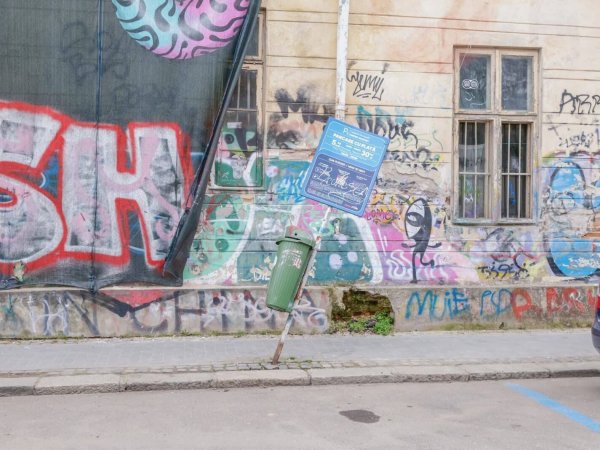
The General Council voted on Tuesday, June 30, to approve a programme to remove graffiti and illegal posters from Bucharest's protected zones. The vote was nearly unanimous — 43 in favour, none against, two abstentions — a sign that, administratively, the issue is no longer up for debate. The harder question sits on the other side of that vote, where the city is deciding what its visual identity should look like without input from the people who actually created it.
How It Works, Mechanically
The programme won't roll out across the whole city at once. The General Directorate of Urban Planning will designate the zones, and the Local Police will identify the affected buildings, stage by stage. Notified owners will have two options: handle the cleanup themselves within 90 days, or enrol in the city's programme, in which case the work will be carried out by the Street Administration — though the owner still pays 20% of the cost, with the remaining 80% covered by City Hall.
The regulation is explicit about deadlines: "The owner or administrator who chooses not to enrol in the programme is required to provide proof of having initiated the cleaning procedures for unauthorised graffiti or signage through appropriate methods within a maximum of 45 calendar days from the date the notification is communicated, and to complete the cleaning works within a maximum of 90 days from that date, without causing further damage to finishes or architectural elements."
On paper, this reads like standard urban administration — plenty of European cities have rules for graffiti on historic buildings. In practice, the mechanism reduces a genuinely complicated question to a single variable: authorised or not. And that's exactly where the regulation falls short.
"A Disease" Versus Mural Art
Back in March, when the issue was publicly debated by City Hall, Sector 6's administration, and the Ministry of Culture, Bucharest's mayor Ciprian Ciucu set the tone with an unambiguous comparison: "We need to stop this disease. In Sector 6, there's none of this. I stopped both graffiti and illegal signage."
The word choice matters. "Disease" leaves no room for gradation — there's no good graffiti and bad graffiti, just graffiti, to be eliminated. But architects and street artists present at that same debate raised exactly this concern: the administration treats every graffiti intervention identically, whether it's a quick tag or a genuinely valuable mural, created by a known artist, sometimes even at a property owner's or institution's request.
The distinction isn't merely aesthetic. Bucharest has, for several years now, an internationally visible street art scene — large-scale murals, gallery-coordinated projects, festivals dedicated entirely to urban art. Many of these works never go through a formal authorisation process, for the simple reason that no clear, accessible procedure exists for an artist or owner to obtain that authorisation without running into heavy bureaucratic obstacles.
Also recommended Bucharest’s urban mural map: where street art comes to life
What the Regulation Could Have Included, and Doesn't
Local authorities have stated that the regulation targets "unauthorised inscriptions and drawings that degrade building façades, particularly in the historic areas of the Capital" — a phrasing that, at least in theory, leaves room for interpretation. "Degrade" isn't necessarily synonymous with "any unauthorised graffiti"; it could be read as a qualitative criterion rather than a purely administrative one.
The problem is that the regulation doesn't specify who decides what "degrades" a façade and what doesn't. Without an explicit standard or an aesthetic review body, that decision falls, in practice, to the Local Police identifying the affected buildings — a body that doesn't typically have expertise in urban art. The difference between a street tag and a mural by a recognised artist ends up being evaluated using the same administrative tool: whether or not a permit exists.
That leaves uncovered exactly the area architects and artists flagged at the March debate: genuinely valuable artistic work, especially work created without a formal authorisation process — because, currently, no simple, accessible process for mural art exists in Romania. Without one, an artist or owner who wants a legitimate piece on a façade has no path forward except informality, which is precisely the zone the regulation now targets with penalties.
Who Pays for Someone Else's Decision
There's also a less-discussed question: the owners. The regulation puts them on the front line — they're the ones notified, they're the ones who pay, whether in full if they go the independent route, or partially (20%) if they enrol in City Hall's programme.
But the owner of a historic building isn't necessarily the one who decided to have graffiti on its façade. Often, it's the opposite — someone painted it overnight, without consent, and now the owner is the one who has to prove, within 45 days, that cleanup procedures have begun. In practice, the victim of vandalism becomes financially and administratively responsible for it.
Disorderly tags, half-torn posters, the visual clutter on the façades of historic buildings are a real problem, visible to anyone walking through the old centre or the city's interwar neighbourhoods. The question isn't whether Bucharest needs cleaning up. It's whether "cleaning up" implicitly means eliminating every form of unauthorised visual expression — or whether there's still room, in the regulation, for the distinction architects at that debate publicly asked for.
Bucharest voted for a mechanism, but it hasn't yet voted, even in principle, for a definition of what it actually wants to preserve.
Photo: Primăria Capitalei/FB