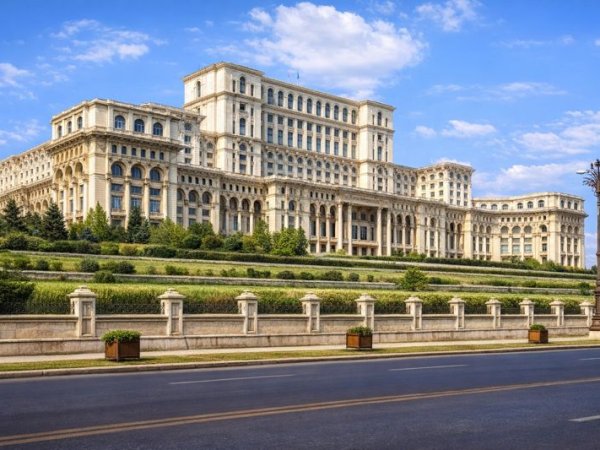
What the Palace of Parliament will look like after the fence is removed. Details of the project approved by Bucharest City Council
By Bucharest Team
- NEWS
- 30 JAN 26
The Bucharest General Council has approved a project that could reshape one of the most rigid urban boundaries in the capital: the fence surrounding the Palace of Parliament. The decision opens the way for a broader urban regeneration process in central Bucharest, covering part of the former Uranus neighborhood.
Although the vote marks an important step, the actual implementation of the project will require several administrative and technical stages, meaning the changes will not happen immediately.
Why the fence around the Palace of Parliament is set to be removed
According to the project’s initiators, the current fence acts as a major urban barrier, fragmenting the city and limiting pedestrian access between key areas of Bucharest. In its present form, the perimeter of the Palace of Parliament is widely perceived as hostile, difficult to cross, and poorly integrated into everyday urban life.
Removing the fence is seen as a solution to:
- improve pedestrian circulation;
- reduce unnecessary detours between neighboring districts;
- create a more open and welcoming public space;
- reconnect the area with nearby parks and public squares.
What urban changes are included in the regeneration project
The plan approved by the Bucharest General Council goes beyond the simple removal of the fence and is part of a wider vision for transforming the surrounding area. Official documentation outlines several interventions designed to redefine public space around the Palace of Parliament.
Key elements of the project include:
- the creation of urban promenades allowing pedestrian crossings through the area;
- the development of interconnected leisure and recreation zones;
- the expansion and protection of green spaces;
- the reorganization of traffic to reduce pressure from car circulation;
- improved accessibility for pedestrians, cyclists, and public transport.
The area concerned is located near major city landmarks, including Constitution Square and Izvor Park, and the project aims to better integrate this symbolic zone into the city’s urban fabric.
A project based on institutional cooperation
Implementing the project requires a cooperation protocol involving several state institutions. Alongside Bucharest City Hall, the initiative brings together the Romanian Government, Parliament, the Romanian Patriarchate, the Romanian Academy, and Metrorex.
Each institution will have specific responsibilities, ranging from approvals and coordination to ensuring compatibility with existing infrastructure. Metrorex’s involvement is required due to the overlap between the project area and metro lines and safety zones.
A long-discussed idea revived in a new urban context
The idea of removing the fence around the Palace of Parliament is not new. Over the years, similar proposals have been put forward by local authorities and parliamentary leaders, but none progressed beyond the discussion stage.
This time, the project received formal approval from the General Council and is part of a broader strategy to regenerate the former Uranus neighborhood, an area deeply affected by large-scale urban interventions during the communist period.
We recommend:
What happens next after the City Council vote
The council’s approval marks the beginning of a process rather than its conclusion. The next steps include:
- signing the cooperation protocol between the institutions involved;
- organizing an urban design competition;
- obtaining the required permits and approvals;
- determining budgets and funding sources.
Only after these stages are completed will a concrete timeline for the transformation be established. Until then, the project remains a strategic initiative that, if fully implemented, could significantly change how the Palace of Parliament relates to the city and its residents.