Why You Should Attend the “Words, Coffee, Capșa and Caragiale” Event: An Evening in Caragiale’s Bucharest, with Black Coffee, Stories and Old-Fashioned Sweets

- Articles
- 11 SEP 26
What would it be like to step into I.L. Caragiale’s Bucharest for a few hours, drink a cup of black coffee at Capșa and listen to stories about the world that gave birth to some of the best-known characters in Romanian literature? This is precisely the atmosphere that the “Words, Coffee, Capșa and Caragiale” event aims to bring back to life. It is scheduled for Wednesday, September 23, 2026, starting at 6:30 p.m., at Casa Capșa on Calea Victoriei. This is not being presented as an ordinary lecture about Caragiale, nor as a rigid gathering built around biographical facts. The proposed concept is more conversational, allowing the writer to be rediscovered through stories about the man behind the works, his era, the customs of Bucharest and a world in which irony, politics, the press and the coffeehouse naturally came together. The chosen venue could hardly be more appropriate. Casa Capșa is one of the addresses that have become synonymous with old Bucharest. Over the years, its café, confectionery, restaurant and hotel have been closely connected to the capital’s cultural and social life, attracting writers, artists, journalists and politicians. For one evening, Caragiale is thus brought back into a universe that resembles him: a city of talk, colorful characters, conflicting opinions, intrigues and humor that often conceals an extremely serious observation about society.
An Evening in Which Caragiale Returns to Capșa
“Words, Coffee, Capșa and Caragiale” begins with a simple yet highly relevant question: why do we still laugh, more than a century later, at the characters and situations created by I.L. Caragiale?
The answer can be found precisely in the way the playwright viewed society. Caragiale did not limit himself to creating comic characters. He observed, with remarkable precision, human weaknesses, political mechanisms, vanity, opportunism, hypocrisy and the gap between what people claim to be and what they really are.
In “A Lost Letter,” “A Stormy Night,” “Carnival Scenes,” “Mr. Leonida Facing the Reaction” and his numerous sketches, Bucharest and Romanian society at the end of the 19th century become a vast stage. The characters talk endlessly, contradict one another, suspect each other, conspire, make promises, change their minds and constantly try to protect their public image.
This is also where Caragiale’s enduring relevance comes from. Some settings have changed, the costumes have disappeared and the language of the period is no longer the language of today, but the human behaviors captured by the playwright remain surprisingly recognizable.
The event at Capșa proposes precisely this kind of approach to Caragiale. Through anecdotes, observations and uncomfortable questions, the writer is presented not as a solemn figure from school textbooks, but as a man of his time, attentive to what was happening around him and capable of transforming everyday life into literature.
Casa Capșa, the Place Where Bucharest Learned to Sit and Talk
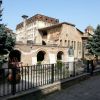
There are few places in Bucharest where an event about Caragiale would feel as natural as it does at Casa Capșa. The history of the famous establishment began in 1852, when brothers Anton and Vasile Capșa opened the “La doi frați” confectionery. The business would later expand, and the Capșa name would become one of the best-known brands in old Bucharest.
Grigore Capșa played an important role. He trained professionally in Paris and made a decisive contribution to modernizing the confectionery. Over time, Casa Capșa came to offer not only confectionery products, but also a place for meetings and socializing, while its café became one of the best-known in the capital.
In 1886, the Capșa complex expanded with the addition of a hotel and café. From that point on, the establishment became even more deeply embedded in Bucharest’s cultural history. Writers, journalists, artists and politicians met there, and the conversations held around its tables became part of the city’s public life.
In such a setting, the event’s title takes on a special meaning. “Words, Coffee, Capșa and Caragiale” does not merely describe a cultural gathering; it symbolically recreates one of the forms of social interaction that defined old Bucharest.
The city of that time was one in which information circulated through newspaper offices, cafés, restaurants, theaters and beer halls. Politics was discussed, performances were debated, rumors were spread and reputations were built. And Caragiale, both journalist and playwright, knew this world extremely well.
Black Coffee, Sweets and the Taste of an Evening from Another Era
Although the cultural component is at the heart of the event, the experience does not end with stories about Caragiale. The organizers have also prepared a menu intended to extend the atmosphere of Casa Capșa.
The evening begins with a welcome Prosecco, followed by classic sweets from the Casa Capșa Confectionery and mini pastries—smaller versions of the products that helped make the confectionery famous.
Perhaps the most fitting detail for a gathering dedicated to Caragiale, however, is the black coffee. Coffee is part of Capșa’s historical identity, and the old café was a place where the coffee ritual was closely connected to conversation, meetings and the city’s public life.
Thus, “Black coffee, my dear fellow—what else?” as the organizers put it, is more than just a drink included in the ticket price. It is also a small atmospheric detail meant to evoke the world of Bucharest cafés, where conversations could last for hours.
At the end, each participant will also receive a box of Capșa sweets, allowing the experience to continue at home. This detail turns the event into a combination of cultural gathering, journey through Bucharest’s history and gastronomic experience.
Why the Event Can Be More Than a Literary Gathering
One of the reasons the event may appeal to the public is precisely that it is not aimed exclusively at literature enthusiasts. Caragiale serves as the starting point for a much broader story about Bucharest.
Those interested in the city’s history can discover a world in which Calea Victoriei was one of the major centers of urban life, while cafés and restaurants served as genuine social spaces. Theater lovers can view Caragiale’s works from the perspective of their own era, while food enthusiasts have the opportunity to discover some of the products associated with Casa Capșa.
There is also an entertainment component. The organizers promise an evening built around anecdotes, observations and uncomfortable questions, without an excessively solemn atmosphere. The idea is for the audience to be able to laugh, but also to reflect on the issues Caragiale wrote about more than a century ago.
This may be the best way to approach the playwright. Caragiale should not be turned into an inaccessible monument. He can be read, discussed and rediscovered with humor, precisely because his work continues to provoke reactions.
A Journey into Bucharest’s Past Without Leaving the Capital
For those who love old Bucharest, the event has another important dimension. It offers an opportunity to view the present-day city through the stories of a man who lived more than a century ago.
Caragiale’s Bucharest no longer exists in the form it once had. Some buildings have disappeared, the streets have changed, trams and automobiles have replaced the old carriages, and cafés no longer serve the same social function. Nevertheless, certain addresses have survived, and Casa Capșa remains one of the strongest links to that Bucharest.
For this reason, the gathering can be seen as a journey through time without artificial sets. There is no need for a historical reenactment to imagine Caragiale’s world. It is enough to enter a place steeped in history, drink a coffee and listen to stories about the people who were part of old Bucharest.
And when the conversation turns to social customs, politics, irony, betrayal and truth, the distance between Bucharest then and Bucharest today seems to shrink considerably.
When Does “Words, Coffee, Capșa and Caragiale” Take Place and How Much Does a Ticket Cost?
The “Words, Coffee, Capșa and Caragiale” event will take place on Wednesday, September 23, 2026, starting at 6:30 p.m., at Casa Capșa on Calea Victoriei in Bucharest.
There are 60 places available, and a ticket costs 165 lei per person. The price includes both the cultural experience and the gastronomic component: welcome Prosecco, classic Casa Capșa sweets, mini pastries, black coffee and Borsec Gama mineral water. At the end, each participant will receive a box of Capșa sweets.
For someone looking for a simple night out, 165 lei may seem like a significant price. For those interested in Bucharest’s history, Romanian literature and experiences built around historic venues, however, the event offers something that is difficult to find on an ordinary evening.
Ultimately, it is a gathering where literature meets gastronomy, the city’s history meets the present and Caragiale returns, at least for a few hours, to one of the settings that best evokes his Bucharest.
And perhaps this is the best reason to attend: to discover that, more than a century after I.L. Caragiale’s death, many of the things that make us laugh at his characters have not disappeared at all. Only the setting, the clothes and the way we describe them have changed. At Capșa, however, the words remain. And on September 23, Caragiale will once again be at their center.
We also recommend: Symbols of Bucharest: Casa Capșa, “the only intellectual venue” of the interwar period, where writers had their “artistic baptism”