When and how did the first license plates appear in Bucharest?
By Bucharest Team
- Articles
- 02 FEB 26
At the end of the 19th century, on the dusty streets of the capital, a few "horseless carriages" began to frighten pedestrians and shock high society. Their owners would unwittingly become the pioneers of Romanian motoring.
The first "madman" to bring a car to Bucharest
The story begins in the autumn of 1889, when Baron Barbu Bellu (yes, the one with the cemetery today) was walking through Paris and discovered the wonder of the age. Armand Peugeot and Leon Serpollet had just created a kind of motorized carriage, a revolutionary vehicle that ran without horses. And because the baron was a visionary (or simply liked expensive toys), he decided to bring the first automobile to Romania.
Before making the decision, Bellu consulted with the leaders of Bucharest. "Gentlemen, I would like to ask your advice on a little story that has been bothering me for some time," he reportedly told them. He was concerned that he might appear to be "showing off" in a city where many were in need. In essence, the baron was considering the public relations implications of the operation as early as 1889, demonstrating that he was ahead of his time.
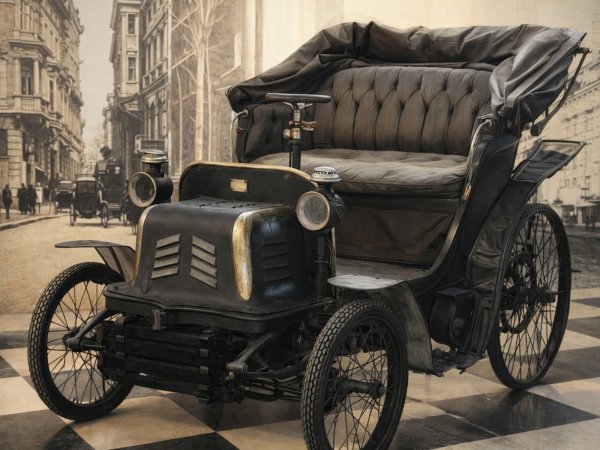
The car was a four-seater Peugeot with four horsepower that reached the astonishing speed of 18 km/h. For reference, this is approximately the speed of a horse-drawn carriage in the countryside on a summer day. At the same time, it should be noted that at that time there were only three or four such models in the whole world. Basically, Bellu was driving a 1889 Ferrari.
When the "automobile" appeared on the streets of the capital, some crossed themselves, others stared wide-eyed. The transmission was chain-driven, like on a bicycle, the trunk was actually a bag placed in front, and it had gas headlights. The noise was considerable, but that was part of the charm. When he died in 1900, the newspapers wrote, "Baron Bellu, the man with the automobile, has passed away." There could be no more wonderful epitaph!
Chaos on the streets of the capital calls for order
By 1900, there were already about 15-20 automobiles on the streets of Bucharest. Their owners—all from high society—held unofficial races on Kiseleff Road and showed off their purchases in Cișmigiu Park.
The city council quickly realized that something had to be done. The mysterious automobiles caused accidents, broke fences, and sometimes crashed through shop windows. Without an identification system, it was impossible to know who was at fault.
In 1896, the Bucharest City Council issued the first regulations on automobile traffic. The document imposed a few simple rules, but they were revolutionary for those times. The maximum speed allowed in the city was 12 kilometers per hour (about the speed of a person jogging). Cars were required to have a bell or horn to warn pedestrians.
But the most important provision concerned identification. Each car had to have a metal plate with a unique number, visible from the front and rear.
What the first license plates looked like
The first car identification plates in Bucharest were far from today's standards. Each owner made their own plate, based on a model established by the Police Prefecture.
The specifications were quite vague. The plate had to be made of metal, usually sheet iron or brass for the more discerning. The numbers were painted by hand, with black paint on a white background. The dimensions varied considerably, depending on the craftsman who made it and the tastes of the owner.
Some aristocrats ordered elaborate plates with ornaments and even their family crest alongside the number, while others opted for minimalist versions. The result was a rather chaotic visual amalgam on the streets of the capital.
The great battle for number 1
This is where the drama begins. Bazil George Assan, the son of the industrialist who built the first steam mill in Romania, had just returned from a trip around the world and designed the first navigable canal between Cernavodă and Constanța, a truly impressive feat, as the man was a consummate visionary, practically a... Leonardo da Vinci of Bucharest.
Assan bought an FN Herstal automobile manufactured in Belgium in 1900, one of only 47 ever produced. The car was a convertible, with leather and wood interior, and gas headlights that lit the way for the driver. It was the high-end car of 1900, a Rolls-Royce avant la lettre.
This car was the first vehicle registered in Bucharest, bearing the number 1. Simple and logical. The first registered car gets the number 1. And that would have been the end of the story, if...
...if Prince George Valentin Bibescu hadn't ordered EXACTLY the same model of car! The prince was a pioneer of motoring and aviation, founder of the Romanian Automobile Club, a dandy of the time who couldn't conceive of being second in anything. As Bibescu did not have time to register his car immediately, Assan became the first to receive a license plate.
Although it was the second car registered in Bucharest, Prince George Valentin Bibescu's FN Herstal was given the registration number 0 (ZERO) by the Prefecture of the Capital. As Assan had already received the number 1, the Prefecture of the Capital found a compromise solution, registering the prince's car with the number 0.
This is how the most bizarre license plate number in Romanian history came about. Prince Bibescu became the owner of the first number in Bucharest, even though he had the second car registered. Where is the logic in that? Let's not rack our brains over it...
The registration procedure, Belle Époque-style bureaucracy
To obtain a license plate number, the owner had to go through several steps. The first visit was to the Police Prefecture, where an official application was filled out. The document included the owner's name, address, make, and characteristics of the car.
This was followed by a rudimentary technical inspection. A city hall official checked whether the vehicle had working brakes, headlights for night driving, and an audible warning device. The examination was more of a formality for those with connections in the administration.
After approval, the owner received a registration certificate, i.e., a handwritten document with impressive stamps and signatures. The registration fee was quite steep, equivalent to several months' salary for an ordinary civil servant.
The owner was also responsible for making the license plates. The prefecture only specified the number assigned and the minimum acceptable dimensions. This practice continued until after World War I, when the state took over the production of standardized license plates.
The automotive boom
During those years, other car enthusiasts brought various cars from abroad, so that by 1904 there were 51 automobiles in Romania. Fifty-one! Today, there are over a million registered in Bucharest!
On April 5, 1904, the Romanian Automobile Club was founded in the hall of honor of the Boulevard Hotel in Bucharest. Prince Bibescu, number 0, was immediately elected president. Romania was among the first 10 countries in Europe and among the first 14 in the world to establish an automobile club.
In September 1904, Prince Bibescu organized the first car race in Romania, on the Bucharest-Giurgiu-Bucharest route (120 km). The unpaved road was sprayed with a binder prepared by an oil factory to limit dust, so onlookers witnessed a serious race on a country road.
The race was won by Prince Bibescu, at the wheel of a Mercedes, with an average speed of 66 km/h, a European record at the time. The man with the number 0 also became the first winner of a car race in Romania. Since he had good connections at the Prefecture, he might as well win races...
Who were the pioneers of Bucharest motoring
The list of the first car owners in Bucharest resembles a register of the social elite of the time. Alongside Gheorghe Cantacuzino-Pașcanu, we find famous names of the time.
Prince George Valentin Bibescu was one of the most passionate motorists of the period. He imported several vehicles and participated in international races. In 1900, he brought a French Panhard-Levassor to Bucharest, considered the best-performing car of the moment. But in the 1924 Yearbook, Prince Bibescu appears with the number 0 and a 31 hp Cadillac. In the meantime, Bibescu had changed brands, switching from FN Herstal to Mercedes and from Mercedes to Cadillac, as he was crazy about the latest automotive innovations.
Statistics on automobile imports
The evolution of the number of automobiles in Bucharest reflects the growing interest in this revolutionary technology.
1889-1895: The pioneering period saw only 3-4 automobiles in the entire country, all owned by eccentric boyars.
1896-1900: The number grew to about 20 vehicles registered in Bucharest. Imports came mainly from Germany and France.
1901-1905: Relative market boom: about 80 new cars were registered in the capital. Prices had begun to fall slightly, and models were becoming more reliable.
1906-1910: The Belle Époque period brought over 300 new cars to the streets of Bucharest. The capital's total car fleet had reached approximately 450 vehicles by the end of the decade.
The most popular brands were Daimler and Mercedes from Germany, Panhard-Levassor and Peugeot from France, plus a few Fiats from Italy.
Memorable events from the pioneering era
The newspapers of the time recorded hilarious and dramatic moments related to the first automobiles.
In 1901, a car drove into the lake in Cișmigiu Park after the driver's brakes failed. The owner (a landowner from Ilfov) was rescued by boatmen who rented pleasure boats. The car was pulled out the next day with the help of horses. The irony of fate amused the entire press in the capital.
The first serious traffic accident occurred in 1899, on Calea Griviței. A car hit a cart loaded with vegetables. The material damage was considerable, and the car owner paid generous compensation to avoid public scandal.
The illegal races on Kiseleff Road became legendary. Young aristocrats bet fabulous sums of money, and the police intervened sporadically, with modest fines representing a minor inconvenience for the participants.
The first "car service" in Bucharest
Frequent technical problems with automobiles led to the emergence of the first repair shops. In 1902, an emigrant German mechanic, Friedrich Wohlfahrt, opened the first specialized workshop in Bucharest on Brezoianu Street.
Wohlfahrt had come to Romania with experience from the Daimler factories. His business prospered quickly because he was the only one in town who knew how to repair the capricious engines of the time.
The workshop also offered driving lessons. For 50 lei (the equivalent of a decent monthly salary), those interested could learn the secrets of starting, changing gears, and, above all, stopping safely.
Fuel, a logistical problem
Gasoline was not available on every street corner in Bucharest in 1900. Car owners had to order fuel from pharmacies or drugstores, where it was sold in small cans at exorbitant prices.
The first "gas station" did not appear until 1910, on Calea Victoriei. It was actually a manual pump installed in a garage yard, but it represented a huge step forward for motorists.
Until then, the most organized owners set up their own storage facilities at home, an extremely dangerous practice that caused several memorable fires in residential neighborhoods.
The legacy of those times
The registration system inaugurated in Bucharest at the end of the 19th century laid the foundations for the organization of road traffic in Romania. The principles established at that time, starting with unique identification and continuing with official registration, technical inspection, etc., have remained valid to this day, obviously with the necessary modernizations.
The first car owners, with their handmade license plates and noisy cars, paved the way for the millions of drivers who would appear in the following decades. Their Bucharest, with cobbled streets and frightened horses, was irreversibly transformed with the arrival of "horseless carriages."
Certainly, however, they never imagined that, a century later, their descendants would be stuck in traffic for hours on end, longing for the days when the entire car fleet of the capital could fit in a supermarket parking lot.