The most visited museum in Bucharest in 2025. How many visitors crossed its threshold
- Articles
- 31 MAR 26
On Șoseaua Kiseleff no. 1, just a few hundred meters from Piața Victoriei, stands a building crowned by a sculpted pediment and a bronze eagle above its entrance. Built in the early 20th century, designed by architect Grigore Cerchez and inaugurated by King Carol I in May 1908, it is the first building in Romania designed from the ground up as a museum. Today, it houses the Grigore Antipa National Museum of Natural History — and, more importantly, 503,934 visitors per year, a figure that places it unequivocally at the top of Bucharest’s museum rankings.
The comparison with other cultural institutions in the capital is telling. The Bucharest Municipality Museums attracted around 75,000 visitors in 2025. The National Museum of Contemporary Art drew 32,000. Antipa surpassed their combined total several times over. In a cultural landscape where audiences are hard to gain and easy to lose, this gap demands an explanation.
Origins: a princely cabinet turned national heritage
The museum was founded in the autumn of 1834, at the initiative of Mihalache Ghica — brother of ruler Alexandru Ghica and a passionate collector of painting, archaeology, and numismatics — who established the “National Museum of Antiquities.” The initial collections were modest: a few minerals, fossils, taxidermied animals, and ancient coins. For several decades, the institution changed location and administrative oversight multiple times, until a scientist transformed it fundamentally.
Grigore Antipa led the museum for 51 years, reorganizing it in the new building designed by Grigore Cerchez and inaugurated by King Carol I on May 24, 1908. On that occasion, 16 halls were opened, including one featuring four biogeographical dioramas — the Sahara Desert, the African savanna, the American prairie, and the tundra — among the first of their kind worldwide, later serving as models for many other museums.
The building was reopened in 2011 after a $14 million renovation. The modernization introduced five documentary screening rooms, 3D projections, 66 infotouch stations, and interactive laboratories — a transformation that repositioned the institution in line with contemporary global museography standards.
The collections: two million specimens, eight departments
The museum’s scientific heritage includes approximately two million specimens of invertebrates and vertebrates, both current and fossil, originating from Romania and diverse geographical regions — from the equator to the polar areas, from surface waters to depths exceeding 6,000 meters.
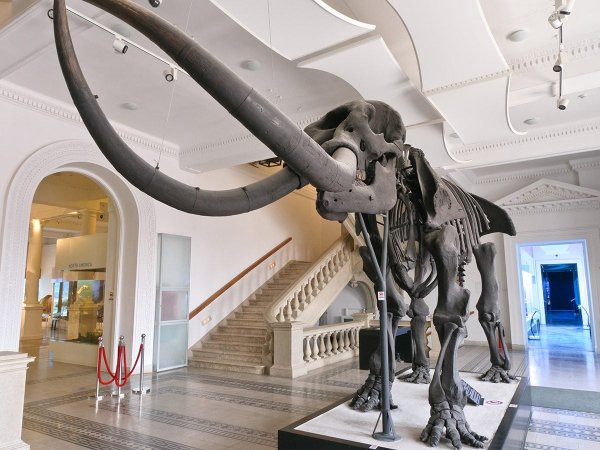
The collections are organized into eight sections: geology and mineralogy, paleontology, comparative anatomy, ethnography and anthropology, vertebrates, invertebrates, entomology, and scientific collections. One of the emblematic exhibits remains the skeleton of Deinotherium gigantissimum — discovered by the museum’s first director, Grigoriu Ștefănescu — one of the largest mammals ever to have lived on Earth.
The permanent exhibition follows Antipa’s core idea: presenting ecosystems through dioramas, allowing visitors to travel through natural habitats from Romania and across the world, along with their characteristic fauna.
In 2025, the museum’s researchers continued expanding the collections. Through the acquisition of engineer Marin Goia’s lepidoptera collection, 30,200 specimens were added, over 90% of them identified and classified by genus and subfamily, many belonging to protected, rare, or very rare species in Romania.
Activity in 2025: education, research, inclusion
Visitors to the permanent exhibition represent only part of the institution’s activity. In 2025, the museum recorded 58,073 participants in 60 educational projects, totaling 846 activities, 117,459 visitors to three major temporary exhibitions, and 6,550 visitors with special needs.
By organizing 51 editions of the “Quiet Hours” program, dedicated to people with sensory impairments and neurodiverse individuals, as well as 32 “Discover” workshops for children and young people with special educational needs, the institution consistently attracted new audience segments.
On the scientific front, the research team carried out work within the multiannual program “Assessment of the taxonomic and genetic diversity of national and global fauna” and published volume 68 of the journal Travaux du Muséum National d’Histoire Naturelle “Grigore Antipa” — a long-standing publication that continues to appear in French, reflecting its international vocation.
Funding: a model of partial sustainability
In 2024, the museum received approximately €1.24 million in state subsidies, while its total budget — supplemented by its own revenues — reached around €2.75 million. In practical terms, for every leu received from the state budget, the institution generated an additional 1.21 lei in its own income. These revenues cover almost all expenses beyond salaries — a situation that places constant pressure on investment and innovation capacity, but also signals efficient audience management.
Architecture and location
The museum building, located on Șoseaua Kiseleff no. 1, Sector 1, is the first structure in Romania designed and built from the ground up as a museum. The façade, designed by Grigore Cerchez, features a sculpted pediment representing Natural History and a bronze eagle above the entrance. Today, the building is a historical monument, listed under code LMI B-II-m-A-18983.
Its location, at the intersection of Șoseaua Kiseleff and Piața Victoriei, ensures excellent accessibility — the Piața Victoriei metro station connects the museum to Lines 1 and 2.
Tickets and visiting hours (2026)
The standard adult ticket costs 20 RON, with discounts available for pupils and students (5 RON) and pensioners (10 RON). Children under 3 enter free of charge. The regular visiting schedule is Tuesday to Sunday, 10:00–18:00, with last entry one hour before closing. The museum is closed on Mondays.
Grigore Antipa passed away in 1944, after 51 years spent in the same building, with the same collections growing around him. He did not live to see the 2011 renovation, the interactive screens, or the programs for children with special needs. What he did live to build, however, was something that survived all these changes: the idea that a science museum can also be a place people genuinely want to visit.