The mall where you don’t have to get out of your car. What the new Otopeni project says about Bucharest’s relationship with the automobile
- Articles
- 27 SEP 26
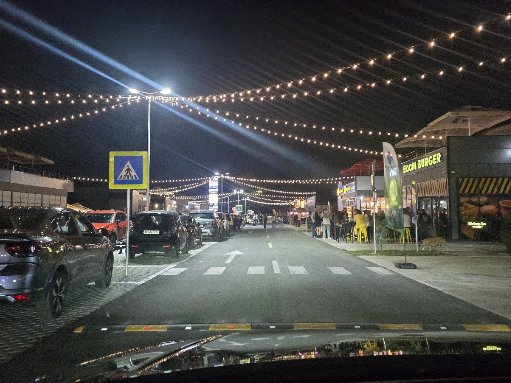
You drive in, order from your car and can leave without having to find a table or walk through a shopping mall. In Otopeni, on DN1, a new commercial complex has opened around a very specific type of customer: the person already behind the wheel.
Laufer DriveIn Mall officially opened on September 24, 2026, at 233 Calea Bucureștilor. The complex brings together 15 restaurants, commercial spaces, a supermarket and car-related services. Customers can be served directly in their vehicles or park and stay at one of the restaurants or outdoor terraces.
On its own, it is an unusual commercial concept for Romania. Look at its location, however, and the project also says something about how Bucharest has developed over the past few decades. It is not in a pedestrian district or beside a central square. It sits on DN1, one of the main roads into the capital, within a metropolitan area that has expanded rapidly beyond Bucharest’s administrative boundaries.
The mall did not create this reality. It positioned itself right in the middle of it.
DN1 is already one of metropolitan Bucharest’s major traffic corridors
The choice of Otopeni cannot be separated from traffic on DN1. The Bucharest–Ilfov Sustainable Urban Mobility Plan shows that, according to CESTRIN data for 2022, the Otopeni–Bucharest Ring Road section of DN1 was among the busiest roads in the region. Its annual average daily traffic exceeded 30,000 vehicles.
The pressure becomes even more visible during rush hour. The same document shows that the high transport demand generated in Ilfov and directed towards Bucharest puts considerable pressure on roads crossing the ring road. DN1 is identified as one of the affected corridors, with congestion extending northwards towards the Balotești area.
There is another factor affecting this route in 2026: construction work on Metro Line M6. The project that will eventually connect Bucharest with Henri Coandă International Airport currently affects road traffic along parts of the Băneasa–Otopeni corridor.
Against this background, a commercial centre has appeared that does not try to persuade drivers to leave their cars somewhere and walk into an indoor shopping gallery. It does almost the opposite: it adapts shopping and eating to the journey people are already making by car.
Administrative Bucharest ends at the city boundary. Daily journeys do not
Understanding the phenomenon requires looking beyond the line separating Bucharest from Ilfov on a map. Otopeni is not administratively part of Bucharest, but the relationship between the two is part of everyday metropolitan life.
The Sustainable Urban Mobility Plan treats Bucharest and Ilfov together precisely because real mobility does not respect this administrative border. According to the data analysed in the plan, Ilfov County had approximately 543,000 registered residents, around 154,000 more than the population recorded by the 2011 census. The document explicitly refers to the continuing rapid suburbanisation of Bucharest when discussing increasing traffic volumes.
This means housing built beyond the city boundary, but also daily journeys between these communities and Bucharest. People live in Otopeni, Tunari, Corbeanca, Voluntari and other surrounding areas, work somewhere else, take their children to school, shop and use services spread across a metropolitan area far larger than Bucharest itself.
For some of these journeys, the car is not simply a preference. It is one of the most practical options available. The choice varies considerably depending on the route, time of day and destination, and the comparison between a car, the Metro, STB and ride-sharing in Bucharest shows just how different the options can be even within the same city.
The relationship between Bucharest and Otopeni also matters for another obvious reason: the airport. DN1 remains one of the main road routes to Henri Coandă International Airport, even though the train provides an alternative that is not affected by road congestion. Car, taxi, public transport and rail each offer different advantages depending on how you get to the airport from different areas of Bucharest.
The issue is not simply the number of cars, but the alternatives available
It would be too easy to say that Bucharest residents simply “love their cars” and leave the explanation there. The mobility documents describe a more complicated situation.
The Sustainable Urban Mobility Plan identifies the absence of high-capacity public transport alternatives, such as metro or tram connections, to some communities surrounding Bucharest, as well as the limited number of Park&Ride facilities, among the factors that maintain pressure on the main access roads.
The document reaches an uncomfortable conclusion for a metropolitan area that has expanded around road transport: many of these roads cannot simply continue to be widened. The proposed direction is instead to reduce demand for private road transport and encourage more efficient alternatives, from public transport to non-motorised mobility.
Inside Bucharest itself, the picture changes from one journey to another. The metro can be considerably more efficient on some routes, while in other areas the car still provides flexibility that is difficult to replace. For anyone trying to leave the car behind, there is nevertheless an extensive network of metro lines, buses and trams in Bucharest, although coverage and journey times are far from uniform across the city.
The official strategy therefore moves in a different direction from the logic of a drive-in mall. The mobility plan calls for better public transport, more non-motorised journeys, better integration between urban development and transport, and more efficient traffic management.
There is no administrative contradiction here. A private investor responds to the market that exists today, while public authorities are, at least through their strategic documents, attempting to change the way the metropolitan region moves in the longer term.
A shopping centre designed for someone who is already behind the wheel
This is where the Otopeni project becomes particularly interesting. Not because it invented the drive-through, but because it takes something normally offered as an additional service and makes it central to the commercial experience.
The developer estimates that, once the complex reaches maturity, it could receive more than 4,000 customers a day. Ilan Laufer has also said that the Otopeni development is a pilot project and that, if the model works, he sees room for another three or four such developments in Bucharest, as well as projects in other major Romanian cities.
These figures need to be read for what they are: estimates made by the developer, not customer numbers already recorded by the mall. The complex has only just opened, so there is not yet enough evidence to say whether consumers will embrace this model on a large scale or whether it will be successfully replicated elsewhere.
What we can see is the type of customer it targets.
It could be the commuter travelling between Bucharest and the northern metropolitan area, someone heading to or from the airport, a parent with a child in the car, or simply a driver trying to combine several errands into a single stop.
For that customer, not having to park, enter a building and then return to the car can become part of the product itself.
You are not only buying food. You are also buying time.
From the traditional mall to commerce built around the car
Bucharest’s traditional shopping malls work according to a different logic: you arrive at the destination, find a parking space, get out of the car and spend time inside.
The relationship between shopping centres and the automobile can even be seen in the cost of parking at Bucharest’s major shopping malls. Parking acts as an intermediate space between the road and the commercial experience. In Otopeni, that stage can disappear altogether for certain services.
The change becomes more interesting when placed alongside the relatively recent history of shopping centres in Bucharest. București Mall, which opened in the late 1990s, introduced the capital to the modern shopping-centre model in which stores, restaurants and entertainment are brought together under one roof. Larger developments followed, fundamentally changing the way people in Bucharest shopped and spent their leisure time.
Retail parks have already changed this relationship. Instead of parking once and entering a large enclosed gallery, customers can leave their cars close to the particular store they want to visit. The distance between the vehicle and the shop becomes shorter and the visit can become faster.
The drive-in mall pushes the same logic one step further. For some purchases, customers no longer have to leave their cars at all.
A commercial project adapted to a city that has spread beyond its borders
Otopeni is a particularly relevant location for this experiment. DN1 connects Bucharest with the airport and with communities to the north, while official mobility documents confirm the heavy traffic pressure along this corridor.
Placing a shopping centre explicitly oriented towards drivers here fits the area's existing mobility pattern. There is, however, no public evidence showing that the developer selected this location specifically on the basis of the indicators contained in the Sustainable Urban Mobility Plan or because of a particular commuter profile. Claiming such a connection as fact would go beyond the available evidence.
What can be observed is something broader: commercial development is adapting to a functional Bucharest that no longer ends at the capital's administrative boundary.
Your home may be in Ilfov, your workplace in Bucharest, your child's school somewhere else, your shopping stop somewhere along the route and the airport further ahead on the same road. In this kind of urban model, the time spent travelling between destinations acquires commercial value.
The drive-in model responds directly to that reality: if the customer is already in the car, the service moves as close as possible to the route they are already travelling.
Bucharest is trying to reduce traffic while the market learns to live with it
This is perhaps the most interesting part of the picture.
On one side, strategic documents for Bucharest and Ilfov call for better public transport, non-motorised mobility, Park&Ride facilities and less pressure from private cars on the road network.
On the other, private investment looks at the journeys people are making today and builds services for customers who are already behind the wheel.
Both developments can happen at the same time.
A drive-in mall does not prove that Bucharest will become even more dependent on cars. Nor does it prove that mobility policies have failed. Drawing either conclusion would require considerably more data and a much longer period of observation.
What the project does show is how important the automobile remains to the everyday economy of the Bucharest–Ilfov region. Important enough for the car to become a starting point for the architecture and operating model of an entire commercial centre.
And the location matters. On DN1, along a corridor where official documents record tens of thousands of vehicles every day and describe the pressure created by journeys between Ilfov and the capital, a mall has opened that does not necessarily ask you to leave your car at the entrance. It invites you to drive in.