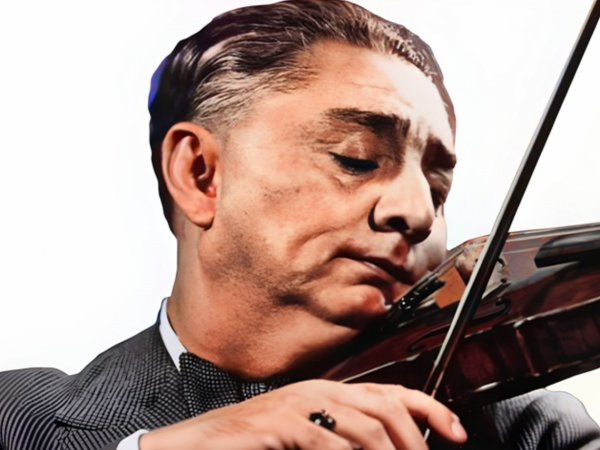
The king of Bucharest’s lăutari was expelled from the Conservatory but impressed Caragiale and Enescu. The life of Grigoraș Dinicu
- Articles
- 23 MAR 26
A child named Grigoraș was born in the early days of April, somewhere in the Scaune neighborhood of Bucharest. A child who would one day become “The King of the Lăutari,” the creator of the famous Hora Staccato, the musician whom Marlene Dietrich came to hear, and who would captivate the world with his violin.
Who was Grigoraș Dinicu
When Grigoraș Dinicu came into the world in 1889, he was born into a family of Romani lăutari in the Scaune neighborhood of Bucharest. His father, Ionică Dinicu, was a musician who had performed in France and Russia, and a colleague of the celebrated Sava Pădureanu, former violinist for the Tsar, whose name still appears on a champagne label and on one of the most expensive brands of cigars.
Grigoraș’s maternal uncle, Dimitrie Dinicu, studied cello in Vienna, was a Conservatory classmate and friend of George Enescu, first cellist of the Bucharest Symphony Orchestra and Conservatory professor. His mother, meanwhile, ran a small café in the lăutari district.
Early lessons and childhood in the streets of Scaune
Grigoraș took his first violin lessons with Moș Zamfir, an elderly lăutar, and during his childhood in the alleys of the neighborhood, he learned traditional Romanian tunes like Lume, lume soro lume, Arde foc la București, and even Ciocârlia. He also learned that the fingers of a true lăutar are not “blocks of ice,” unlike some self-taught performers who play notes without feeling, as George Sbârcea notes in Ciocârlia fără moarte: Grigoraș Dinicu și Bucureștiul lăutarilor de altădată. In the early years of the 20th century, he sang in the choir at the Scaunele Vechi Church alongside the sons of other lăutari families.
At 13, he heard a symphony orchestra and recorded music for the first time on a gramophone in the home of German musician Rudolf Malcher in Bucharest, who told Dimitrie Dinicu that the boy did not need a violin teacher yet. Between 1902 and 1906, Grigoraș studied violin at the Conservatory, admitted after preparation with Carl Flesch.
The famous expulsion and private mentorship
An episode from those years demonstrates his early determination: wanting to earn money to help his family, Grigoraș secretly joined a pantomime show at La Moși. Unfortunately, Dumitru Dinicu and Carl Flesch came to watch, and from behind the pantomime’s performance, the true violin emerged. Recognizing his talent, Carl Flesch expelled him, but at the same time offered to mentor him privately. Despite the expulsion, Grigoraș did not lose a year at the Conservatory.
In 1906, he performed his graduation exam on the stage of the Romanian Athenaeum, playing Paganini’s Violin Concerto No. 1, earning First Prize. He also included an original composition in the program, Hora Staccato, marking the beginning of a piece that would make him immortal.
Rising fame in Bucharest’s cafés and restaurants
After graduating, Grigoraș became the leader of the house band at the Bufet garden, a favorite gathering of writers and artists, who immediately embraced him. Vlahuță remarked, “Whoever listens to Grigoraș’s violin sees and hears the music at the same time.” At the famous Restaurant Gambrinus, he performed Ciocârlia for the first time at Caragiale’s insistence.
“Grigoraș, boy, play me a Ciocârlia!” Caragiale shouted one dawn.
He spent many years performing at Bucharest’s best establishments and also gave back to the community, playing for typhus patients. His artistry soon attracted the admiration of prominent intellectuals and musicians of the era, including George Enescu. Around this time, Victor Filoti took him to Budapest to play for Lacz Laczi, Hungary’s most renowned lăutar, nicknamed “the prince of lăutari.” After hearing Grigoraș, the prince reportedly exclaimed, “If I am the prince of the lăutari, this Romanian seems to me their true king.”
International acclaim: London and Paris
Grigoraș’s career then took him abroad. Casalli, owner of the Green Park Hotel in London, offered him a contract for his ensemble. There, he became known as “the king of the gypsy players and his band,” and his violin caused a sensation in the British press. From London, he went to Paris, performing at the famed Ambassadeur, where Ciocârlia enchanted both nouveau riche patrons and refined music lovers.
It was in Paris that he met the legendary violinist Jascha Heifetz, who declared Grigoraș Dinicu the greatest violinist he had ever heard. Heifetz requested permission to adapt Hora Staccato as a concert piece, which Dinicu granted. Since then, Hora Staccato, the composition for which Dinicu is primarily remembered, entered concert repertoires under the name Dinicu-Heifetz.
Honors, tours, and recognition
Doors opened wherever he went. Returning briefly to Bucharest, he performed at the beloved Continental Hotel, celebrated by the Philharmonic, and his ensemble won competitions to represent Romania at the International Exhibition in Paris. There, he received a Diploma of Honor, the Ministry of Public Instruction’s Order, and a promotion to officer rank. At the New York International Exhibition, his ensemble performed with Maria Tănase, and for four months, he played at Jean Filipescu’s restaurant, where Marlene Dietrich came to hear him.
Upon returning to Romania after the invasion of Poland, he performed at the Modern Restaurant in Sărindar, drawing listeners like Ionel Perlea and George Enescu. In 1938, he became concertmaster without salary for the Pro Arte symphonic ensemble. Exhaustion from his 1943 tour in Ankara and Constantinople caused a stroke, nearly paralyzing his left hand and making violin performance torturous. Nevertheless, Grigoraș Dinicu persevered, continuing to play with difficulty but never giving up.
Final years and legacy
In 1946, while working at a modest restaurant, Yehudi Menuhin came to see him. Reportedly, he played Ciocârlia for the last time for Menuhin. On March 27, at 10 a.m., Grigoraș Dinicu passed away, and with him, an entire era of lăutari culture seemed to vanish. On his deathbed, he requested that Zigeunerweise by Sarasate be performed at his grave. Though Ionel Perlea attempted to do so, the crowd made it impossible. Instead, the orchestra led by Ionel Budișteanu, “Barbu Lăutaru’s” ensemble, performed Hora Staccato.
Grigoraș Dinicu’s life was a journey from the alleys of Scaune to the stages of Europe, a story of extraordinary talent, resilience, and the ability to turn the violin into a voice that spoke across social and national boundaries. His music continues to remind the world of the genius of Romania’s lăutari tradition and the immortal Hora Staccato that made him a legend.
We also recommend: The history of the first lăutari of Bucharest, Roma slaves of the 14th century: They played until “even the stones were crying”