The history of the first lăutari of Bucharest, Roma slaves of the 14th century: They played until “even the stones were crying”
- Articles
- 30 JAN 26
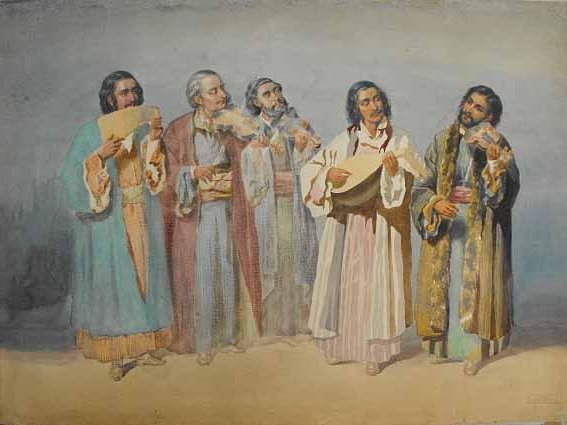
The history of old Bucharest cannot be understood without the sound of lutes, cobzas, and violins that accompanied the life of the city for centuries. Long before music became a free profession, the first lăutari of the capital were Roma slaves, people without rights, but endowed with a gift that made them indispensable: music. From the 14th century until the middle of the 19th century, they sang in princely courts, inns, boyar feasts, and neighborhoods, giving voice to the joys, sorrows, and loves of the people of Bucharest.
The slaves who gave the city its voice
The first lăutari of Bucharest lived and created under the harsh condition of slavery. Until the year 1856, when slavery was abolished in the Romanian Principalities, Roma musicians belonged to the ruling prince, monasteries, or boyars. They did not sing out of pleasure, but out of obligation, yet from this constraint one of the most vibrant musical traditions in the Romanian space was born.
Historian C.I. Ionnescu Gion described with emotion the almost instinctive bond between the Roma and music. He observed how, from very early ages, Roma children reacted to sounds as if music were written into their bodies.
At the sound of a melody, they would stop, bend their bodies toward the direction of the sound, their eyes would sparkle, and their fingers would begin to touch imaginary strings. To contemporaries, this reaction seemed proof that music was not merely a craft, but a way of existence.
The arrival of the Roma in the Romanian Lands
For a long time it was believed that the Roma arrived in the Romanian Lands around the year 1400. Later research showed, however, that their presence is older, dating from around 1300. Along with them came the first organized forms of music, which would decisively influence Romanian folklore.
These people brought instruments, rhythms, and ways of interpretation that, over time, blended with local traditions. From this encounter was born lăutari music, a vivid mixture of improvisation, sensitivity, and expressiveness, which became the soundtrack of old Bucharest.
Princely lăutari and old documents
Historical documents confirm the important role lăutari had as early as the 16th century. C.I. Ionnescu Gion mentions that in the year 1558, in Bucharest, there were lăutari who were slaves of Prince Mihnea Ciobanul, “very renowned for the skill with which they played the lute.”
In princely documents appear the names of lăutari treated as goods of exchange. One document records that the ruler of Wallachia gifted Vornic Dânga of Moldavia with Ruste the Lăutar. In another act, Barcan the Comis is mentioned as having sold Tâmpea the Lăutar for the enormous sum of 4,000 silver coins, a fortune for those times. These testimonies show not only the musicians’ value, but also the tragedy of their status as slaves.
Court music and Fanariot splendor
In the 18th century, Fanariot Bucharest was a city of contrasts: extreme poverty in the neighborhoods and oriental luxury in boyar courts. Music had become an essential element of public life. At the courts of beys and rulers, parade music was in great fashion, with lăutari, pipers, drummers, trumpeters, and lyre players.
The lăutari were organized into guilds and had a chief, officially recognized by the ruling authority. This structure offered them minimal professional protection, although it did not change their social condition. Great boyars kept their own ensembles, and among the most famous, around 1790, were the lăutari of the Golescu family.
Fear of novelty and “unclean” instruments
Any musical novelty aroused suspicion in old Bucharest. At the end of the 18th century, the appearance of the clavier caused real controversies. Some adored it, others called it “the vessel of the devil.” There were cases in which the instrument was smashed with axes or turned into a box for jam jars.
This fear of change shows how deeply traditional the city was, but also how strong the attachment to lăutari music remained, considered authentic and alive.
Songs of love and longing
The lăutari knew how to improvise for every feeling: joy, mockery, pride, or sorrow. Yet love was the theme that set their bows ablaze most strongly. Around the great passions of the time were born songs that circulated for years through the neighborhoods.
One famous love story was that of Vasilache Saegiul and Marica Brezoianca, born Filipescu. Another, widely discussed, was the love of the wife of Alexandru Moruzi for the poet Ienăchiță Văcărescu. All of Bucharest knew that the feelings were not returned, and the lăutari turned the story into a true “hit song” of the time, sung with irony and sighs.
The verses spread quickly, and people hummed them laughing or grieving, depending on the case. Music thus became an oral chronicle of the city.
Songs that made even the bricks weep
Some love stories were so dramatic that lăutari were asked to sing “from the depths of the heart.” Famous was the love of Bălăceanu for Lady Bărcăneasa. The songs dedicated to this passion were filled with sighs and moans so deep that, as Gion wrote, it seemed that even bears and the beams of Bucharest’s bridges were crying.
The expression “cry, lăutar, so that even the brick may cry” became emblematic of the emotional power of music. The lăutar did not merely perform a melody — he lived the story, and the audience vibrated together with him.
The dances and celebrations of the city
Old Bucharest residents worked hard, but they also knew how to enjoy life. The city was full of holidays, and without lăutari there was no real celebration. People danced the sârba, chindia, căzăceasca, gălățeanca, hârlăuanca, rața, arnăuțanca, and zoralia, “as at the tent door.”
The folk calendar was rich: Ignat, Christmas, Brezaia, Vasilca, Vicleimul, the Star, the Sorcova, the Câșlegile, Shrovetide, Saint Toader, Easter, the paparude, and the slaughterhouse festivals. Each event had its own music, and lăutari were always present. Even night games were played by the light of phosphorescent rot from the wooden bridges of the city.
Barbu Lăutaru, the living legend of music
Among all the lăutari of old times, Barbu Lăutaru remains the best-known figure. Born in 1780, a slave on the estate of the boyar Drăgulici, he learned music from his father, who played the fiddle. His exceptional talent raised him above his social condition.
He was the chief of the Moldavian lăutari for forty years and often sang in Bucharest as well. His friendship with Iosif Naniescu, abbot of the Sărindar Monastery, shows the respect he enjoyed even in ecclesiastical circles.
Freedom earned through music
In the year 1808, with the money earned from playing music, Barbu Lăutaru freed his family from slavery — a rare and courageous act for that era. He traveled throughout the country, accompanied boyars on official missions, and carried the fame of Romanian music beyond borders.
His style was a synthesis of Romanian folk song, oriental influences, and Russian romance. This combination made him unique and deeply expressive.
The meeting with Franz Liszt
A legendary moment took place in the winter of 1847 in Iași, when Barbu Lăutaru impressed the great composer Franz Liszt. According to accounts of the time, Barbu reproduced on the cobza, after a single hearing, a melody that Liszt had played on the piano.
The episode was mentioned even in the French press, in the weekly La vie parisienne, confirming the international reputation of the Romanian lăutar.
Barbu Lăutaru in cultural memory
The image of Barbu Lăutaru remained alive thanks to the verses of Vasile Alecsandri, who turned him into a symbol of a vanished world.
The poet captured the melancholy of an artist who had once been “the voice that delighted the world” and who, with changing times, had come to be forgotten on the streets. Through him, the entire history of enslaved lăutari gains face and voice.
The legacy of Bucharest’s lăutari
The enslaved lăutari of Bucharest left no palaces and no written chronicles, but they left something more enduring: music. Through their songs were passed down emotions, stories, loves, and sufferings. They sang until “even the stones were crying,” and the city listened to them for centuries.
After the abolition of slavery, their music continued to live, transforming and adapting, yet keeping the same burning heart. The history of the first lăutari is, in essence, the history of a people who, deprived of freedom, found in song a way of survival and dignity.
We also recommend: The story of the fiddler Fărâmiță Lambru, the accordionist whom artist Maria Tănase “adopted” and “made a man”