The history of Unirii Hall, the food and medicine reserve of the Capital in case of war, built during the time of Alexandru Ioan Cuza
- Articles
- 06 MAR 26
Few places in Bucharest have undergone transformations as dramatic as Unirii Square. In the summer of 1986, this central space, filled with buildings of artistic and historical value, was radically changed. From a coherent urban ensemble, dominated by elegant halls and representative monuments, the area became a uniform commercial platform, subordinated to the new aesthetic imposed by the communist regime. At the center of this story stands Unirii Hall, a building erected in the 19th century, which was not only a commercial space, but also a true strategic reserve of food and medicine for the Capital.
The birth of a modern project in the 19th century
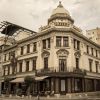
Built during the reign of the ruler Alexandru Ioan Cuza and completed during the reign of King Carol I, the Great Hall – as it was initially known – represented a symbol of Bucharest’s modernization. Inspired by the great covered markets of Paris, the building quickly became an urban landmark and an essential mechanism for supplying the city.
The idea of building a modern hall in the center of the Capital came from the initiative of the French entrepreneur Alexis Godillot, who contracted the work with the Bucharest City Hall. In a period when the city was seeking its European identity, such a project was more than a practical investment – it was a declaration of intention.
The works began during the reign of Alexandru Ioan Cuza, in an era of reforms and structural transformations. The completion of the construction, in 1872, took place under Carol I, at a moment when Romania was consolidating its institutions and infrastructure. Unirii Hall was conceived after the model of the famous Parisian halls, known as Les Halles, glorified by the writer Émile Zola in his novel “La ventre de Paris.” Like its French counterparts, the Bucharest hall was to share, decades later, a similar fate: demolition in the name of urban systematization.
Located near Hanul lui Manuc, the Great Hall was initially intended for the commercialization of meat. The metal structure, the balanced proportions and the large roof turned it into a modern space for that time. It was a harmonious, functional and ingenious construction, adapted to the needs of a Capital in full expansion.
The expansion and completion of the commercial ensemble
Over the following decades, the complex in Unirii Square developed constantly. In 1887 the Fish Hall was built, equipped with special basins for keeping live fish – a remarkable innovation for that era. In 1899 the poultry hall appeared, and later a fruit hall, an ice factory and pavilions dedicated to the sale of vegetables and dairy products were erected.
These extensions transformed the area into a true food center of Bucharest. The diversification of functions and the enlargement of proportions culminated in 1903, when the ensemble was considered complete and perfected. Unirii Hall had become not only a commercial space, but a vital infrastructure for the city.
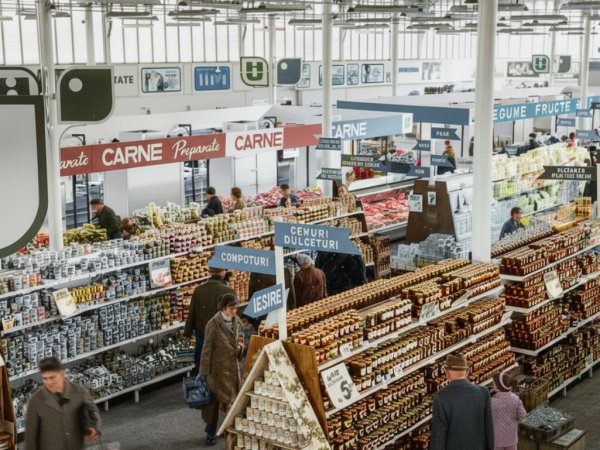
Beyond its aesthetic appearance and the efficiency of its interior organization, the construction had an essential practical quality: it functioned as a huge urban pantry. In the basement, refrigeration installations arranged on several levels ensured the preservation of food in optimal conditions. Over time, these installations were modernized, adapting to technological progress.
In case of war or other disasters, Unirii Hall could sustain the supply of the Capital with food and even medicine. It was, in essence, a strategic reserve, a guarantee of urban survival in an era marked by conflicts and instability.
The refrigeration systems and the strategic role of the hall
Few Bucharest residents knew that beneath the daily bustle of merchants and buyers there was a complex storage system. The basements of the hall were equipped with refrigeration installations that were advanced for their time, capable of preserving tons of food. The arrangement on several levels allowed an efficient organization of stocks, and successive modernizations maintained the functionality of the space until the 1980s.
Even in the summer of 1987, after the demolitions in the area had begun, the installations were still functioning. It was a paradox of history: while the city was destroying its past in the name of an ideological vision, the basements of the hall continued to shelter substantial food reserves.
Under these levels also lived several hundred cats, which had become part of the mythology of the place. With the pouring of the concrete slab over the basement, they were buried together with the memory of an era. This image remained, for many, the symbol of the brutality with which the city’s heritage was treated.
The demolitions of the 1980s and the disappearance of a symbol
The dramatic transformations began in January 1985, with the demolition of Spitalul Brâncovenesc and of the Medico-Legal Institute, buildings of undeniable architectural and historical value. The plan imposed by Nicolae Ceaușescu aimed at “clearing the land” in order to make room for the House of the People and the great Victory of Socialism Boulevard – a grandiose project, but devastating for the old center of the city.
In the summer of 1986, Unirii Square underwent a radical transformation. Biserica Sfântul Ioan Nou, dating from the 18th century, was moved by translation over a distance of 23 meters, using the ingenious method of engineer Eugeniu Iordăchescu. Subsequently, it was hemmed in between massive concrete blocks.
Magazinul Unirea, whose original aluminum and glass façades were still standing, was soon to be modified in order to align with the new socialist aesthetic. In this landscape of permanent construction site, Unirii Hall was the last to be demolished.
According to the testimony of architect Mariana Croitoru, published in the magazine of the Union of Architects of Romania, the demolition took place gradually. First, the sheet metal was removed from the roof, then the metal structure was dismantled. Throughout the summer of 1986, the hall coexisted, as a silent witness of the past, with the new blocks rising threateningly around the square. Until one day, when it disappeared completely.
Between 1986 and 1987, the old hall near Hanul lui Manuc was wiped off the face of the earth, as part of the pharaonic project of systematizing the entire area. In its place a park appeared, which Bucharest residents looked upon with distrust, considering it, symbolically, cursed.
The memory of an urban “pantry”
Unirii Hall was more than a commercial space. It was a strategic infrastructure, an engineering achievement and a symbol of 19th-century modernization. It sheltered food, supported the local economy and ensured a vital reserve for the city in times of hardship.
Its disappearance left a void not only physically, but also symbolically. In a city where memory is often sacrificed in the name of progress, the story of Unirii Hall remains a lesson about the fragility of heritage and about responsibility toward the past.
Today, when we cross Unirii Square, few can still imagine the bustle of the halls, the smell of fresh fish, the cries of the merchants or the coolness of the basements filled with provisions. Yet the history of this place continues to exist, hidden beneath asphalt and concrete, reminding us of a time when Bucharest was building its future without denying its past.
We also recommend: Unirii Square - Bucharest's landmark, renamed 6 times