The Armenian Church in Bucharest, Between History and Myth. Who Founded It 110 Years Ago
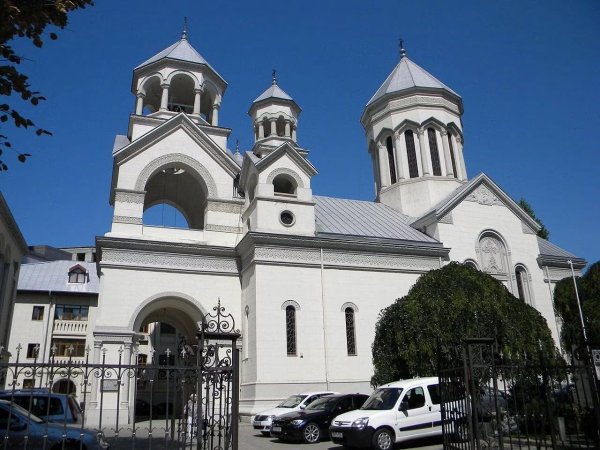
In the heart of Bucharest's old Armenian quarter, on Carol I Boulevard, stands one of the capital's most distinctive religious landmarks: the Armenian Church, dedicated to Saints Michael and Gabriel. Built at the beginning of the 20th century, between 1911 and 1915, the present cathedral of the Armenian community in Romania continues a religious tradition that dates back several centuries. The building is remarkable for its architecture, inspired by the great monuments of Armenian Christianity, as well as for the heritage preserved within the surrounding complex. Behind its walls lies an important part of the memory of Bucharest's Armenian community, while nearby institutions such as the Dudian Museum and Library preserve valuable documents and objects connected with Armenian history and culture in Romania. The history of the present church, however, is more complicated than it might initially appear. It was not built on a site without a past, but on the location of earlier Armenian places of worship. The construction of the cathedral at the beginning of the last century was therefore the continuation of a religious tradition maintained by successive generations.
An old community and the first Armenian churches in Bucharest
The presence of Armenians in Bucharest has been documented for several centuries. According to the Embassy of the Republic of Armenia in Romania, the first Armenian church in the capital, known in some sources as Bărăția, was built sometime between 1581 and 1629 and initially served both Armenian Orthodox and Catholic believers. After the church passed into Catholic administration, the Armenian community continued its religious life through another place of worship.
The history of the site where today's Armenian Cathedral stands is particularly connected with an older stone church built in the 18th century. The National Archaeological Record states that, in 1685, a merchant from Constantinople, Hovianț Harutiun Amira, together with members of the Armenian community, built a stone church, while in 1742 Prince Mihai Racoviță granted the Armenians of Bucharest permission to construct another stone church. That building was later rebuilt after the fire of 1781.
The Union of Armenians in Romania also preserves the memory of Harutiun Amira Hovianț as one of the community's major benefactors. Institutional sources mention several successive Armenian places of worship, built and rebuilt with his support and that of his descendants. The present church should therefore not be viewed as a building that suddenly appeared in 1911, but rather as the latest link in a much older religious history.
Who designed the present Armenian Church
One of the details that requires clarification concerns the authorship of the project. Some older accounts have attributed the construction exclusively to architect Dimitrie Maimarolu, one of the most important figures in Bucharest architecture at the end of the 19th and beginning of the 20th centuries.
Institutional sources belonging to the Union of Armenians in Romania and the National Archaeological Record, however, identify Dimitrie Maimarolu and Grigore C. Cerchez as the architects of the present church. The same attribution appears in specialized documentation published by the Museum of the Municipality of Bucharest.
Dimitrie Maimarolu was already well known for his projects in Bucharest, while Grigore C. Cerchez, an architect of Armenian origin, had a direct connection with the community that would use the new building. Their collaboration also helps explain the building's distinctive character: the project combines the experience of Romanian architecture at the beginning of the 20th century with clear references to Armenian architectural traditions.
The foundation stone was laid in July 1911, and construction continued for approximately four years. The National Archaeological Record dates the construction from 1911 to 1915, while the Union of Armenians in Romania states that the building was completed on September 6, 1915.
Architecture inspired by Etchmiadzin
The present Armenian Church is not simply an adaptation of Romanian ecclesiastical architecture. Its overall design and appearance were developed from the tradition of major Armenian churches, with sources from the Armenian community identifying Etchmiadzin Cathedral, in Armenia, as an important model. Etchmiadzin is one of the principal spiritual centers of Armenian Christianity.
The building stands out through its powerful volumes and its composition inspired by Armenian ecclesiastical architecture. The church has a basilical structure combined with a central composition dominated by the main dome. The bell tower and secondary volumes complete the silhouette of the building, which is visibly different from the Romanian Orthodox churches constructed during the same period.
The interior further contributes to the building's distinctive character. The church contains religious paintings and representations that preserve the spiritual memory of the Armenian community. It is therefore not merely a place of worship, but also a space in which Armenian tradition, the history of the Bucharest community and religious heritage come together.
The Dudian Museum and the heritage surrounding the cathedral
One of the most important elements of the Armenian complex consists of the cultural institutions located immediately around the church. Opposite the entrance stands the Armenian Cultural Center, while the complex also includes the Dudian Museum and Library, institutions that preserve objects connected with the history and culture of Armenians in Romania.
The Dudian Museum's collections include books, manuscripts, religious objects and other heritage pieces. Their presence transforms the area around the church into a genuine center of community memory. For visitors, the experience of the site therefore goes beyond admiring the architecture of the building and can continue through the discovery of documents and objects illustrating the history of Armenians in Romania.
The courtyard of the complex also contains a bust of General Andranik, one of the important figures in Armenian history. The monument, made of bronze by sculptor H. Torosian, represents General Andranik Ozanyan, a figure who became a symbol of the Armenian national struggle. A khachkar, a traditional Armenian cross-stone, is also located here and is dedicated to the memory of the victims of the Armenian genocide.
A church affected by aggressive urban development
The recent history of the monument demonstrates how vulnerable historic heritage can become in the face of large-scale urban development. At the beginning of the 2000s, construction began immediately next to the Armenian complex on a major office building, known as the Millennium Business Center.
Technical documentation concerning the church's structural consolidation records the effects caused by the infrastructure works associated with the modern building. Losses of soil material resulted in differential settlement of nearby structures, with recorded values ranging from approximately 0.5 to 7–8 centimeters. Among the affected buildings were the church, the parish house and the cultural buildings belonging to the Armenian complex.
As a result of these problems, consolidation and restoration works became necessary. Documentation from 2002–2003 shows that the interventions involved the Armenian Cathedral as well as the Armenian School, library and Dudian Museum. For the church, structural consolidation works and the restoration of interior paintings were planned.
Problems involving the modern building next door continued to generate controversy in the following years. In 2009, the Millennium Business Center was severely damaged by a fire, and the flames represented a new danger to the historic buildings located nearby. The incident once again drew attention to the difficult relationship between real-estate development and the protection of historic heritage.
The Armenian quarter and Armenian Street
The church cannot be separated from the neighborhood that developed around it. Armenian Street has been documented since the 17th century and became one of the most important landmarks of Bucharest's Armenian community. Over time, the area surrounding the church brought together homes, shops, religious institutions, schools and community organizations.
The connection between the church and the neighborhood remains visible today. The Armenian complex brings together religious and cultural institutions, while Armenian Street continues to be associated with the community's memory. This continuity has allowed the area to become, in recent decades, an important space for promoting Armenian heritage in Bucharest.
In 2013, the Union of Armenians in Romania, in partnership with the Municipality of Bucharest through ArCuB, organized the first edition of the Armenian Street Festival. The event took place from August 2 to 4 in the courtyard of the Armenian Church, at the headquarters of community institutions, at the Dudian Museum, the Armenian Cultural Center and along the street that bears the community's name.
The festival aimed to introduce the public to the contribution of Armenians to the development of Bucharest in cultural, religious, scientific and political terms, while also presenting Armenian traditions, music and cuisine. The event subsequently became an established cultural occasion, and the 2026 edition was announced as the festival's tenth edition.
A monument preserving the memory of a community
More than a century after its construction, the Armenian Church remains one of the most expressive monuments of modern Bucharest. Its importance does not come solely from its size or architectural appearance, but above all from the historical continuity it represents.
Places of Armenian worship existed on the site of the present cathedral long before the construction of the 1911–1915 building. Generations of believers contributed to preserving this tradition, while the name of Harutiun Amira Hovianț remains associated with one of the key stages in the development of the community. According to institutional and specialist sources, the present building was designed by Dimitrie Maimarolu and Grigore C. Cerchez.
Today, the Armenian Church is simultaneously a place of worship, a historic monument and the core of an important cultural complex. The Dudian Museum, the library, the khachkar, the bust of General Andranik and the community institutions surrounding the church complete the picture of a place where the past has not remained confined to archives.
For Bucharest, the value of this ensemble is particularly important because it recalls the multicultural character of the city. The story of the Armenian Church is not simply the story of a building erected more than a century ago, but also the story of a community that contributed to the development of the capital for hundreds of years. For this reason, the cathedral on Carol I Boulevard remains one of those Bucharest monuments where architecture, faith, memory and community identity meet in a single place.
We also recommend: The Anglican Church, Queen Marie of Romania’s place of faith and prayer. The chalice she gifted still offers communion to the people of Bucharest today