Symbols of Bucharest: Obor Railway Station, the Neo-Romanian Historic Monument in the Eastern Part of the Capital
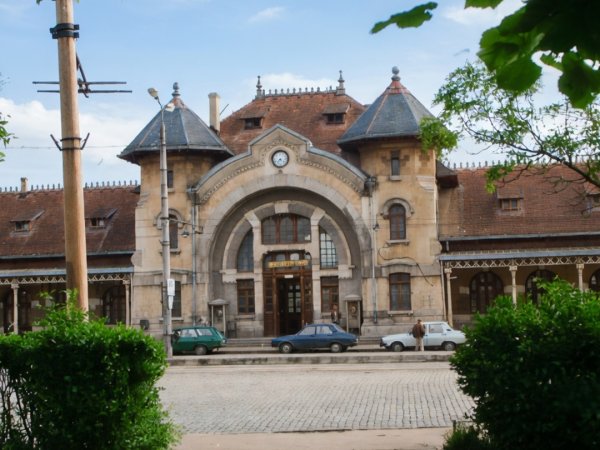
In the eastern part of Bucharest, in an area that has undergone radical changes over the past decades, Obor Railway Station still preserves the image of a capital city from the beginning of the 20th century. Also known as East Railway Station, the building was inaugurated on February 1, 1903, and represents one of the interesting examples of early Neo-Romanian architecture applied to a railway construction. Today, the station is far less busy than Bucharest's major railway stations, yet this very discreet atmosphere allows it to retain part of its old-world charm. Beyond its architectural value, Obor Railway Station also has a special historical significance. In June 1935, 17 railway wagons arrived here carrying from Russia some of the Romanian assets returned as part of the first partial restitution of Romania's Treasury from Moscow. Historical documents show that the shipment included archives, documents, books, heritage objects and other valuable items, but not the gold belonging to the National Bank of Romania.
A railway station built on the outskirts of old Bucharest
At the beginning of the 20th century, Bucharest was undergoing an accelerated process of modernization. Railways had become one of the essential infrastructures of modern Romania, while the city's expansion required stations capable of handling both passenger traffic and freight transportation. Obor Railway Station emerged in this context, on land that, in 1903, was still located on the outskirts of the capital.
The choice of location was not accidental. Its distance from densely populated areas and its proximity to the commercial fairgrounds known as the Obor were important considerations. The station could therefore serve the commercial activities of eastern Bucharest without placing major railway infrastructure in the middle of residential neighborhoods.
The station was inaugurated on February 1, 1903, becoming one of the important components of Bucharest's railway network. Over time, the railway lines in this area provided connections toward the eastern and southeastern parts of the country, while the railway infrastructure around the station became connected to other points in the capital's network.
An interesting aspect of its history is precisely its relationship with urban development. A railway station that had once been built on the outskirts of the city eventually became surrounded by neighborhoods, boulevards and buildings that bear little resemblance to the peripheral landscape of more than a century ago.
Who designed Obor Railway Station
The identity of the building's architect remains one of the mysteries surrounding it. There is no complete consensus among the sources that have attributed the project to different architects. Some sources name Petre Antonescu, one of the most important promoters of Neo-Romanian architecture, while others identify Constantin Giogolea as the architect. There are also heritage sources that simply state that the architect responsible for East Railway Station is unknown.
The Constantin Giogolea hypothesis is supported by biographical information indicating that the architect worked within the New Works Department of the Romanian Railways and was involved in the design of railway buildings. One source dedicated to his biography explicitly associates him with Obor Railway Station, reportedly built under the contracting supervision of engineer Moscovici.
Under these circumstances, definitively attributing the building to one of the two architects should be done with caution. For a historically rigorous presentation, it is more appropriate to mention the disputed authorship rather than present as certain an attribution that is not unanimously accepted.
The architectural style of the building, however, is much less controversial. Obor Railway Station is regarded as an early example of Neo-Romanian architecture and is included in Romania's railway heritage.
The monumental entrance and the charm of Neo-Romanian architecture
Viewed from the outside, the building stands out through its symmetrical composition and monumental entrance. The massive stone archway, with the clock positioned at its center, is framed by two towers that give the building a monumental appearance without making it comparable in scale to the great railway stations built during the same period.
The building has a ground floor and two upper floors, while the steep hipped roofs contribute to the characteristic silhouette of Neo-Romanian architecture. The design combines the functionality of a railway building that was modern for its time with decorative elements inspired by traditional Romanian architecture.
This combination is important for understanding Bucharest's architecture at the beginning of the 20th century. Neo-Romanian architecture was not limited to private residences, schools, institutions or administrative buildings. Its principles were also adapted to structures with technical functions, and Obor Railway Station is one of the examples demonstrating this development.
The platform has also preserved its original metal structure. Although it has been repainted numerous times, the survival of the structure contributes to the value of the complex. The station should not be viewed merely as an isolated building, but as part of a railway ensemble that includes other historic elements.
A railway complex that preserves traces of the past
The value of Obor Railway Station is not limited to the main building. Around it, several elements of the old railway infrastructure have survived, including the water tower, auxiliary buildings and the pedestrian metal footbridge. Some of these structures have considerable technical and historical value because they illustrate how a Bucharest railway complex functioned at the beginning of the 20th century.
Over time, however, the condition of these elements has deteriorated. Heritage sources have repeatedly highlighted conservation problems affecting the auxiliary buildings and installations, in contrast with the relatively good condition of the main structure. The original wooden frames were replaced with PVC windows fitted with insulated glazing, while successive interventions altered part of the building's original appearance.
One of the most difficult moments for the historic building came in May 2007. A fire seriously damaged the roof of part of the station, while firefighters worked for several hours to bring the blaze under control. Contemporary press reports stated that the fire also spread to nearby structures.
Despite these interventions and deterioration, technical assessments have indicated that the main building remains in relatively good structural condition. The station also survived the major earthquakes of 1940, 1977, 1986 and 1990 without suffering major visible structural damage to the main building.
The day when part of Romania's Treasury arrived at Obor Railway Station
Perhaps the best-known chapter in the history of Obor Railway Station is connected with the events of June 1935. Following the normalization of Romanian-Soviet relations, Soviet authorities returned to Romania some of the assets that had been transported to Moscow during the First World War.
On June 16, 1935, 17 freight wagons from Russia arrived at Obor Railway Station. Historical sources do not agree on the exact number of crates: some documents and studies mention 1,436 crates, while other accounts refer to 1,443. According to the National Museum of Romanian History, the route followed by the shipment was Moscow–Odessa–Constanța–Obor Railway Station, and 212 of the crates were subsequently handed over to the National Bank of Romania.
The contents of the shipment were extremely diverse. The returned items included archival documents, maps, manuscripts, books, records, religious objects, paintings, carpets and other belongings of institutions and private individuals. The crates received by the National Bank of Romania contained, among other things, banknotes and materials intended for printing banknotes, as well as various documents and securities.
One important clarification must be made, however: the 1935 shipment did not represent the return of the gold belonging to the National Bank of Romania. The National Museum of Romanian History explicitly notes that neither in 1935 nor in 1956 was the National Bank's gold treasury returned.
Other objects of considerable historical value also returned to Romania during the same period. The restitution represented an important episode in the long and complicated history of Romania's Treasury in Moscow, while Obor Railway Station became the place where some of these assets were received and checked.
The quiet railway station that still preserves Bucharest's memory
Today, Obor Railway Station no longer has the importance it enjoyed during certain periods of Bucharest's railway history. It is far less crowded than Bucharest North Railway Station, and passenger traffic is relatively limited. Nevertheless, the station continues to serve railway transportation and remains connected to routes toward the eastern and southeastern parts of Romania.
It is precisely this quieter atmosphere that gives the station its particular charm. In a Bucharest dominated by modern buildings, busy boulevards and new real-estate developments, Obor Railway Station offers a glimpse of a city that existed before the capital underwent massive expansion. The monumental entrance, towers, clock, metal platform structure and surrounding railway buildings preserve fragments of an era when the railway represented one of the great symbols of modernity.
Several years ago, urban regeneration proposals for the area around Obor Railway Station included the idea of restoring the historic station and transforming it into a railway museum, alongside the construction of a new station. The proposal was part of a broader plan to reorganize the area and make better use of abandoned railway infrastructure.
Until such an initiative becomes reality, Obor Railway Station remains a monument worth seeing beyond its present-day function. It is a building erected at the beginning of the last century, with a still-disputed architectural authorship but a clearly defined stylistic identity. More importantly, it is the place where, in 1935, one of the most remarkable episodes in the history of Romania's Treasury took place. Obor Railway Station is therefore not merely an old railway station in eastern Bucharest, but one of those Bucharest buildings where architecture, history and the memory of the city come together in a way that would be difficult to replace.
We also recommend: Basarab railway station in Bucharest: brief history, major events, its role today