Bucharest Stories: “La trei frunze de viță,” the Tavern Where Romanian Mici Were Said to Have Been Invented
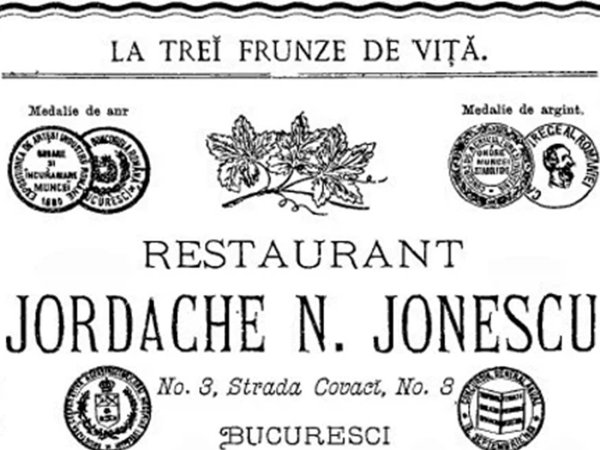
In Bucharest during the second half of the 19th century, Covaci Street was one of the places where the city most vividly displayed its mixture of working-class neighborhoods, merchants, artists, politicians, journalists, and food lovers. Among shops, inns, and taverns, one establishment would become one of the great culinary legends of the capital. It was the restaurant known as “La trei frunze de viță,” “La Iordache,” or, thanks to the humor of satirist Nae Orășanu, “La o idee,” located at 3 Covaci Street. Here, several of the ingredients that made old Bucharest famous came together: Romanian food, local wines, lăutari musicians, satirical journalism, politicians, and a clientele seeking both good food and a lively atmosphere. The establishment also became famous for its mici, and legend has it that it was precisely here, after the kitchen supposedly ran out of sausage casings, that the meat mixture was placed directly on the grill, giving birth to the Romanian mici. The story, however, is more complicated. Historical evidence shows that preparations similar to mici already existed in Bucharest before Iordache's restaurant became famous. Around 1870, the French journalist Ulysse de Marsillac described a “highly seasoned little sausage,” while in 1876 the press was already referring to “cârnații mititei,” or small sausages. Therefore, Iordache can more accurately be regarded as one of the great popularizers and refiners of mici rather than their unquestionably proven inventor.
From a modest tavern to Iordache's restaurant
The history of the establishment is linked to George Ionescu, an entrepreneur from Ciochina, in the former county of Ialomița. He arrived in Bucharest at a very young age, entered the world of commerce, and worked for several years as an apprentice before accumulating enough capital to start his own business. He began with a grocery shop, then moved into the tavern trade and the sugar business, where he would eventually become an important figure.
As his businesses developed, he brought his nephews, Iordache and Constantin Ionescu, into the enterprise. Of the two, Iordache remained involved in the restaurant business and eventually transformed the establishment on Covaci Street into a landmark of late 19th-century Bucharest. Historical sources identify him as Iordache N. Ionescu, owner of the restaurant at 3 Covaci Street, which became famous for its cuisine and the atmosphere created by its lăutari musicians.
The restaurant grew together with its owner's reputation. From a modest tavern with simple furnishings, it developed into a restaurant frequented by people from many different social backgrounds. The food was considered hearty, the portions were generous, and the service became known for its speed and discipline.
A testimony preserved by memoirist Iuliu Moisil describes a bright and pleasant dining room, with staff dressed in white and attentive service. Customers were impressed not only by the Romanian cuisine but also by the unusual names given to dishes and drinks. According to his recollections, a meal at Iordache cost only a few lei, making the restaurant accessible to a relatively broad urban clientele.
Nae Orășanu and the menu that became a legend
The restaurant's fame was not based on its cuisine alone. Nae Orășanu, one of the best-known satirists and journalists of Bucharest in the second half of the 19th century, also played an important role. A regular customer, Orășanu turned the menu into a kind of linguistic comedy.
Instead of simply ordering țuică, water, or coffee, customers could join in the verbal game created around Orășanu. Țuică became “an idea,” water was “a natural one,” a hot pepper was “a fuse,” Turkish coffee was “a chat,” while a mixture of wine and mineral water was called “a battery.” Ordinary sausages were given the name “patricians,” while small sausages became known as “mititei.” These expressions entered the collective memory of Bucharest and contributed significantly to the restaurant's legendary aura.
The establishment eventually became known as “La o idee,” after one of Orășanu's best-known verbal inventions. The atmosphere reflected the bohemian Bucharest of the time: journalists, writers, politicians, and artists could be found around the same tables, in a place where conversation, food, and music were all part of the same urban experience.
Among the personalities who frequented such circles were C.A. Rosetti, Manolache Costache Epureanu, Emil Costinescu, and other important figures from political and cultural life. Iordache was no longer simply a tavern in the old sense of the word; it had become a meeting place for an active and curious Bucharest.
Were mici invented here?
This is where one of the best-known stories in Romanian culinary history begins. According to the tradition recorded later by Constantin Bacalbașa, Iordache's kitchen supposedly ran out of sausage casings one day. In order not to waste the prepared meat mixture and to continue serving customers, the meat was shaped directly and placed on the grill without a casing. The preparation proved successful, and the new dish entered the restaurant's menu in the form of small sausages, or “mititei.”
The story is spectacular and has remained one of Bucharest's best-loved culinary legends, but historical research requires an important qualification. Mici did not appear out of nowhere at Iordache's. Around 1870, Ulysse de Marsillac was already describing, in the garden restaurants along the route between Filaret Railway Station and the Metropolitan Church, a highly seasoned little sausage served with hot peppers. In 1876, the satirical newspaper Ghimpele recorded the consumption of “cârnați mititei” at Eliad's garden in Obor. During the same period, the press was already mentioning “mici” on Covaci Street.
It is therefore difficult to argue that Iordache literally invented the dish. More likely, the restaurant played a decisive role in establishing it, standardizing the way it was served, and, above all, popularizing the name that would eventually become firmly established in Romanian cuisine.
A recipe later recorded by Bacalbașa for the years 1872–1873 also shows that mici already had a culinary tradition. Beef was mixed with suet and seasoned with cumin and allspice, garlic, and meat broth, after which the mixture was grilled. The recipe is quite different from many modern versions, demonstrating that Romanian mici went through a process of transformation before reaching the form familiar today.
From Covaci to the Paris World's Fair
By the final decades of the 19th century, Iordache's restaurant had gone far beyond the status of a neighborhood tavern. Its cuisine had become sufficiently renowned for the establishment's name to be associated with Romania's participation in major international exhibitions.
In 1889, the restaurant's chef represented Romania at the Paris World's Fair, while Romanian dishes and wines attracted public attention. Historical sources dealing with Bucharest restaurants from the beginning of the 20th century specifically mention the restaurant of Iordache N. Ionescu at 3 Covaci Street for its steaks and mici, accompanied by Romanian wines.
In 1900, the restaurant was represented in Paris once again, this time in a context where Romanian cuisine and music went hand in hand. The taraf led by Cristache Ciolac, one of the most important Bucharest lăutari of the period, accompanied the delegation. His presence definitively connected Iordache's name with the world of lăutărească music and the bohemian image of Bucharest.
This combination of cuisine and music became one of the restaurant's defining characteristics. Ciolac performed for cultural figures and politicians, while the restaurant was associated with writers and artists such as Vlahuță, Goga, and Delavrancea. George Enescu, who was deeply interested in lăutari music, also maintained connections with Ciolac and the music he performed.
Iordache, a landmark of Bucharest's culinary world
The restaurant's fame was not confined to its Covaci Street headquarters. The business expanded into other parts of the capital and had seasonal locations at fairs and resorts. The garden in Obor was one of the places where music and food came together, while Ciolac's taraf contributed to the spectacular atmosphere of the evenings.
The restaurant also became associated with highly regarded wines. Around Iordache and his business partners, a commercial network developed that included cellars stocked with local wines, frequented even by demanding customers. Ion Luca Caragiale, one of the great observers of old Bucharest, was among those who appreciated the wines sold there.
After Iordache N. Ionescu's death in 1901, the restaurant's reputation continued to live on in the city's collective memory. A popular pun claimed that at “nea Radu's” in Covaci, a customer could drink until he “became” drunk and then start all over again. Beyond the humor, such expressions demonstrate just how deeply the establishment had entered Bucharest's urban folklore.
War and the end of an era
The First World War profoundly changed life in Bucharest and inevitably affected the activity of restaurants. During the German occupation, food became extremely difficult to obtain, while public life was subjected to severe restrictions. Nevertheless, accounts from the period show that Iordache's restaurant continued to provide, for a limited circle of privileged customers, products that had become almost impossible to find.
In his diary, Vasile Cancicov recorded a meal at Iordache's on May 1, 1917, during the food crisis. Alongside drinks, his account mentions black caviar, chicken, pike-perch, meat, and, above all, the famous mici. It was, however, an experience reserved for a privileged clientele, at a time when Bucharest's population was suffering from shortages and rationing.
After the war, the restaurant's golden age never returned. The business gradually lost the brilliance it had once enjoyed, and the establishment at 3 Covaci Street eventually disappeared from Bucharest's culinary landscape. The name Iordache continued to be associated with other establishments and addresses, but the legend of the great restaurant in the heart of Bucharest had already become part of the past.
Cristache Ciolac, one of the best-known lăutari associated with the establishment, also met a tragic end. After falling ill and suffering paralysis of his right arm, he was forced to give up the violin. He died in Bucharest in February 1927 and was buried in the “Pătrunjel” cemetery, now known as Reînvierea Cemetery in the Colentina district. His death symbolized, in a way, the end of a generation of lăutari who had helped make Iordache's restaurant one of Bucharest's great musical centers.
Today, Covaci Street still bears its historic name, but the atmosphere of that world has disappeared. The restaurant at number 3 is gone, yet its story remains closely linked to one of Romania's most powerful culinary symbols.
“La trei frunze de viță,” or “La Iordache,” cannot be regarded with documentary certainty as the place where mici were invented. Evidence shows that similar preparations already existed in Bucharest before the restaurant became famous. But Iordache played an essential role in establishing mici as a defining feature of the Bucharest restaurant scene, turning them into an emblematic product and helping popularize the name that would eventually become permanently embedded in Romanian culinary vocabulary.
Around the grill on Covaci Street, food, journalism, politics, music, and humor came together. And among all the stories that survived from that period, the tale of meat being placed directly on the hot coals without a casing remains the most appetizing. Perhaps the mici were not born exclusively at Iordache's, but it was there that they became a legend.
We also recommend: Bucharest stories: La Banditu’ Tavern Told the Time in the Apărătorii Patriei Neighborhood in Interwar Bucharest