Bucharest stories: The 1891 cholera epidemic that frightened Ion Luca Caragiale
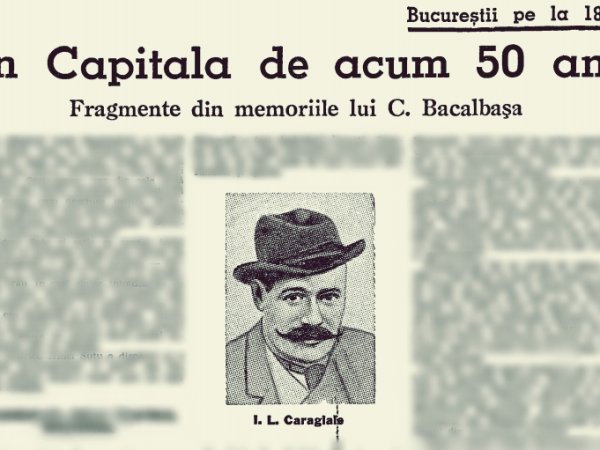
At the end of the 19th century, Bucharest was a city where news of an epidemic could trigger genuine panic. Cholera was among the diseases that inspired the greatest fear, especially because its rapid spread and high mortality made any suspected case a potential threat to an entire community. In the summer of the period described by Constantin Bacalbașa, the atmosphere in the capital was marked by anxiety, rumors and increasingly strict preventive measures. One of the most vivid episodes connected to that period involves playwright Ion Luca Caragiale. According to Bacalbașa's recollections, Caragiale was so frightened by the news of cholera that, late one night, he asked to be accompanied home. The episode took place at Birtul Enache, on Academiei Street, and ended with an unsettling scene involving a man who had suddenly died in a hotel. There is, however, an important historical clarification. Although the story is traditionally associated with the year 1891, the best-documented cholera epidemic that actually entered Romania during this period occurred in 1893. Sources from the sanitary authorities show that 1892 passed without confirmed cholera cases in Romania, while in July 1893 the disease reached the country through Brăila and subsequently appeared in several other localities. Bacalbașa's recollection itself is imprecise regarding the exact year, referring generally to a summer “in the 1890s.”
Cholera, one of Bucharest's great fears
For a city such as Bucharest at the end of the 19th century, cholera represented much more than an ordinary medical problem. The disease could spread rapidly in areas where drinking water was contaminated and where sanitation was inadequate. Bucharest was expanding quickly, but its infrastructure was struggling to keep pace with population growth, making questions concerning clean water, waste disposal, hygiene and housing increasingly important.
The fear was also amplified by the lack of effective treatment. Physicians could provide supportive care and attempt to prevent dehydration, but medical science had not yet developed the modern methods that would eventually make cholera much more manageable. In such circumstances, the arrival of news about an outbreak in another city could be enough to generate widespread alarm.
Romanian authorities had already accumulated considerable experience in dealing with epidemics. During the 19th century, quarantine measures, sanitary inspections and disinfection became increasingly important components of public health policy. By the 1890s, officials were attempting to replace some older forms of terrestrial quarantine with systematic sanitary inspections and disinfection, while maintaining strict controls on waterways and maritime routes.
Bucharest tried to keep the disease at bay
The capital was not isolated from the rest of the country. News, travelers and goods arrived from ports and towns where epidemics could already be present. For this reason, Bucharest's sanitary authorities monitored developments closely and introduced preventive measures whenever there was a threat of contagion.
The Council of Hygiene of Bucharest discussed such measures repeatedly. Documents from the period show that the authorities were concerned with preventing cholera from reaching the capital and with improving disinfection and sanitary practices. The experience of previous epidemics had demonstrated that prevention was often the only realistic weapon available to the authorities.
The situation became particularly serious in 1893. Cholera appeared in Brăila in July and then spread to other points, including Sulina, Tulcea, Galați, Cernavodă and Fetești. In August, new cases were recorded in Călărași and other counties. According to a report by physician Iacob Felix, contaminated water, dirty hands, clothing, footwear and contaminated food could all contribute to the transmission of the disease.
Caragiale, frightened by the news of the epidemic
It was against this background of anxiety that one of the most memorable stories about Ion Luca Caragiale's fear of cholera was recorded. Constantin Bacalbașa describes the playwright as being deeply frightened by the news of the epidemic. The recollection places the scene late at night at Birtul Enache, on Academiei Street, one of the establishments frequented by Bucharest's literary and journalistic circles.
Caragiale was not simply concerned about the possibility of becoming infected. According to Bacalbașa, the fear became overwhelming when the people around him discussed the epidemic and the possibility that cholera might reach Bucharest. The playwright allegedly asked not to be left alone and wanted someone to accompany him home.
The story is especially striking because Caragiale is generally remembered for his sharp observation, irony and ability to turn the weaknesses and fears of society into comedy. In this episode, however, the famous playwright appears not as the detached observer of Bucharest life, but as an ordinary man confronted with the fear of a deadly disease.
A carriage, Regală Street and a sinister coincidence
The episode became even more disturbing on the way home. Bacalbașa recalls that Caragiale and his companion encountered a group of people transporting the body of a man who had suddenly died at the Hotel Union. The sight immediately reinforced Caragiale's fears that cholera had already reached the capital.
The coincidence was particularly frightening because sudden death was one of the images most closely associated with epidemic disease in the public imagination. Yet the man who had died at the hotel had not actually been a victim of cholera. The coincidence was enough, however, to transform Caragiale's anxiety into genuine panic.
The episode illustrates how epidemics affected people not only through the actual number of victims but also through the atmosphere they created. In a city without modern mass communication, information circulated through newspapers, conversations, taverns, markets and public institutions. Rumors could therefore travel almost as quickly as the disease itself.
Bacalbașa's recollection also has to be read as a memoir rather than as an exact medical record. The author himself was writing decades after the events, and the year is not firmly established in the anecdote. Other versions of the story similarly place it vaguely in the summer of the 1890s.
Why the fear of cholera was so powerful
The fear was not irrational. Cholera could kill within a very short period, particularly when patients became severely dehydrated. In the 19th century, the mechanisms through which the disease spread were not yet fully understood by the general population, while access to safe drinking water and adequate sanitation remained major challenges.
The experience of Brăila in 1893 demonstrated the seriousness of the problem. The city lacked a modern sewage system, and water was drawn directly from the Danube. Between July 7 and October 8, 1893, 469 cholera cases were recorded there, of which 290 were fatal. Such figures help explain why news of an outbreak could generate panic hundreds of kilometers away.
For Bucharest, the threat was particularly serious because of the city's dense neighborhoods and uneven sanitary infrastructure. The authorities therefore emphasized disinfection, isolation and sanitary inspections. Temporary hospitals were also considered part of the response to possible outbreaks, while doctors were called upon to improve their practical knowledge of hygiene, disinfection and bacteriology.
The 1893 epidemic and the measures taken by the authorities
The historical record makes 1893 the key year for understanding the cholera threat described in this story. The disease entered Romania through Brăila in July and then appeared in a number of towns and counties. In Călărași, for example, the first case was recorded on August 3, followed by additional cases two days later. Authorities responded through isolation and disinfection, and the local epidemic eventually declined before ending in September.
The measures were part of a broader effort to prevent cholera from reaching Bucharest and other major urban centers. The sanitary authorities monitored suspected cases, controlled movements from affected areas and promoted disinfection. The fact that Bucharest avoided a major epidemic during this period was regarded as an important sanitary success.
Among the preventive recommendations was the treatment of drinking water. Bacalbașa recalls that physician Victor Babeș recommended the use of alum, known in Romanian as “piatră acră,” as part of efforts to make water safer. The anecdote also mentions a small metal device presented in connection with the treatment of water.
Even though some of these recollections belong to the language and medical understanding of the period, they reveal how seriously water quality was regarded. By the end of the 19th century, Romanian physicians and sanitary officials were increasingly aware that epidemics could be controlled only through a combination of medical knowledge, hygiene, disinfection and administrative intervention.
Caragiale, the man behind the characters
The cholera story offers an unusual glimpse into the personality of Ion Luca Caragiale. The writer who observed Bucharest society with extraordinary precision was also capable of experiencing the same fears as the people he portrayed.
His works often expose human weaknesses, vanity, hypocrisy and panic with remarkable humor. Yet the episode recorded by Bacalbașa shows that fear itself could affect even an acute observer of human behavior. In the face of an invisible and potentially deadly disease, irony could easily disappear.
This contrast makes the anecdote particularly valuable from a cultural perspective. Caragiale's reaction does not diminish his reputation as a writer or intellectual. On the contrary, it places him within the everyday reality of his time, when epidemics were not distant historical events but immediate threats that could change the behavior of an entire city.
The story also helps explain why public health became such an important concern in Bucharest during the late 19th and early 20th centuries. The experience of cholera, smallpox and other infectious diseases gradually contributed to the development of modern sanitation policies and to a stronger understanding of the relationship between urban infrastructure and public health.
A story about Bucharest and the fear of epidemics
The episode involving Caragiale and the supposed cholera victim at the Hotel Union has survived because it captures something larger than a single night. It reflects the atmosphere of a city confronted with a threat that could not be seen, easily explained or reliably treated.
The historical chronology nevertheless requires a distinction. The title of this article preserves the year 1891 associated with the source material, but the documented cholera epidemic that affected Romania in this particular period was the one of 1893. In 1892, sanitary authorities were already preparing for the possibility of an outbreak, while in 1893 the disease actually entered the country and spread through several localities.
Whether Caragiale's fearful night took place in 1891, 1893 or another year in that decade cannot be established with absolute certainty from Bacalbașa's recollection alone. What can be established is that the fear of cholera was a genuine part of everyday life in late-19th-century Bucharest and that Caragiale himself was remembered as having reacted strongly to the threat.
The story therefore remains one of those revealing fragments of Bucharest's past in which a famous writer, an old inn, a night-time carriage and a sudden death come together against the background of an epidemic. Beyond the anecdote, it preserves the atmosphere of a city learning, often painfully, that hygiene, clean water and public health could be matters of life and death.
We also recommend: How Ion Luca Caragiale “drove away” Aristizza Romanescu and Constantin Nottara from the National Theatre of Bucharest