Symbols of Bucharest: Cinema Dacia Marconi, Calea Griviței and the relic left from Interwar Capital
- Articles
- 25 MAR 26
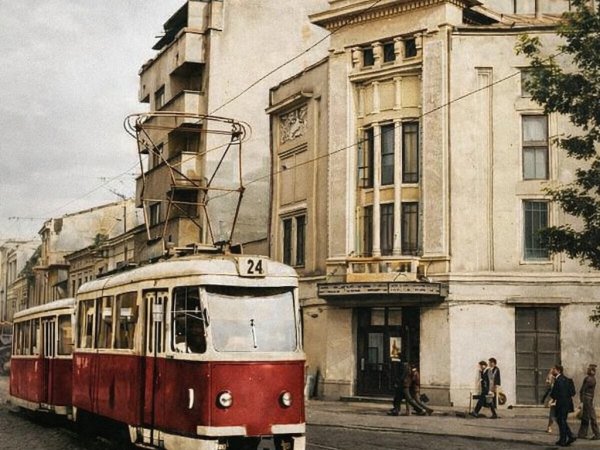
On Calea Griviței, one of the oldest and most historically charged arteries of the capital, at number 137, there is a building which, although today seems forgotten by time, preserves in its walls the echo of a fascinating era. It is about the former Cinema Dacia Marconi, an authentic relic of interwar Bucharest, when the city was living a moment of cultural effervescence and openness toward modernity.
A silent witness of an effervescent era
In the interwar period, Bucharest was often compared with major European capitals, and cinemas had become not only places of entertainment, but true social and cultural centers. In this context, the appearance of a modern cinema, built according to the newest standards of the time, represented a clear sign of urban evolution.
Hidden today among newer or less spectacular buildings, the former Cinema Dacia Marconi remains a discreet but powerful symbol of an era in which film was a collective experience, and going to the cinema had a particular elegance.
The Art Deco architecture and the vision of constantin cananău
The building was authorized in 1926 by the architect Constantin Cananău and inaugurated in 1930, in a period when the Art Deco style was beginning to assert itself in the European urban landscape. The cinema stands out through a sober but elegant architecture, characterized by accentuated vertical lines, a compact volumetry and discreet geometric details.
This type of design reflected the spirit of the era: modern, functional and oriented toward the future. Without being excessively ornamented, the building impressed through balance and proportions, becoming a point of attraction for the inhabitants of the city.
Initially, the cinema bore the name Marconi, a name with technological and modern resonance, probably inspired by progress in the field of communications. In the 1930s, the hall had already become an emblematic space for film screenings, attracting a diverse audience and contributing to the consolidation of urban culture.
The transformations during the communist period
After the establishment of the communist regime and the wave of nationalizations from 1948, the cinema entered a new stage of its existence. In 1951, it was renamed Cinema Alexandr Popov, in line with the ideological orientation of the time and with the Soviet influence over Romania.
Later, on September 24, 1963, the building received the name Cinema Dacia, in a symbolic gesture of cultural “nationalization,” specific to the national-communist discourse. This change of identity was not only a formal one, but reflected the profound transformations through which Romanian society was passing.
Although it lost part of the cosmopolitan aura it had in the interwar period, the cinema continued to function as a popular hall, accessible to the general public. The films screened here had become part of the daily life of Bucharest residents, and the hall remained a place of meeting and escape from everyday reality.
The degradation and abandonment of a historical building
Toward the end of the 20th century, along with political and economic changes, many of Bucharest’s old cinemas began to be abandoned. The same fate befell Cinema Dacia, which was closed and left in neglect.
In the absence of restoration interventions, the building entered an accelerated process of degradation. The façade, once elegant, began to deteriorate, and the decorative elements were affected by the passage of time and the lack of maintenance.
Although it returned to the former owners, the building did not benefit from restoration works, despite the fact that it is included on the list of historical monuments. This situation reflects a broader problem of Bucharest’s heritage, where many valuable buildings are left to deteriorate.
The bas-reliefs and their mysterious symbolism
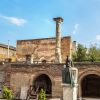
One of the most fascinating elements of the building is represented by the bas-reliefs that decorate the façade. Although today they are heavily degraded, they offer an image of the symbolic richness of interwar architecture.
The depicted scenes have mythological and biblical inspiration, a detail also found on other buildings in Bucharest from that period. These decorative elements did not have only an aesthetic role, but also a symbolic one, suggesting ideas about destiny, morality and the human condition.
The most well-known scene, already entered into urban folklore, is inspired by the Apocalypse, chapter 6. The image of the pale horse, ridden by Death, followed by hell, has become a powerful symbol, which still fascinates passersby today. This representation adds an almost mysterious dimension to the building, transforming it into a space loaded with meanings.
The hope of restoration and the return into the cultural circuit
Surprisingly and, at the same time, encouragingly, in recent years the news appeared about the restoration of the former cinema and its reintegration into the cultural circuit of the city. This initiative represents an important step toward the recovery of urban heritage.
The restoration of such a building does not mean only the reconstruction of a physical space, but also the recovery of a part of the collective memory of the city. Cinema Dacia Marconi is not just a building, but a symbol of an era in which Bucharest was connected to major European cultural trends.
Its reintegration into cultural life could bring a new breath to the area and would contribute to the revitalization of an important historical artery such as Calea Griviței. At the same time, it would offer the inhabitants of the city the opportunity to rediscover a part of their past.
Between past and future: the role of urban heritage
The story of Cinema Dacia Marconi is, in essence, a story about transformation, loss and hope. From a symbol of interwar modernity, to an abandoned building and, possibly, to a culturally revived space, this place reflects the evolution of the city itself.
Bucharest is a city of contrasts, in which past and present often coexist in a tense way. The saving of buildings like this one is essential for preserving urban identity and for transmitting cultural values to future generations.
In the end, Cinema Dacia Marconi remains more than a simple relic. It is a bridge between eras, a testimony of a Bucharest that once was and a promise of a city that can rediscover its heritage. Its restoration would mean not only the saving of a building, but also the reaffirmation of respect for history and culture.
We also recommend: Cinema Volga, Studio Martin and today’s ruins. How one of Bucharest’s oldest cinemas disappeared