Mircea Eliade’s Bucharest: Mântuleasa District, the Cultural Mosaic, the Manta Family, and the Birthplace of the Famous Writer
- Articles
- 09 SEP 26
Few places in Bucharest have managed to gather, within such a limited space, so many layers of history, legend, and literature as the old Mântuleasa district. Today, the neighborhood situated between the city’s former commercial arteries still preserves fragments of the charm of Bucharest in days gone by. Old houses, courtyards hidden behind massive gates, gardens, churches, and buildings erected in different styles create a landscape where Neoclassicism, Neo-Romanian architecture, and interwar Modernism meet. It was in this Bucharest of narrow streets and houses filled with stories that Mircea Eliade grew up and was shaped as a person and writer. Just a few streets away from present-day Mântuleasa Street stood the house with an attic on the former Melodiei Street, now Radu Cristian Street—a place that would remain one of the defining images of his childhood and adolescence. Eliade lived there for approximately twelve years, and in his memoirs he would later emphasize the decisive importance the attic had in his development. Mântuleasa was therefore not merely a street the famous writer knew from childhood walks or from the years he spent at the neighborhood school. Later, the place became one of the gateways through which Eliade transformed real Bucharest into a mythical Bucharest. Through the novella On Mântuleasa Street, published in exile, the old lane entered the geography of Romanian literature once and for all and became one of the best-known spaces in Eliade’s imaginative universe.
From the Outskirts of Phanariot Bucharest to a Merchants’ District
The history of Mântuleasa begins in a period when Bucharest had a completely different configuration. The district was part of a group of settlements that developed in the late seventeenth and early eighteenth centuries near Podul Târgului din Afară, the area now occupied by Calea Moșilor. At that time, it was one of the city’s outskirts, beyond which stretched vacant land and gardens.
Accounts of the great fire of 1739 clearly suggest this peripheral position. The fire, which destroyed a significant part of Bucharest, stopped in the less densely built-up areas near Târgul Moșilor and the lanes developing toward the Olari district. This was therefore the boundary of the densely built city.
The first known documentary mention of Mântuleasa Lane dates from 1707. The street formed part of a longer route connecting the city’s old commercial arteries: present-day Calea Călărașilor, formerly known as Podul Vergului, and Podul Târgului din Afară, today’s Calea Moșilor. Its position explains why the area was inhabited by merchants and craftsmen, whose activities depended on their proximity to the major trade routes.
On old maps of Bucharest, the route appears as a lane crossing an area where large plots of land and cultivated fields still existed. Mântuleasa at that time bore little resemblance to the densely urbanized area we know today. It was a district situated on the boundary between the city and the countryside, a place of gardens, orchards, and households with extensive grounds.
The district developed around the parish of the same name and along Mântuleasa Lane, which held practical importance within the city’s road network. Over time, agricultural land and gardens began to be divided, and the number of houses increased. A record from the late eighteenth century mentions twenty-eight houses in the area, a figure that indicates the still modest size of the district.
The Legend of Mântuleasa and the Story of the Wattle Fence
The name of the street, the district, and the church is connected to the Manta family, one of the wealthy families who lived in the area. Over time, however, local tradition preserved several versions of the story, and documented history became so intertwined with legend that it is sometimes difficult to distinguish reality from oral memory with precision.
One legend refers to a large garden that stood on the site of the present-day Mântuleasa Church. At the far end of the property, there was supposedly a boyar’s house surrounded by outbuildings, stables, storage sheds, and carriage facilities. This image is consistent with the appearance of Phanariot Bucharest, where the estates of wealthy people often occupied considerable areas and included both the main residence and numerous auxiliary structures.
Tradition holds that the Manta family’s property was surrounded by a fence made of woven branches. After nightfall, however, the district was poorly lit, and the numerous, aggressive dogs posed a danger to passersby. Those who traveled along the lane at night supposedly broke off a branch from the fence to defend themselves.
The story was also recorded by historian George I. Ionescu-Gion, who mentioned the Bucharest expression “he took it from Mântuleasa’s fence,” used to describe someone who takes from a place where nothing is left. According to the legend, passersby used the fence so frequently to obtain a stick for protection that eventually almost nothing remained of it.
In another version of the story, a widow known as Mântuleasa, left alone after her husband’s death, decided to build a church in his memory. Illness prevented her from seeing her plan completed. After her death, members of the Manta family supposedly continued the construction.
For generations, these stories formed part of the area’s collective memory. They should nevertheless be treated with caution, since the legendary versions differ from one another and do not always correspond to the information provided by the church’s documents and foundation inscription.
Mântuleasa Church and the Names of Its Founders
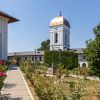
One of the most important landmarks of the old district is Mântuleasa Church, one of Bucharest’s historic places of worship. According to information provided by the parish, the church was built during the reign of Prince Grigore Ghica, and its foundation inscription preserves the names of its principal female founders: Lady Maria, the sister of Manta Cupețul, and Lady Stanca, his wife. The parish dates the building to 1734, and the church is dedicated to Saints Michael and Gabriel, together with Saint Nicholas.
The differences in dating found in some sources result from differing interpretations of the stages of construction and consecration. Historical tradition refers both to 1732–1733, as the period when certain works were completed, and to 1734, the year mentioned in the foundation inscription and in the parish’s current presentation. What is certain is that the church was built in the first half of the eighteenth century, at a time when the district still lay on the outskirts of Bucharest.
The church was built in the tradition of Wallachian architecture influenced by the Brâncovenesc style. It has a cruciform plan, an altar, a nave, and a narthex, as well as a porch supported by columns. The bell tower is positioned above the area separating the narthex from the porch.
There are fewer documents about the Manta family than there are legends that later developed around its name. It is known, however, that Manta Cupețul and his family belonged to Bucharest’s prosperous merchant class. By 1733, Manta was already dead, as suggested by the fact that his name does not appear as a direct participant in the founding act inscribed on the church.
The Mântuleasa area continued to develop after the construction of the church. From a district on the outskirts of Phanariot Bucharest, it gradually underwent the transformations of the following centuries, becoming an increasingly dense urban area with a diverse population and an ever more varied architectural character.
The District That Became an Architectural Mosaic
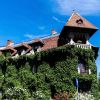
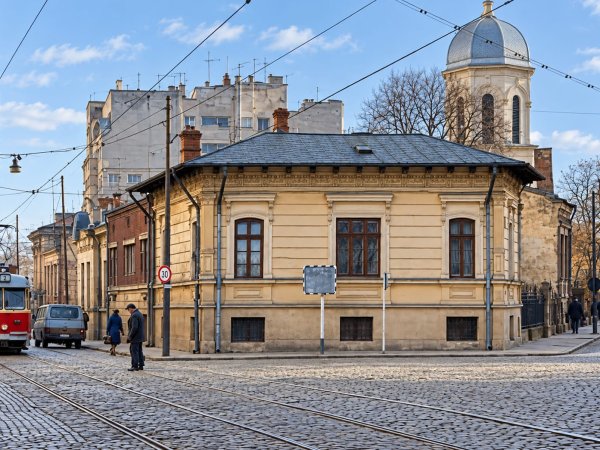
Present-day Bucharest still preserves traces of several historical periods in the Mântuleasa area. The street and its surroundings form a genuine urban mosaic in which nineteenth-century houses coexist with villas and buildings constructed during the first decades of the twentieth century.
Some of the old Bucharest-style households, with houses set deep within their courtyards and small gardens, have survived to this day. Alongside them appeared Neoclassical buildings, houses featuring Neo-Romanian elements, and Modernist structures reflecting the transformation of the capital during the interwar period.
Nearby are buildings of considerable importance to the history of Bucharest’s architecture. The Negustori–Mântuleasa area is often noted for the diversity of its architectural heritage, ranging from nineteenth-century houses to experiments in modern architecture. Present-day Mântuleasa Street is, in fact, only part of the broader historical route of the old lane, whose sections were altered and reorganized over time. Research devoted to the neighborhood has shown how extensively the street’s original configuration changed through successive subdivisions and renamings.
This layering of historical periods explains the area’s particular charm. Mântuleasa is neither a museum district nor an urban ensemble that has remained intact. On the contrary, it is a place where every period of Bucharest’s history has left its mark. It is precisely this blending of past and present that created the atmosphere now associated with the world of Mircea Eliade’s fiction.
Mircea Eliade’s House with an Attic
A few streets away from Mântuleasa, on the former Melodiei Street, stood the house where Mircea Eliade spent a decisive part of his childhood and adolescence. Today, the street is called Radu Cristian Street, and the former house no longer exists.
The Eliade family settled in the house on Melodiei Street, and Mircea Eliade lived there during the years in which his intellectual formation took place. In his memoirs, the writer speaks of the attic to which his family moved permanently in 1919 and of the two rooms that, in his own words, played a decisive role in his life.
The house extended toward several streets and had an unusually large courtyard and garden. The attic, with its small windows and the distinctive atmosphere of its low-ceilinged rooms, would become one of the symbolic images of Eliade’s autobiographical universe.
The house was demolished during the interwar period, and the building that now stands at that address was later erected in its place. A commemorative plaque was installed on the building, recalling that it was once the site of the “house with an attic” where Mircea Eliade created his early works.
For Eliade, however, the house was not the only important place. His childhood was connected to the entire neighborhood. He attended the school on Mântuleasa Street, and this part of Bucharest remained present in his memory long after he left Romania.
How Eliade Transformed Mântuleasa into a Mythical Place
The worldwide fame of Mântuleasa Street is now associated above all with Mircea Eliade. The novella On Mântuleasa Street transformed a real lane into a literary space charged with mystery, where ordinary time begins to fracture and reality seems to conceal a dimension inaccessible at first glance.
In Eliade’s fantastic fiction, Bucharest is not merely a backdrop. The city becomes a living organism, while streets, houses, courtyards, and cellars can become points of passage toward other levels of reality. Mântuleasa is one of the most important examples of this mythical geography.
The real place and the imagined place overlap without being identical. Eliade did not seek to write a documentary history of the street; rather, he sought to recover what he regarded as a place’s deeper truth: its memory, symbols, and capacity to preserve the traces of vanished lives.
In this sense, the old district was perfect for his literary universe. Mântuleasa already had its own history, legends, and areas of mystery. It had an old church, stories about orchards and wattle fences, houses built in different periods, and an atmosphere in which the modern city had not yet managed to erase the past completely.
That is why, when we speak today of Mircea Eliade’s Bucharest, Mântuleasa occupies a special place. The writer was not born on this street, but his childhood and adolescence unfolded nearby, and the years he spent in the neighborhood provided the living material from which he would later construct one of the most fascinating urban mythologies in Romanian literature.
The Mântuleasa district thus remains a place where history and fiction do not exclude one another. Beyond the legends about the Manta family, the church built in the first half of the eighteenth century, and the urban transformations of the past three centuries, there is also Mircea Eliade’s Mântuleasa: a real street that, through literature, became more than a street.
Today, a walk through the area means a journey through several Bucharests. It is the Bucharest of the Phanariot outskirts, of merchants and craftsmen, of nineteenth-century houses, of interwar Modernism, and of the childhood of a writer who would become one of the world’s best-known historians of religion. And somewhere among these layers of time, old Mântuleasa continues to exist, preserving in its architecture and stories a part of the city that shaped Mircea Eliade.
We also recommend: The passions of the nearsighted teenager of Bucharest: Mircea Eliade rowed on the Danube, climbed mountains, and played oina in the neighborhood