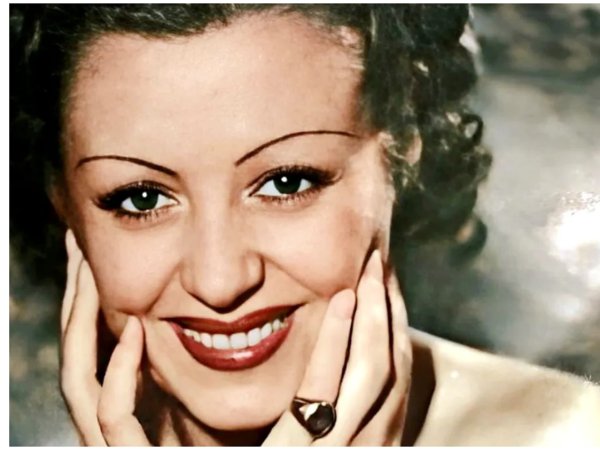
Mia Apostolescu, the diva of interwar Bucharest, the right hand of Constantin Tănase. The story of the stunning cupletist from Cărăbuș
- Articles
- 11 DEC 25
Mia Apostolescu remains one of the emblematic figures of Romanian theatre from the interwar period, a name that made history on the stage of the famous “Cărăbuș” theatre and on many other stages across the country. Considered a presence both fascinating and unmistakable, she stood out not only through her vibrant beauty, but also through a special talent that made her one of the most beloved artists of her time.
The rise of an unparalleled artist in interwar theatre
Cheerful, expressive and full of contagious energy, Mia Apostolescu conquered the public like no one else, turning each appearance into a true artistic event.
In that era, her contemporaries saw her as a true “universal bomb”, a force of nature that electrified the stage at every performance. Her place in revue theatre was so important that many considered her the “right hand” of Constantin Tănase, the director and soul of the “Cărăbuș” theatre. This appreciation came not only from her musical or acting talent, but from the real contribution Mia Apostolescu brought to the extraordinary success of the revue movement of that period.
The talent that redefined the Cărăbuș stage
Mia Apostolescu was recognized as the most inspired and most appreciated cupletist of the “Cărăbuș” theatre, a complete artist, capable of transforming the simplest couplets into memorable moments. The well-known theatre critic Al Lazăr wrote about her in a 2012 recollection that she was “beautiful, intelligent and talented, Tănase’s right hand and his comic counterpart.”
The description continued with a true ode dedicated to her talent: “A scatterbrain, a madwoman, a reckless whirlwind, a wildly uninhibited one, a wonder of couplets. Angel and demon, passion and temptation, charm and seduction, all in one, a universal bomb that exploded at every performance.”
This portrait captures the essence of an artist for whom the stage was pure life. Mia Apostolescu had the rare ability to uniquely combine stage energy, fine irony, dance, music and theatrical expressiveness, succeeding in creating a personal style, immediately recognizable. Each of her roles was an explosion of expressiveness, and the public, captivated by her charm, always returned to see her again.
But her talent did not stop at couplets. Mia was also a formidable comedy actress, with a magnetic stage presence. Her entrances alone were enough to capture everyone’s attention, and the way she built her characters demonstrated a deep understanding of the mechanisms of comedy. All these qualities explain why she rose so quickly into the elite of revue theatre.
The unique partnership with Constantin Tănase
One of the strongest artistic alliances of the interwar period was the one between Mia Apostolescu and Constantin Tănase. At “Cărăbuș”, Mia was not just a successful actress, but a cornerstone for the shows led by Tănase. Her flawless professionalism and dedication to her craft transformed her into an ideal partner for the great actor.
In the plays “Ura, Cărăbuș!” and “Lozul Cărăbușului”, Mia Apostolescu offered remarkable performances, solidifying her status as a star of revue theatre. Together with Tănase, she formed an artistic duo that magnetized the public. The two complemented each other impeccably: Tănase was the master of satire and situational comedy, while Mia brought freshness, femininity, dynamism and a stage play that elevated every scene to a higher level.
During this period, she became not only a beloved actress, but also an influential personality in the artistic world. Her colleagues respected her, the public idolized her, and “Cărăbuș” increasingly tied its image to her incandescent presence.
An emblematic presence of revue theatre
Mia Apostolescu not only played, she literally “blossomed” in every play in which she appeared. Together with Lisette Verea, Nae Roman, Elena Zamora, Sergiu Malagamba and the famous duo Stroe and Vasilache, Mia was part of an elite of interwar theatre that elevated the revue genre to the rank of national art.
A famous episode in her career is the encounter with the world cinema legend Charlie Chaplin, which took place in Paris, in a restaurant. Mia was together with Tănase and his wife, and the moment turned into a memorable meeting, in which the two great artists – Tănase and Chaplin – danced and talked at length.
The anecdote recorded by Ioan Massoff and Radu Tănase shows Tănase’s proud reaction when a waiter introduced him as an American: “Please tell him I am Romanian… Roumain… an artist from Bucharest… Bucharest… comprenez?”
Mia was present that historic evening, as part of Tănase’s artistic family.
The loyalty that saved “Cărăbuș”
A truly dramatic moment for the “Cărăbuș” theatre was the devastating fire on Christmas Eve 1938, which broke out during the premiere of “Poftă bună la Tănase!”. The building was burning, and the troupe watched helplessly as the place that had been their “home” for years collapsed.
In that chaos, Mia Apostolescu rose as a symbol of devotion. Determined, shaken, but full of courage, she is said to have exclaimed: “How could we abandon Cărăbuș? It is our bread, our life, our home, our love!”
Moreover, she offered with moving sincerity her own jewelry and furs for the reconstruction: “I will sell all my furs and jewelry from my ‘pheasants’.” It was an exceptional gesture, the ultimate proof of her attachment to the theatre and to Constantin Tănase.
The show was moved to the Savoy hall, and Mia followed the troupe on tours in the Orient – Istanbul, Cairo, Beirut, Tel Aviv, Jerusalem – demonstrating a resilience that became legendary.
The final years of a legend
After the death of Constantin Tănase in 1945, Mia Apostolescu continued to perform in shows such as “Răbdare, Tănase”, “Nu te lăsa, Tănase!” and “Gioconda la Savoy”. Although the absence of her lifelong artistic partner was deeply felt, she remained an important presence on Romanian stages, keeping the revue tradition alive.
Today, Mia Apostolescu is regarded as a reference figure of Romanian theatre, a complete artist who surpassed through talent and personality the limits of her time. Her devotion, inner strength, professionalism and stage magnetism transformed her into a symbol of the interwar era.
Her legacy lives on in collective memory: Mia Apostolescu is the diva who redefined revue theatre and forever became “the star of Cărăbuș”, the woman who knew how to transform every role into an explosion of charm and authentic art.
We also recommend: The Great Constantin Tănase, the Poor Boy Who Put Bucharest on the Map of Romanian Theater. He Put Cardboard in His Shoes and Ran Across the City for a Pretzel