June 25, 1984, the day Bucharest tried to outshine Paris in grandeur: construction began on the House of the People and the boulevard meant to surpass the Champs-Élysées
By Raluca Ogaru
- Articles
- 25 JUN 26
On June 25, 1984, the Ceaușescu regime officially marked the beginning of one of the largest urban projects in Bucharest’s history: the construction of the House of the Republic, later known as the House of the People and today as the Palace of Parliament, along with “Victory of Socialism” Boulevard, now Unirii Boulevard. It was the moment when the center of Romania’s capital entered a radical stage of transformation, driven by the ambition to create a new monumental political and administrative center, inspired by the grand urban axes of totalitarian regimes.
The project did not simply mean the construction of a huge building and the creation of a wide boulevard through the city. It meant demolitions, the forced relocation of many residents, the disappearance of old neighborhoods, and the permanent transformation of a significant part of historic Bucharest. Behind the image of grandeur stood one of the harshest urban interventions of the communist period.
How the project that changed central Bucharest began
The House of the Republic and “Victory of Socialism” Boulevard were designed as the central elements of the new Civic Center. The Ceaușescu regime aimed to concentrate the most important state institutions in a newly built area, one that was controlled both urbanistically and symbolically, and very different from old Bucharest, with its narrow streets, historic houses, and neighborhoods that had developed organically over time.
The earthquake of March 4, 1977, was used as a turning point for this reshaping of the city. After the disaster, Nicolae Ceaușescu summoned specialists and architects to discuss the construction of a new political and administrative center. The Dealul Spirii-Uranus area became central to the plan, as it was considered suitable for the large-scale new buildings.
Before the Palace of Parliament came to dominate the area, the Uranus neighborhood stood there, with sloping streets, old houses, buildings of architectural value, and an urban life typical of old Bucharest. It was an area inhabited by merchants, craftsmen, small business owners, and middle-class families.
The transformation did not happen naturally, through gradual development, but by erasing a large part of the city. In the 1980s, the demolitions affected not only Uranus, but also other old areas in the center of the capital. In their place came construction sites, wide boulevards, massive apartment blocks, and spaces designed to represent political power.
The House of the People, the building meant to concentrate power
The Palace of Parliament was built during Nicolae Ceaușescu’s rule, at a time marked by severe economic hardship for the population. The regime’s idea was for this building to bring together the main state institutions in one place and function as a symbol of communist political power.
The building has dimensions that are difficult to match: 365,000 square meters of total built surface, 270 meters in length, 245 meters in width, and 84 meters in height above ground level. According to official data from the International Conference Center of the Chamber of Deputies, the Palace of Parliament is recorded as the largest administrative building for civilian use, the heaviest administrative building, and one of the most expensive administrative buildings in the world.
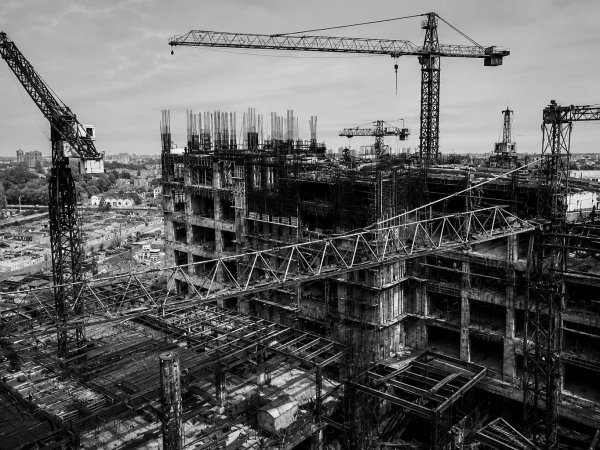
Almost entirely Romanian materials were used in the construction: marble, cement, steel, crystal, wood, glass, and carpets produced in the country. The construction site mobilized more than 100,000 people, and during peak periods nearly 20,000 workers were working in three shifts, day and night. Between 1984 and 1990, thousands of soldiers also took part in the construction.
In December 1989, the building was not finished. According to the same official source, at the time of the Revolution, the works were approximately 60% completed. After the fall of the communist regime, the building’s role changed: in 1993, the seat of the Chamber of Deputies was established in the House of the Republic, and later the building also came to host other institutions, including the Senate, the Legislative Council, and the Constitutional Court.
“Victory of Socialism” Boulevard, the socialist answer to the Champs-Élysées
In parallel with the Palace of Parliament, the regime laid out “Victory of Socialism” Boulevard, today’s Unirii Boulevard. The artery was meant to connect Constitution Square to Alba Iulia Square, crossing Unirii Square, and to function as the monumental axis of the new socialist Bucharest.
The regime’s ambition was for the boulevard to surpass the famous Champs-Élysées in Paris in grandeur. This is where one of the best-known comparisons related to Bucharest in the 1980s comes from: the idea that Ceaușescu wanted to build an avenue that was larger, wider, and more imposing than the Parisian one.
The boulevard was not designed as an ordinary street, but as an urban stage for power. Its width, the perspective toward the House of the People, the massive apartment blocks, and the fountains placed along the axis were all meant to create a sense of monumentality. Everything was designed for ceremony, visual control, and the impression of strength.
Its original name, “Victory of Socialism,” clearly reveals the message the regime wanted to send. After 1989, the artery became Unirii Boulevard, and the political meaning of the name disappeared. The urban form, however, remained the same: a massive intervention cutting through the city and recalling one of the most aggressive periods of systematization in the capital’s history.
The urban cost of a project of grandeur
The construction of the House of the People and “Victory of Socialism” Boulevard permanently changed the face of Bucharest. To make way for the new Civic Center, neighborhoods, houses, streets, churches, and public buildings were demolished. An important part of the city’s memory disappeared in a short period of time, under the pressure of a political project that sought to replace old Bucharest with a monumental official setting.
Historical and journalistic accounts of that period speak of thousands of houses wiped off the map and tens of thousands of people relocated. Beyond the numbers, the impact was profound: uprooted families, broken communities, and a loss that remains difficult to recover for the capital’s urban heritage.
This transformation remains one of the most controversial in the history of the city. For some, the Palace of Parliament is today a tourist landmark and one of the best-known buildings in Romania. For others, it remains the symbol of a period when the city was redesigned without consulting its residents and without respect for the history of the place.
Both realities coexist. The Palace of Parliament is today the seat of democratic institutions and a tourist attraction, but its origin remains tied to an authoritarian project, born in a context of political control, personality cult, and economic sacrifices imposed on the population.
What remains today of June 25, 1984
The date of June 25, 1984, marks in Bucharest’s history not only the beginning of a construction site, but the beginning of an irreversible urban transformation. The House of the People and “Victory of Socialism” Boulevard were built to express the power of the Ceaușescu regime, but after 1989 they came to be reinterpreted in a different political and social context.
Today, the Palace of Parliament is one of Romania’s most visible buildings, while Unirii Boulevard is one of the capital’s major arteries. Still, every look toward this area also recalls the vanished neighborhoods, the people who were relocated, and the way Bucharest was forced to change its face.
READ ALSO:
Unirii Square - Bucharest's landmark, renamed 6 times
In place of old Bucharest, the communist regime wanted to build a city of official grandeur. It succeeded in leaving behind a huge building and a monumental boulevard, but also one of the most painful ruptures in the capital’s urban memory.
PHOTO: rezistenta.net