How Santa Claus was transformed into Father Frost in communist Romania
- Articles
- 22 DEC 25
Christmas represents one of the deepest and most meaningful holidays in Romanian culture, a blend of faith, tradition, family, and identity. During the communist regime, however, this celebration was subjected to a forced process of reinterpretation, as the authorities attempted to eliminate its religious dimension and adapt it to the official ideology, which was atheist and strictly controlled. The transformation of Santa Claus into Father Frost is one of the most visible and symbolic expressions of this approach, affecting not only the winter holidays but also the spiritual life of Romanians.
Christmas under the suspicion of communist ideology
After the establishment of the communist regime, Christmas quickly became a problem for the authorities. Being a deeply Christian holiday, associated with the Birth of Jesus Christ, it directly contradicted the official doctrine, which promoted atheism and rejected any public religious manifestation. The communist state regarded Christmas not only as a holiday, but also as a potential instrument of “negative ideological influence.”
In this context, religious traditions were marginalized, and public manifestations related to Christmas were discouraged or even banned. Carols, religious services, and Christian symbols were removed from the public space, while the press and official propaganda avoided any reference to the spiritual significance of the holiday.
Nevertheless, for most Romanians, Christmas remained an emotional and identity landmark, closely tied to family and to the continuity of values passed down from generation to generation.
The silent resistance of family traditions
Despite the pressure exerted by the regime, the authentic spirit of Christmas did not disappear. It largely withdrew into the private sphere, becoming a form of silent resistance. People continued to decorate the Christmas tree, prepare traditional meals, and gather with their families, even if they did so discreetly and cautiously.
Carols were sung in whispers, within small circles, and attending church on Christmas night was often an act of courage. For many Romanians, the holiday was no longer just an occasion for joy, but also an affirmation of personal identity and faith. Thus, Christmas acquired an additional dimension, becoming a symbol of subtle opposition to totalitarian control over spiritual life.
The attempt at reinvention: “The Winter Holiday”
In the 1950s, the authorities tried a different strategy: not the complete elimination of the holiday, but its “rebranding.” In 1959, Christmas was officially presented under names such as “The Winter Holiday” or “The Winter Solstice Holiday.” The idea was to preserve a form of festivity, but one entirely devoid of religious content.
This approach aimed to channel people’s need for celebration into an ideologically controlled framework. However, the attempt did not have the desired effect. Christian traditions and popular customs were too deeply rooted to be erased by mere changes in name. In Romanian homes, Christmas continued to be Christmas, even if officially it no longer bore that name.
Christmas leave and the control of free time
A significant moment occurred in the 1960s, when Romanians obtained the right to time off during the Christmas period. This decision was perceived as a concession by the regime, meant to reduce social tensions and to offer the impression of relative normality. Nevertheless, this freedom was closely supervised.
The authorities monitored how people spent their free time, remaining vigilant toward any religious manifestation considered “excessive.” Even in this context, Christmas leave represented for many Romanians an opportunity to renew family bonds and preserve traditions, even if in forms adapted to the political climate.
The appearance of Father Frost, a symbol of ideology
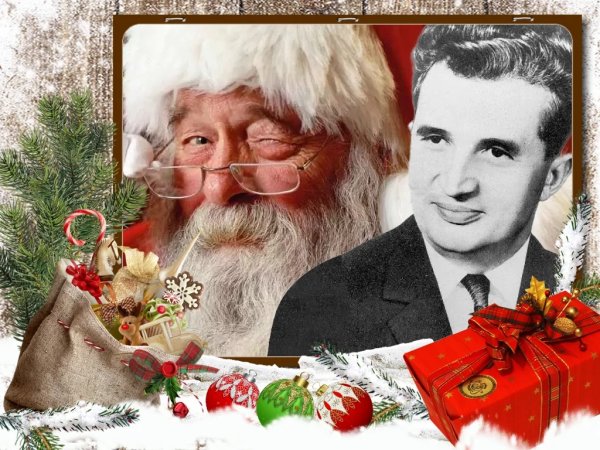
The most visible attempt to replace traditional Christmas was the introduction of the character Father Frost. Emerging in official discourse in the 1970s, Father Frost was a secular figure, inspired by the Soviet model, meant to substitute Santa Claus. This character had no connection to religion or to the Nativity, being presented instead as a “progressive” old man dedicated to educating children in the spirit of socialist values.
Father Frost brought gifts to children, but these were symbolically conditioned on their promise to become model citizens of socialist society. In propagandistic discourse, he was described as having the ability to observe children’s behavior and to “report” any deviations from the norms imposed by the regime. Thus, his figure acquired not only an educational role, but also a subtle coercive one.
The failure of an artificial symbol
Despite the authorities’ efforts, Father Frost failed to truly establish himself in the collective consciousness. For most Romanians, he remained an artificial character, lacking emotion and authentic cultural roots. Santa Claus, with all his symbolic and emotional weight, continued to exist within families, even if his name was sometimes spoken cautiously.
This situation generated a form of silent resistance, in which people outwardly complied with official requirements, while preserving their traditions in the private sphere. Paradoxically, the regime’s attempt to control the winter holidays strengthened attachment to authentic Christmas and reinforced the sense of community.
Communist Christmas, between adaptation and continuity
Christmas in communist Romania was, in essence, a mixture of compromise and resistance. On the one hand, people were forced to adapt to a restrictive political framework; on the other hand, they found ways to keep the essence of the holiday alive. The Christmas tree, the family meal, carols, and gifts continued to exist, even if sometimes under different names or forms.
The introduction of Father Frost remained an ephemeral episode, an ideological experiment that failed to replace authentic tradition. After the fall of the communist regime, Santa Claus naturally returned to the public space, a sign that the bond between people and their values had never truly been broken.
A legacy of cultural resilience
Today, Christmas in Romania is a holiday full of emotion and meaning, carrying within it the memory of a difficult period. The story of the transformation of Santa Claus into Father Frost is not merely a historical chapter, but a lesson about the power of people to preserve their cultural identity in the face of political pressure.
In conclusion, Christmas during the communist period was more than an ideologically adapted holiday; it was proof of resilience, hope, and solidarity. Even under the most restrictive conditions, Romanians managed to keep the joy of Christmas alive, demonstrating that authentic traditions cannot be erased by decrees or propaganda, but continue to live in the hearts of people.
We also recommend: The history of Hala Laminor in Bucharest, from the Malaxa factories to today’s Christmas market