How Saint George Inn disappeared. The story of a lost symbol of old Bucharest
- Articles
- 25 MAR 26
The history of Saint George Inn in Bucharest does not begin, as one might think, as a story about trade and urban bustle, but as one deeply connected to spirituality and monastic life. At its origin stands the monastery with the same name, whose first forms of organization appear in the second half of the 16th century, during the reign of Alexandru II Mircea, between the years 1568 and 1574. In that period, Bucharest was still a city in formation, and constructions had rather a utilitarian and defensive character than a monumental one.
The beginnings of a construction with monastic roots
The first cells built here had the role of supporting the life of the monks and of creating a stable religious nucleus in a city in continuous change. Over time, this nucleus was to attract not only believers, but also economic interests, since its positioning inside the city made it ideal for the development of commercial activities.
The slow transformation of the monastery into a complex ensemble was determined by the interventions of influential figures of the time. Among them was the dragoman Panaiotache, but especially the ruler Constantin Brâncoveanu, whose ambitious vision radically changed the appearance of the place. Under his patronage, the construction was expanded and consolidated, becoming an imposing edifice for that time.
The transformation into a first-rank commercial center
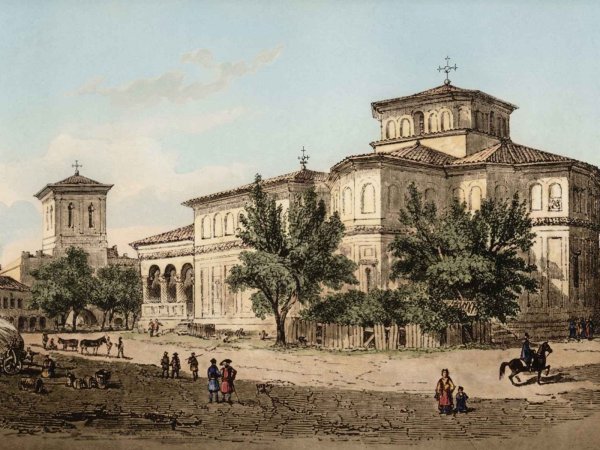
Around the year 1698, the ensemble began to acquire a new function: that of an inn. This transformation was not a sudden one, but the result of a natural evolution, in which the monastic space adapted to the economic needs of the city. By 1706, when the expansion works were completed, Saint George Inn had already become one of the most important commercial points in Bucharest.
The construction impressed through its dimensions and organization. The two rows of vaults, the large courtyards and the spacious cellars offered excellent conditions for the storage and trading of goods. The merchants who arrived here brought products from important areas of European and Oriental trade, such as Leipzig, Galați or Constantinople, turning the inn into an essential economic node.
The atmosphere was intense and diverse. Prosperous merchants, coming from different corners of the world, negotiated, established partnerships and contributed to the development of a dynamic urban economy. The inn thus became not only a place of transit, but also a space of meetings, of cultural exchanges and of multiple influences.
The religious prestige and the fragile balance of prosperity
An important element that contributed to the success of the inn was its religious status. The monastery was dedicated to the Patriarchate of Jerusalem, a fact that granted it a special prestige and a certain protection. This connection with a major spiritual center of the Orthodox world attracted donations and constant investments, ensuring the financial stability of the ensemble.
However, prosperity did not come without compromises. As commercial activity increased, the space around the inn became more and more crowded. Improvised shops appeared, built of wood and attached to the main walls, which suffocated the streets and radically changed the appearance of the area.
This chaotic development actually reflected a broader problem of Bucharest in that period: the lack of coherent urban planning. The city was growing rapidly, and commercial needs often exceeded the authorities’ capacity to maintain order. Saint George Inn thus became a symbol of prosperity, but also of urban disorder.
A fortress of trade in the face of time
For decades, the inn resisted major trials, such as earthquakes and fires that frequently affected Bucharest. The solid construction, made of durable materials and designed to withstand time, gave it the reputation of a true commercial fortress.
This image is also evoked in the writings of Anton Pann, who captures the vibrant atmosphere and the complexity of life around the inn. For contemporaries, the place was not only an economic space, but also a cultural one, where traditions, customs and different mentalities met.
The inn had become a landmark of the city, a point of orientation and a symbol of Bucharest’s vitality. Here, commercial routes, individual destinies and cultural influences intersected, creating a microcosm representative of that era.
The fire of 1847 and the beginning of the end
The destiny of the inn was, however, to be radically changed by one of the most devastating events in the history of the city: the Great Fire of Bucharest of 1847. This fire destroyed a large part of the city center, leaving behind ruins and radically transforming the urban landscape.
Although Saint George Inn largely resisted, its walls remaining standing, the impact of the fire was strong enough to compromise its future. The authorities, faced with the necessity of rebuilding the city, decided its demolition, probably considering that it no longer corresponded to the new urban requirements.
This decision marked the end of a symbol that had dominated the economic and social life of Bucharest for almost two centuries. In its place, the city was to evolve in a different direction, leaving behind an important part of its past.
The disappearance of a symbol and the memory of the city
The demolition of Saint George Inn meant more than the loss of a building. It was the disappearance of a space that had concentrated, over time, multiple dimensions of urban life: religious, economic and social.
In its absence, Bucharest lost a point of reference, a place where traditions and modernity, the East and the West, met. The inn had been a witness to the transformations of the city and had actively contributed to shaping its identity.
Today, the memory of this place survives only in documents, accounts and historical evocations. Its story remains an eloquent example of the way in which urban evolution can lead to the disappearance of important landmarks, in the name of progress.
Between nostalgia and the lessons of the past
Looking back, the disappearance of Saint George Inn can be interpreted as an irreversible loss, but also as a lesson about the fragility of urban heritage. Cities are living organisms, in continuous change, but this change often comes with sacrifices.
Today’s Bucharest preserves few traces of the inns of the past, and what has disappeared can no longer be recovered except through memory and research. In this context, the story of Saint George Inn becomes a symbol of a rich, but vulnerable past.
At the same time, it invites us to reflect on the way we relate to heritage and to urban identity. The loss of this inn is not only an episode of history, but also a warning for the future, about the importance of preserving the values that define a city. Thus, Saint George Inn remains, even in absence, an essential landmark of old Bucharest, a memory of an era in which trade, faith and everyday life intertwined in a unique and fascinating way.
We also recommend: The story of Șerban Vodă Inn in Bucharest, from the refuge of bankers to the State Printing House and boarding house for poor girls