The story of Șerban Vodă Inn in Bucharest, from the refuge of bankers to the State Printing House and boarding house for poor girls
- Articles
- 24 MAR 26
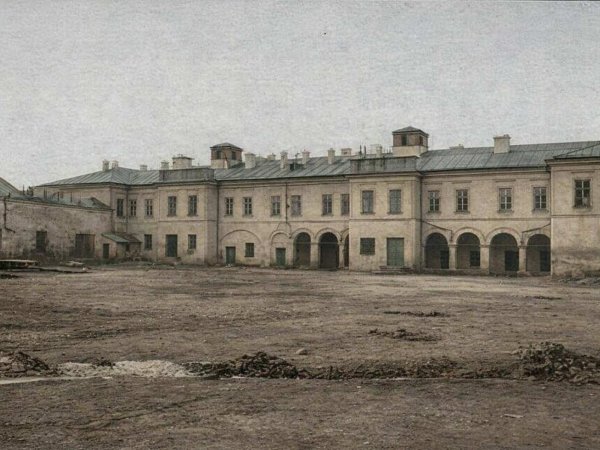
Șerban Vodă Inn was one of the most important commercial establishments of old Bucharest, but also one of those places in which the history of the city could be seen in miniature: trade, shelter, prestige, fires, philanthropy, modernization and, in the end, demolition. Built during the time of Șerban Cantacuzino, between the years 1683 and 1685, the inn quickly became a major urban landmark, both through its size and through its economic and social role. It was considered the largest inn of this kind in the Capital, a solid construction, in the shape of a quadrilateral, with thick walls, without windows to the outside and with a single gate that was closed at night, following the pattern of the defensive architecture specific to the large inns of the era.
An inn-fortress in the center of Bucharest trade
Placed on the land on which today is The National Bank of Romania, on the street which in the past was called “the great street from the Upper Fair”, the inn became so well known that for a time the street itself was identified by reference to it, being called “the street that leads to Șerban Vodă’s Inn”. This change says much about the place that the building occupied in the mental and commercial geography of old Bucharest. The inn was not only a space of transit for merchants, but a true nucleus of urban life.
In its early period, Șerban Vodă Inn fulfilled the classic function of the great Oriental inns: it offered safety, storage space and lodging for merchants coming from outside the city or from other regions. The lack of windows toward the outside and the thick walls were not simple architectural whims, but practical elements, meant to protect both people and goods. In a time in which the insecurity of roads, robberies or invasions were part of everyday reality, such a building was indispensable for the local economy.
Its protective role also emerges clearly from a testimony evoked in the source about the inn: in September 1716, out of fear of a Tatar invasion, some Bucharest residents left their houses and took refuge in the great inns of the city, among which Șerban Vodă Inn, Saint George Inn and Cotroceni Monastery. Therefore, the building was perceived not only as a place of trade, but also as a refuge in times of crisis, a space in which the inhabitants of the city could place their most precious goods and even their lives in safety.
At the beginning of the 18th century, a church was also built in the courtyard of the inn, an element that strengthened the status of the complex as a small autonomous universe. As often happened in the case of the great urban ensembles of the time, the economic function intertwined with the religious and community one. The church was, however, to be demolished about a century later, a sign that the inn went through several transformations and successive adaptations, as the city changed.
From shops and money changers to a small center of urban life
The fame of Șerban Vodă Inn was linked not only to its size, but also to the diversity of the activities that took place here. The source evokes the image of an extremely lively place, in which various kinds of shops operated: of “Lipscani goods”, of spirits, of ironware imported from England, of tobacco, cigars and groceries. Even concrete examples of goods and merchants are mentioned: liqueurs in one shop, Jamaica rum in another, or the grocery of the well-known Gheorghe Assan and Martinovici. All these details outline a cosmopolitan space, connected to the commercial flows of the time and capable of bringing to Bucharest diverse products, some considered refined or exotic.
At the same time, the inn was also a preferred place for money changers and bankers. The text in the consulted source quotes a suggestive wording by Mircea Constantinescu, who described the inn as a kind of “Intercontinental laid out horizontally”, with an upper floor only in the main building at the back of the courtyard. The comparison, of course metaphorical, says something essential: Șerban Vodă Inn was perceived as a prestigious, spacious and sought-after place, especially by people of money. It was not only a stopping place for ordinary merchants, but also a center frequented by the economic elites of the era.
This combination of practical usefulness and social status explains why the inn lasted so long in the memory of the city. It sheltered not only trade, but also a certain idea of prosperous Bucharest, in full movement, with openings toward East and West alike. In a single place met goods, capital, influences and people from different worlds. Precisely for this reason, Șerban Vodă Inn can be regarded as a precursor of the great modern multifunctional buildings, even if its form was an old one, close to a fortress.
A place of education and philanthropy
One of the most interesting sides of the history of the inn is the fact that, beyond its commercial purpose, it also hosted institutions with an educational and social role. According to the source, for a period a boarding school with four classes functioned here, where skills considered useful in everyday life were taught: embroidery frame work, piano, a little arithmetic, drawing and calligraphy. In addition, there are mentioned, through Ion Ghica, the existence of a piano and a harp as early as around the year 1810, which adds a note of cultural refinement to a place that many would associate exclusively with trade and the storage of goods.
The presence of such a boarding school shows that the inn had become, at a certain moment, also a space of formation. It was not a school in the modern sense of the word, but the invoked curriculum suggests a type of practical and salon education, oriented toward domestic life and toward the good manners of the era. In a Bucharest situated between tradition and modernization, this mixture of useful and ornamental was perfectly plausible. The inn thus mirrored not only the economy of the time, but also the aspirations of a society that was beginning to place more value on instruction and on urban social codes.
Even more impressive is the fact that a home for poor girls also functioned here, having a capacity of about one hundred places and being cared for by Elisabeta Știrbei, as the source mentions. This detail changes the perspective on the building a great deal. The inn was not only a space of money and trade, but also a place where urban philanthropy manifested itself. Behind its thick walls, therefore, there also unfolded a discreet history of social aid, of care for vulnerable categories and of the involvement of the elites in supporting charitable initiatives.
Through this overlapping of functions, Șerban Vodă Inn appears as a truly living urban organism. It is hard to find, in old Bucharest, many examples of buildings that passed so naturally from the role of commercial fortress to that of space for education, social assistance and administrative activities. Here also lies the charm of its story: the inn knew how to reinvent itself without losing its importance.
The State Printing House and the entry into administrative modernity
The 19th century brought new transformations for the inn. Besides the headquarters of some bankers of the time, the building also housed the State Printing House, which functioned here between 1869 and 1883. The fact that an institution of this type was installed in a former inn says much about the way in which the city reused old spaces, adapting them to the new needs of the modern state. The inn, built for merchants and caravans, thus came to serve the bureaucratic and cultural apparatus of a Romania in full process of institutional consolidation.
This stage is especially significant. The State Printing House was not a simple commercial activity, but an institution with a strategic role in the circulation of documents, official acts and publications. In a way, Șerban Vodă Inn was passing from the economy of goods to the economy of text and administration. The walls that had once protected bales of merchandise, barrels, ironware or tobacco came to shelter machines, letters, papers and another form of power: that of the modern state.
Also here, the source mentions that the Bucharest residents saw the first steam machine brought into the inn. Even if the wording also has a picturesque note, the episode is symbolic. It suggests the meeting between the old inn-filled Bucharest and the new technological era. The inn, built in the 17th century, was becoming a witness to the beginnings of technical modernization. It is an almost cinematic image: in a setting of thick walls, heavy gates and inner courtyards, the steam machine suddenly appears, that is to say the clear sign that the old world is beginning to be overtaken.
Fires, reconstructions and the beginning of decline
Like many other old buildings of Bucharest, Șerban Vodă Inn also went through dramatic moments. The source mentions two large fires, in 1704 and in 1804, which marked its existence. According to the account reproduced there, the inn burned twice, but it was rebuilt after each disaster. Such episodes were not rare in the city of old, where fire represented one of the greatest threats for dense buildings and for crowded commercial areas.
The ensemble, which also included the church inside, was strengthened during the time of Constantin Brâncoveanu, who ascended the throne after the unexpected death of Șerban Cantacuzino. The intervention shows that the inn was considered important enough to deserve successive repairs and reinforcements. In other words, it was not a marginal building, left to its fate, but one in which investments were made precisely because it represented an important element of economic and urban life.
The real decline came, however, much later, in the context of the great political and administrative changes of the 19th century. The inn had been dedicated by Șerban Cantacuzino to Cotroceni Monastery, and the law of the secularization of monastic estates, adopted in 1863 during the time of Alexandru Ioan Cuza, caused the building to enter state ownership. From that moment, its old identity began to dissolve. The state took over the space and integrated it into another logic, one less connected to the tradition of the old establishments and more to the administrative and financial reorganization of the Capital.
Demolition and disappearance in the name of progress
The final fate of the inn was decided after the founding of the National Bank of Romania, in 1880. Shortly afterward, the need arose to build a representative headquarters for the new financial institution. On October 3, 1881, the Board of Directors of the NBR authorized the governor I.I. Câmpineanu to negotiate with the Ministry of Finance the purchase of the land on which Șerban Vodă Inn stood. From that moment, the destiny of the old ensemble was, practically, sealed.
On February 9, 1882, the law by which the sale of the land to the National Bank was approved was published in the “Official Gazette”, and the consequence was the demolition of the inn in the following year, according to the source. The act had a logic of its time: Bucharest was orienting itself more and more toward Europeanization, and the old inn, with its air of an Oriental fortress, seemed unsuitable for the new image that the political and financial elite wanted to build for the city. In its place there had to appear the monumental architecture of the modern state.
This demolition says much about the way in which the Capital was modernized. Progress did not mean only construction, but also the sacrifice of old landmarks, considered outdated or incompatible with the taste of the era. Șerban Vodă Inn disappeared precisely because it was too connected to another world: one of merchants, enclosed courtyards, Oriental influences and the old Phanariot Bucharest. In place of that world came another, more sober, more institutional, more westernized.
Still, the story of the inn did not end completely with the demolition. The source mentions that its ruins were rediscovered in 2007, following archaeological research, and that in the underground spaces valuable mural paintings from the 18th century were also identified, among them representations of Saint Nicholas and of the Dormition of the Mother of God. Although part of them were lost because of vandalism, negligence and humidity, the discovery brought the memory of this place back into attention.
In the end, Șerban Vodă Inn remains an emblem of old Bucharest precisely through this dense and contradictory biography. It was, in turn, a commercial fortress, a shelter in troubled times, a space of bankers and luxurious shops, headquarters for the State Printing House, a boarding school with four classes and a home for poor girls. Few buildings managed to concentrate so well the transformations of the city. Its disappearance made room for another Bucharest, but its memory continues to tell the story of a capital city always situated between tradition and change.
We also recommend: The story of “The inn without a name”, the temple of lost souls. Here the poor and the unlucky sought refuge