How a well-managed city center looks in Europe — and what Bucharest could learn from it
- Articles
- 23 MAR 26
When Bucharest's mayor describes the city center as a place where, at a single glance in any direction, "something scratches your retina," he puts his finger, perhaps without realizing it, on a wound older and deeper than rusty lamp posts or cars parked on sidewalks. The problem with central Bucharest is not one of aesthetics — it's one of urban governance, of an administrative system's capacity to impose and maintain standards in public space over the long term. Looking at other European capitals, the picture becomes clearer by contrast.
Barcelona: when the street belongs to the people
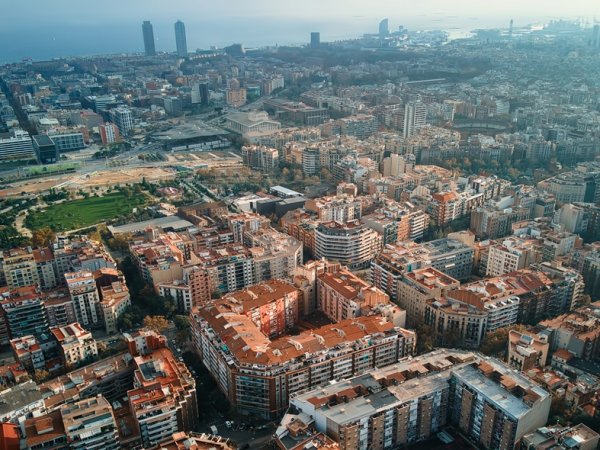
The most cited urban experiment of the last decade in Europe remains Barcelona's Superblocks program. The concept is simple in logic, bold in impact: a grid of 3x3 blocks is closed to through traffic, cars are redirected to peripheral arteries, and the interior space is transformed into pedestrian zones with greenery, benches and playgrounds. The first superblock implemented in the Sant Antoni neighborhood brought, one year after its inauguration, a 33% reduction in NO2 levels and a significant drop in street noise. In Poblenou, the first transformed neighborhood, 75% of the space previously occupied by cars was freed up for cycling lanes, benches and spaces for social interaction.
The intervention also brought concrete economic benefits: 20 new local businesses opened in the Poblenou area, with commercial activity growing by over 30%. Merchants who feared that restricting car traffic would hurt their sales discovered the opposite — a street lived in by people attracts more customers than one dominated by machines.
The city's long-term plan calls for implementing 503 such superblocks. Impact studies estimate that full implementation could prevent over 660 premature deaths annually and increase life expectancy by nearly 200 days per resident. The project has also weathered political turbulence — in 2023, following a change in local administration, the program's continuity came into question, with the new leadership oscillating between distancing itself from the brand and acknowledging its international value. Barcelona's story is, therefore, also a lesson about the fragility of ambitious urban projects in the face of political change — a fragility Bucharest knows all too well.
Paris: the 15-minute city
Paris has adopted a different urban philosophy in form, but similar in direction. The "15-minute city" model starts from the premise that all essential services should be accessible from any point in the city within a quarter of an hour on foot or by bicycle. In practice, this means less space dedicated to cars and more to people — 60% of Barcelona's public space is currently given over to cars, even though residents use them for only one in four journeys, a statistic Paris has set out to overturn through systematic street reconfiguration policies.
On the visual pollution front — a subject directly relevant to Bucharest's reality — French cities have gone furthest in Europe. Grenoble became in 2015 the first European city to massively eliminate outdoor advertising, explicitly invoking the "liberation of public space" and the fight against visual pollution. Nantes banned street advertising on 70% of the city's surface, imposing strict regulations on the remaining 30%. Both decisions were initially challenged by the advertising industry, ended up in court and were upheld — because they had genuine political will and functioning enforcement mechanisms behind them.
Copenhagen: infrastructure as a mindset
Copenhagen offers perhaps the most compelling argument that urban space transformation is not about exceptional financial resources, but about consistency. 49% of all trips to work or school are made by bicycle, up from 35% a decade ago — a gain achieved through sustained municipal investment in cycling infrastructure. The city has approximately 350 kilometers of cycling lanes separated by curbs, plus 23 kilometers of on-road cycling strips and 43 kilometers of green routes through parks.
In 2025, Copenhagen approved the largest budget in its history dedicated to cycling infrastructure — over 600 million Danish kroner. The investment is not urban philanthropy, but economic calculation: cycling brings societal benefits of 6.3 million euros per day and 2.3 billion annually, through reduced healthcare costs, less congestion and lower emissions. Street cleanliness is maintained through a real-time data system that holds sanitation operators accountable — exactly the kind of mechanism Mayor Ciucu implicitly calls for when he says that waste collection companies "steal from us" by failing to keep their schedules.
What sets these cities apart from Bucharest
The answer is not primarily money. It comes down to institutional consistency and political will applied over time. Barcelona worked on the Superblocks program for three decades before it became a reality at scale — the first proposal dates back to 1987, the first experiments to 2016. Paris did not solve visual pollution through a statement, but through a series of gradually implemented regulations backed by functioning enforcement mechanisms.
Bucharest has an outdoor advertising law that in theory regulates the placement of illegal billboards and signage. The law exists. Its enforcement, less so. This is the fundamental distinction from the European models invoked as reference: in the cities mentioned above, the gap between written rules and street reality is small and sanctioned. In Bucharest, that gap has itself become the norm.
When the mayor talks about the "pathological complacency of senior civil servants," he is describing, without using the technical term, exactly this disconnect — sustained by years of inaction and an administrative system fragmented between the general city hall and six district councils, each with their own interests and their own tolerances. Piața Lahovari and the announced interventions in the center may be a start. But the European cities that have achieved real transformations of public space all began from a principle Bucharest's administration has never truly embraced: that the street belongs first and foremost to the people who live it, not to those who exploit it.
Also recommended The most spectacular graffiti and murals in Bucharest