Football between the blocks: Bucharest's neighborhood sports scene before gyms existed
- Articles
- 27 AUG 26
Rapid București started out as a team of railway workers. The club was founded on June 25, 1923, when workers from the Grivița Workshops met at the neighborhood's primary school and laid the groundwork for the association that would later become Rapid. There was no marketing plan behind it, just a group of people who worked together and wanted to play football together. That's what sport in Bucharest looked like before it turned into an industry of memberships and group classes: tied to an institution, a workplace, a neighborhood.
The Army, the Militia, and the clubs that split the city
After 1947, sport in Bucharest took on a new structure, imposed from above. On June 7, 1947, at the initiative of several officers of the Royal House, the Army Sports Association was founded — the future Steaua. A year later, on May 14, 1948, Dinamo appeared, placed under the Ministry of Interior and built explicitly as a rival to the army's club. The two clubs came to concentrate a significant share of the country's top athletes, drawing them to Bucharest with jobs, university spots, and conditions other clubs couldn't match.
This institutional structure quickly spread beyond football. By the 1980s, Steaua had grown into a club with dozens of sections — from rugby, boxing, athletics, and gymnastics, present since its early years, to weightlifting, added in 1950, and water polo. Basically, if you worked at a state institution with enough weight behind it, you had a sports club attached to it, with everything that came with it.
The neighborhood-field boom
Alongside the big clubs, the state built a dense network of small sports grounds, meant for ordinary people rather than performance athletes. The peak year, nationwide, was 1950, when Romania had 1,536 such fields. Large factories, schools, and universities got their own sports spaces for the most part, and the stated goal was for the country's entire urban population — Bucharest included — to have access to a sports facility close to home or work by 1990-1995.
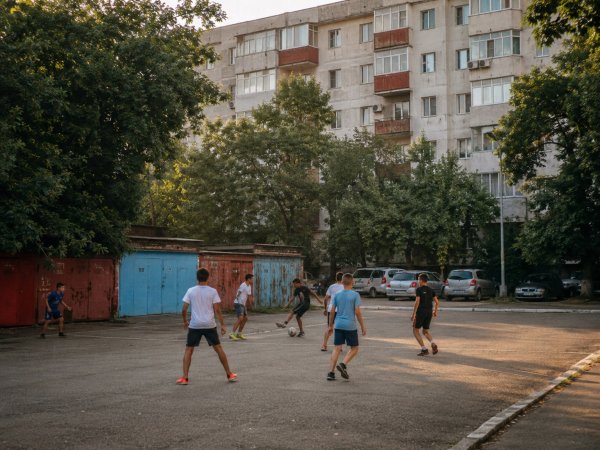
The block-housing districts, built up massively from the 1970s on, came bundled with asphalt fields, officially included as "sports facilities" in neighborhood planning. In practice, many housing complexes had, somewhere between the buildings, a plain field, no grass, no changing rooms, where kids played football after school.
Camp Nou between two garages
The neighborhood field became, for entire generations, the most accessible form of sport around. Kids drew goals on garage doors, and a curb was enough for a full-blown championship. It didn't matter that there was no grass or floodlights — the asphalt between the blocks turned, in kids' minds, into any major stadium in the world.
The games weren't limited to football. Hopscotch, elastics, or blind man's buff used the same minimal space, with chalk pulled out of a school bag standing in for line paint. The street, not a proper facility, was where young Bucharesters spent their active free time, for the simple reason that it was free and always within reach.
What happened to the fields after 1989
Sports infrastructure built before 1989 kept running for a while out of sheer momentum, helped along by the slow privatization of the state economy. Factory football clubs struggled increasingly with money as state funding dried up, and the new private owners had no interest in propping up an unprofitable sports section.
Many of the old factory fields disappeared under new construction. The site of Stadionul Spartac, for instance, is now home to the ParkLake mall. Other fields were simply abandoned, left waiting for a zoning change that would make them attractive for new development. Their story points to a bigger shift, beyond sport: free public space, built for the community, gave way to a real estate market where a sports field just doesn't turn enough profit.
Also recommended Sport and leisure in interwar Bucharest: how Romanians kept fit 100 years ago