Diplomatic Bucharest on foot. The route of historic embassies on Kiseleff, Dorobanți and the Amzei area
By Raluca Ogaru
- Articles
- 30 JUN 26
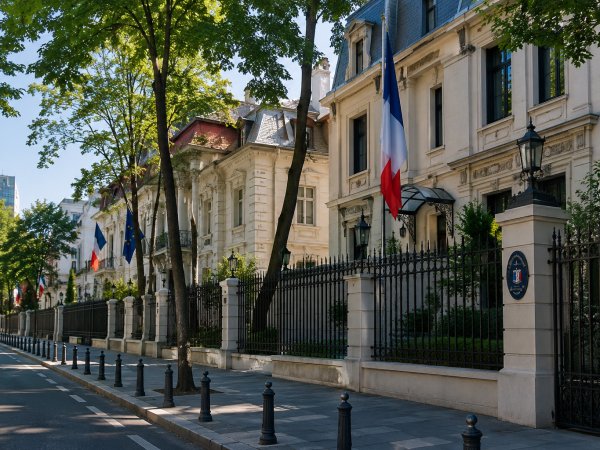
Bucharest has many possible maps: the city of cafés, the city of old houses, the city of parks, the city of museums or the city of wide boulevards. But there is also a diplomatic Bucharest, more discreet, visible on elegant streets, in historic buildings, in interwar villas or in modern headquarters protected by fences, flags and careful security.
For tourists, expats and curious Bucharest residents, the embassy route can be a different way of discovering the capital. It is not a sightseeing route in the strict sense, because embassies are not tourist attractions open to the public, but active diplomatic missions. It is, rather, a walk through the areas where Bucharest has preserved part of its urban elegance: Kiseleff, Aviatorilor, Dorobanți, Piața Victoriei, Jules Michelet, Biserica Amzei and Calea Victoriei.
Why Bucharest has an unofficial diplomatic district
Bucharest does not have an officially delimited diplomatic district, as happens in some other capitals, but it does have several areas where embassies and diplomatic residences are naturally concentrated. The explanation lies in the city’s urban history: many diplomatic missions chose spaces close to representative boulevards, parks, central squares and elegant residential neighbourhoods.
Șoseaua Kiseleff, Aviatorilor, Dorobanți, the Amzei area and the streets around Piața Romană have long offered exactly this kind of setting: prestigious buildings, good access to the centre, proximity to institutions and a quieter atmosphere than in very busy commercial areas. That is why, even without an “official map” of diplomatic Bucharest, walking through these areas shows quite clearly where diplomacy has settled in the cityscape.
The Ministry of Foreign Affairs publishes the list of foreign missions accredited in Romania, and many of them have headquarters in Bucharest, especially in Sector 1. Some are located in old houses adapted for administrative needs, others in modern buildings, while a few have headquarters that have become easily recognisable landmarks for those who pass through the area often.
For Bucharest.ro readers, the interest is not only in the addresses. Embassies say something about the city: about Romania’s international relations, about prestigious neighbourhoods, about diplomatic architecture and about the way the capital has remained a meeting point between different worlds.
The embassy route: from Kiseleff to Piața Amzei
A good diplomatic route can begin on Șoseaua Kiseleff, one of the most beautiful arteries in Bucharest. The area has the advantage of combining green spaces, museums, historic buildings and diplomatic missions. The Embassy of Sweden, for example, has its visiting address at Șoseaua Kiseleff no. 43, according to information published by the Swedish authorities. Nearby are Kiseleff Park, the National Museum of the Romanian Peasant, the Antipa Museum and Piața Victoriei, which makes the beginning of the route very appealing for tourists as well.
From Kiseleff, the walk can continue towards Aviatorilor and Dorobanți, areas where several diplomatic representations, residences and administrative buildings are located. The Embassy of Canada, for instance, is on Tuberozelor Street no. 1-3, in Sector 1, while the Embassy of Germany has its headquarters on Cpt. Av. Gheorghe Demetriade Street no. 6-8. These landmarks should not be treated as places where one can enter without an appointment, but as orientation points in an area that preserves one of the capital’s most elegant urban profiles.
After Dorobanți, the route can descend towards Piața Romană and the Amzei area. Here, diplomatic Bucharest meets cultural and pedestrian Bucharest. Jules Michelet Street, where the British Embassy is located at number 24, is one of the most suitable streets for such a walk: close to important boulevards, the Romanian Athenaeum, Piața Amzei and Calea Victoriei.
The final part of the route can reach Biserica Amzei Street, where the French Embassy is located at numbers 13-15. The area is one of the most interesting for those who want to see central Bucharest beyond the classic routes. You have the church, old houses, cafés, restaurants, access to Calea Victoriei and the feeling that you are in a place where diplomacy, culture and city life discreetly overlap.
What you can see around the embassies
The beauty of this route is that it does not depend only on the embassies. In fact, for a tourist or a local, the most pleasant part comes from what lies between them. On Kiseleff, you can connect the walk with the Antipa Museum, the Museum of the Romanian Peasant, Kiseleff Park and Piața Victoriei. It is one of the few areas in Bucharest where you can easily move from natural history to rural heritage, then to diplomatic architecture and wide boulevards.
In the Dorobanți - Aviatorilor area, the route takes on a more residential feel. The streets are calmer, the houses are more set back, and the walk becomes less touristy and more urban. Here, you are not necessarily looking for a spectacular monument, but for the atmosphere: tall fences, old villas, trees, official headquarters and that kind of quiet that contrasts with the bustle of the large boulevards.
Towards Amzei and Calea Victoriei, the route becomes livelier. You can stop for coffee, walk towards the Romanian Athenaeum, continue to Revolution Square or head towards the Old Town. This transition from quiet diplomatic areas to the city’s cultural centre is precisely what makes the walk work very well on a weekend day.
For tourists, the route can be seen as an introduction to elegant Bucharest, not monumental Bucharest. The Palace of Parliament is not the star here, but the details are: façades, gates, flags, parks, museums and streets where diplomacy has settled without turning the area into a rigid setting.
What tourists and expats should know
Embassies are not classic tourist attractions. They cannot be freely visited, they are not places you enter simply because you happen to pass by and, as a rule, public access is only by appointment or in clearly defined consular situations. The British Embassy, for example, states that public access to embassies, high commissions and consulates is by appointment only.
For expats, this is very important. If you need consular services, a passport, visa, documents, declarations or assistance, you should check the embassy’s official website before going there. Opening hours, required documents and procedures may change, and going directly to the headquarters without an appointment can mean wasted time.
For tourists taking the route on foot, the recommendation is simple: the walk should be done with respect for the status of these buildings. It is better to avoid insistent photos of entrances, surveillance cameras, security staff or security details. A discreet street photo is one thing; intrusive behaviour in front of a diplomatic mission is quite another.
The route works best during the day, in normally busy hours, not very early and not late at night. For a relaxed walk, without entering institutions, two to three hours are enough, depending on how many stops you make at museums, cafés or bookstores.
How to turn the route into a weekend walk
A simple version would be: Kiseleff Park - Antipa Museum - Piața Victoriei - Dorobanți - Aviatorilor - Jules Michelet - Piața Amzei - Calea Victoriei. The route can be done entirely on foot by those used to long walks, but it can also be divided into two stages, using the metro or public transport between areas.
For those visiting Bucharest for the first time, the Kiseleff - Piața Victoriei section is easier to understand and more welcoming. It has major landmarks, museums, parks and clear boulevards. For those who already know the city, the Dorobanți - Amzei area may be more interesting, because it offers less obvious streets and a more local atmosphere.
If the route is done in summer, the best moments are in the morning or evening, when the light falls beautifully on the buildings and the temperature is more bearable. In winter, the walk can be shorter and linked to a stop at a café in the Amzei or Calea Victoriei area. Spring and autumn are probably the best seasons for this kind of route, because diplomatic Bucharest is best seen among trees, façades and soft light.
For Bucharest.ro, such a route can also work as a bridge between the Embassies category and city guides. It is not only an article about institutions, but also about the way institutions settle into the urban landscape and become part of the Bucharest experience.
Diplomatic Bucharest, a discreet map of the city
Diplomatic Bucharest does not announce itself spectacularly. It does not have large gates open to tourists, it does not have route signs and it cannot be discovered in a single stop. It is a discreet map made of streets, flags, houses, official headquarters, fences, parks and institutions that usually work quietly.
That is precisely why the embassy route is interesting. It shows a more sober, more elegant and more international capital than the usual image of a crowded city. It shows how Bucharest has, over time, become a place where diplomacy has mixed with architecture, residential areas and everyday life.
READ ALSO:
How many tourists came to Bucharest in 2025. What the official data shows
For tourists, it is a good walk if they want to step outside the classic routes. For expats, it is a form of orientation in a new city. For Bucharest residents, it can be a rediscovery of streets they pass by often, but have never looked at as a diplomatic map.
In the end, the Bucharest of embassies is not about access, but about context. You do not enter the buildings, but you understand the city around them better. And sometimes, a capital is best discovered exactly like this: not through its loudest places, but through those areas where history, diplomacy and urban life stand side by side, without making too much noise.