Daniel Rosenthal, the Revolutionary Painter Who Died for Romania, Has a Street Named After Him in Bucharest
- Articles
- 28 SEP 26
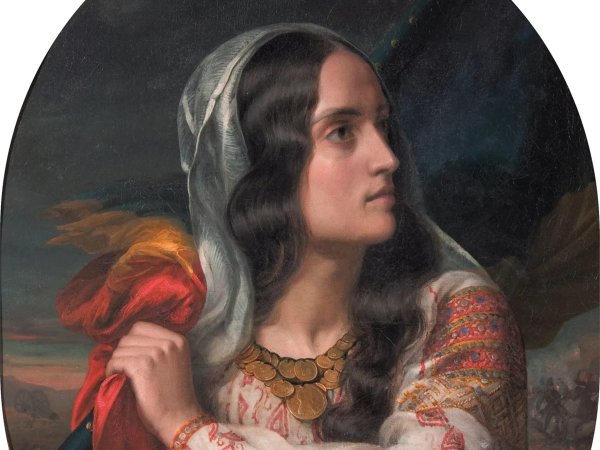
Few destinies in the history of Romanian art are as short and, at the same time, as dramatic as that of Constantin Daniel Rosenthal. Born in Pest, into a family of Jewish merchants of Hungarian origin, Rosenthal arrived in Wallachia in his youth and quickly became close to Bucharest's intellectual and revolutionary circles. He painted portraits, allegorical compositions and scenes inspired by the ideals of the 1848 generation, and his name remained forever connected with the visual image of the 1848 Revolution. Today, the painting “Revolutionary Romania”, preserved at the National Museum of Art of Romania, is one of the best-known visual representations of the ideals of the generation of 1848. At its centre is Maria Rosetti, the wife of C. A. Rosetti and one of the female figures associated with the Wallachian revolution. The painter's life ended brutally, however. In 1851, when he was trying to return to Wallachia to resume his revolutionary activity, Rosenthal was arrested in Pest by the Austrian authorities. He died in detention, at only 31 years old. For Romanian historical memory, his death became a symbol of loyalty to the revolutionary cause that he had embraced. In Bucharest, his name is preserved today by a street in Sector 1, Constantin Daniel Rosenthal Street, located in the Dorobanți area. Documents of the Bucharest City Hall officially record the street, which runs between Barbu Iscovescu Street and Teheran Street.
From Pest to the Academy of Fine Arts in Vienna
Constantin Daniel Rosenthal was born in 1820, in Pest, into a family of Jewish merchants. In Hungarian art historiography, he is also known as David Rosenthal, while in Romania he remained known mainly as Daniel or Constantin Daniel Rosenthal. His background did not prevent him from becoming one of the important figures of Romanian art and of the Romanian Revolution of 1848.
The first information about his artistic training is not always presented identically by different sources. His presence in Vienna, however, is documented, where he studied at the Academy of Fine Arts. Research published by Historia indicates that he enrolled in 1837 and studied until 1839, in the antique drawing class. It was also in Vienna that he came into contact with the Romanian painter Ion D. Negulici, a meeting that was to decisively change his path.
Negulici belonged to the generation of Romanian artists concerned with modernising painting and breaking away from old models. He had studied in Paris and Vienna and would become one of the important painters of the generation of 1848. His friendship with Rosenthal created a connection between the young artist from Pest and the Romanian intellectual environment.
Around 1842, Rosenthal arrived in Bucharest. This date is accepted by numerous sources, although more recent research has also raised the possibility of an earlier presence, based on an inscription on a portrait of the revolutionary Zaharia Boerescu. Therefore, 1842 should be regarded as the traditionally accepted date for his arrival in Wallachia, rather than as an absolute certainty.
In Bucharest, the artist began producing portraits for members of the elite of the time. Among the works associated with this period are portraits of Nicolae Bălcescu and other personalities of Wallachian society. His activity as a portrait painter gave him access to an environment in which the political and cultural ideas that would explode a few years later were circulating.
Friendship with C. A. Rosetti and closeness to the revolutionaries
Bucharest in the 1840s was a city undergoing rapid transformation. Young intellectuals who had travelled to Paris, Vienna or other Western centres returned with ideas about civil liberties, political rights, social reform and national affirmation. Rosenthal entered this environment and became close to people such as C. A. Rosetti, becoming one of his close friends.
In 1844, Rosenthal travelled to Paris together with Vasile Mălinescu, according to his biographies. The French capital would become an essential space for his artistic and political formation. There he came into contact with Romanians who were studying or living in exile and with the revolutionary ideas circulating intensely throughout Europe.
The Parisian experience would also be reflected in the way Rosenthal conceived his painting. He did not limit himself to commissioned portraiture, but began to use artistic images to convey political and national ideas. According to research on his work, this combination of Romanticism, allegory and national ideals would become one of the characteristics of his artistic creation.
The 1848 Revolution, however, transformed him from a painter close to the Romanian intellectual environment into a direct participant in the revolutionary cause. Rosenthal was in Bucharest during the events and requested Wallachian citizenship. Some sources record that it was granted to him in August 1848, through a decree that emphasised his participation in the revolution.
“Revolutionary Romania”, the face of a country fighting for freedom
One of Rosenthal's most important works is “Revolutionary Romania”, painted in Paris in 1850. The painting is today preserved in the Romanian Modern Art Gallery of the National Museum of Art of Romania and represents one of the artist's emblematic works.
In the foreground appears Maria Rosetti, née Grant, the wife of C. A. Rosetti. She is depicted in bust form, turned slightly to the left, with the tricolour in her left hand and a dagger in her right hand. The traditional costume and the solemn expression transform the portrait into an allegory of revolutionary Romania. The National Museum of Art of Romania explains that the work was created in Paris, where Rosenthal joined the Romanian revolutionaries living in exile after the defeat of the movement in Wallachia.
Maria Rosetti was not chosen by chance as the model. Originally from a family of Scottish origin, she had met C. A. Rosetti and would become his wife. During the revolutionary events, Maria became involved in efforts to free Romanian revolutionaries detained by the Ottomans. The National Museum of Art recorded that she disguised herself in Romanian traditional costume and followed the vessel on which the prisoners were being held.
Therefore, in Rosenthal's painting, Maria is not merely a woman being portrayed. She becomes a personification of a Romania embracing the ideals of freedom. The tricolour, dagger, costume and attitude of the character together create an allegorical language specific to European Romanticism.
The Statue of Liberty and the revolution brought into the public square
Rosenthal did not express himself through painting only on canvas. During the 1848 Revolution, his name was also connected with one of the first public artworks dedicated to modern political ideals in Bucharest.
On 23 June 1848, in Vorniciei Square, at the site corresponding today to the area of Calea Victoriei, the “Statue of Liberty”, also known as “Liberated Romania”, was inaugurated. The monument was conceived according to Rosenthal's design, while some research attributes the sculptural execution to Felipe Oliva. Historical sources describe it as an allegory of the ideals of 1848 and one of the first public statues erected in Bucharest.
The statue represented an allegorical female figure, with symbolic elements such as the cross, the scales and broken chains. The message was clear for the period: freedom, justice and liberation from old political constraints.
The monument did not, however, have a long existence. Against the background of Ottoman intervention and the restoration of the Organic Regulation, the interim ruler Emanoil Băleanu ordered its destruction during the night of 28 to 29 June 1848. According to historical accounts, the statue survived for only a few days. Its destruction was condemned by the members of the 1848 generation as an act of vandalism.
Today, the monument can no longer be seen. Its image and the descriptions published in the press of the time have nevertheless survived, making it possible to reconstruct the history of the first period in which Bucharest began to use public space to transmit modern political messages.
The return to Romania and the arrest in Pest
After the defeat of the revolution, Rosenthal went into exile together with the group of Romanian revolutionaries. In Paris, he remained close to C. A. and Maria Rosetti and continued to participate in the political activity of the Romanian exiles.
The period of exile was not an easy one. Rosenthal experienced financial difficulties and, for a time, travelled through Switzerland, where he lived in several cities. In 1851, he decided to return towards Wallachia, intending to contribute to the resumption of revolutionary activity. Radio Romania International records that the Austrian authorities arrested him in Pest, where he was accused in connection with his political and revolutionary activity.
According to his biographies, Rosenthal refused to provide information about his comrades and the revolutionary networks. He was subjected to brutal treatment in detention and died in Pest in April 1851. The sources are not entirely uniform regarding the exact day, with both 22 April and 23 April appearing in historical accounts. The National Museum of Art of Romania indicates the year 1851, while other biographical sources give 23 April as the date of his death. He was only 31 years old.
“He died for Romania” and the memory preserved by Bucharest
After his death, Rosenthal became a symbolic figure for the generation of 1848. Maria Rosetti preserved the memory of her friend, and in 1878 she dedicated a commemorative text to him in the magazine “Mama și copilul”, in which she presented him as a man loyal to the Romanian cause and as a martyr of Romania.
The words attributed to Maria Rosetti had particular force precisely because they came from someone who had known him personally and who had herself participated in the revolutionary events. For Romanian public memory, Rosenthal thus became more than the painter of works about the revolution: he was the artist who linked his own destiny to the cause he had painted.
His work continued to be present in museum collections and in history and art textbooks. Alongside “Revolutionary Romania”, works such as “Romania Breaking Its Chains on the Field of Liberty” contributed to establishing the visual imagery of the generation of 1848. Radio Romania International considers him one of the symbolic artists of the Wallachian Revolution of 1848.
In Bucharest, Rosenthal's memory can be found not only in museum halls. Constantin Daniel Rosenthal Street, in Sector 1, bears the name of the painter and revolutionary. Administrative documents of the capital specify that the street connects Barbu Iscovescu Street with Teheran Street.
It is a symbolic neighbourhood: Rosenthal's name appears in the same area of the city as that of Barbu Iscovescu, another painter of the generation of 1848. Thus, even the map of Bucharest preserves a small open-air gallery of the artists who transformed painting into a form of expression for national ideas.
Constantin Daniel Rosenthal lived only 31 years, but his biography seems to have come straight out of a Romantic novel of the 19th century. He came from Pest, studied in Vienna, arrived in Bucharest, became close to the Romanian revolutionaries, painted the face of an imagined Romania and transformed the ideals of his generation into art.
He died in detention before reaching the age at which many artists are only beginning to consolidate their work. Yet the image of Maria Rosetti with the tricolour and dagger survived, and alongside it survived the name of the painter who created it.
Today, “Revolutionary Romania” can be viewed in a gallery of the National Museum of Art of Romania, while, several kilometres away, a street bears his name. It is perhaps the simplest and most powerful form of urban memory: an artist who came from Pest, became Constantin Daniel Rosenthal in the Romanian space, and continues to be present in Bucharest through his art and through the name of a street.
We also recommend: The story of painter Nicolae Grigorescu, the orphan from the Cărămidarilor neighborhood who painted icons to sell at the fair