Băneasa Forest, the Last Remaining Fragment of the Vlăsia Forests. The Story of the Natural Park on the Outskirts of Bucharest
- Articles
- 03 NOV 26
Just a few kilometers from the center of Bucharest, between busy roads, residential developments and rapidly expanding neighborhoods, lies one of the most important survivors of the old landscape of Wallachia. Băneasa Forest is today the largest forested area associated with the capital and one of the last major remnants of the Vlăsia Forests, the vast woodlands that once covered a large part of the Wallachian Plain. For those who visit it today, Băneasa may seem like nothing more than a forest on the outskirts of the city. In reality, it is much more than that. Among its oaks, lime trees, hornbeams and other deciduous species lies an important island of biodiversity, home to roe deer, badgers, squirrels, bats and numerous bird species. The scientific study supporting the establishment of a protected natural area identifies 19 mammal species, 49 bird species, eight amphibian species, six reptile species and 115 invertebrate species in the area, 46 of them protected. In 2026, Băneasa Forest has reached an important moment in its history. A scientific study supporting the establishment of the “Băneasa Forest Natural Park,” covering a proposed area of 1,221.5 hectares, has been completed and submitted to the Romanian Academy. This does not mean, however, that the forest already has the legal status of a natural park. The process of establishing the protected status is still underway.
Băneasa Forest, a remnant of the Vlăsia Forests
Centuries ago, the landscape surrounding Bucharest looked very different from the one we know today. The Vlăsia Forests referred to the extensive woodland areas that covered central and southern Wallachia and were gradually fragmented by deforestation, agriculture, settlements and the expansion of infrastructure.
Today’s Băneasa Forest should not be viewed as a forest that has remained unchanged since medieval times, but rather as one of the last major areas preserving a connection with that ancient woodland landscape. Recent studies describe it as an island of biodiversity and a surviving fragment of the Vlăsia Forests, now isolated from other wooded areas around northern Bucharest.
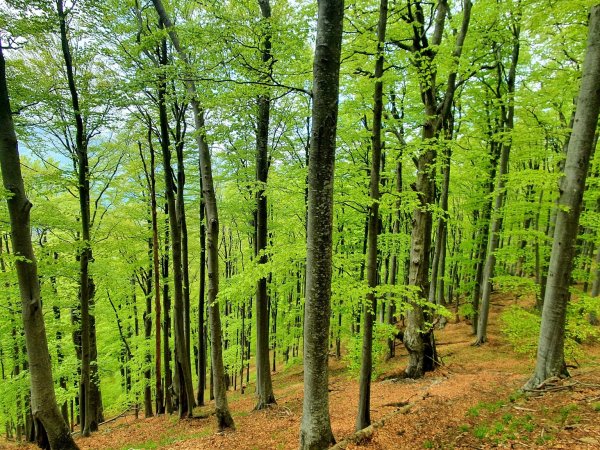
The vegetation is dominated by deciduous trees, including pedunculate oak, hornbeam, lime, elm, ash and maple. Depending on the season, the forest changes its entire appearance. In spring, sunlight filters through the branches as woodland plants begin to cover the forest floor. In summer, the dense canopy provides shade and cooler temperatures, while autumn turns the paths into a carpet of golden and copper-colored leaves.
For Bucharest, this forest also has major ecological importance. It helps regulate temperatures, filter dust and some pollutants, reduce noise and provide habitats for species that have disappeared from many heavily urbanized areas of the capital.
Where does the name Băneasa come from?
The history of the area is much older than the boulevards and residential districts that surround it today. Over time, Băneasa became associated with estates belonging to boyar families and important figures of Wallachian history, while the name itself is traditionally connected with the title “băneasa,” used for the wife of a ban, a high-ranking Wallachian official.
During the 18th and 19th centuries, the area came under the influence of several important boyar families. Among the names associated with Băneasa were the Văcărescus, one of the best-known families of scholars, poets and politicians of the period. The poet Ienăchiță Văcărescu owned property in this part of Bucharest, while the history of the estate is also connected with a palace project initiated by Prince Gheorghe Bibescu in the 19th century.
A historical study published by the Bucharest Municipality Museum shows that the Băneasa-Herăstrău area underwent important administrative changes during the 19th century, while the forest already occupied a significant portion of the commune’s territory.
The forest therefore remained closely connected to the history of Bucharest even as the city began to expand rapidly. From estates and boyar properties, the area gradually became connected to the modern infrastructure of the capital, and the old rural landscape was progressively replaced by roads, buildings and residential districts.
The place where Carol I was given the key to Bucharest
One of the best-known historical episodes associated with Băneasa took place on May 10, 1866. On that day, Prince Carol of Hohenzollern-Sigmaringen entered Bucharest after the journey that would bring him to the Romanian throne.
At Băneasa, the new ruler was welcomed by representatives of the capital and was symbolically presented with the key to the city. From there, the procession continued toward Bucharest, where Carol would take the oath before the Assembly.
The event gave Băneasa an important symbolic role. The northern entrance to the capital became the setting for one of the defining moments in modern Romanian history, when the young German prince was formally welcomed into the city he would rule for nearly half a century.
Băneasa was therefore more than a forest on the edge of Bucharest. At certain moments, it became a symbolic gateway to the capital. The road from the north was one of the important routes into the city, and the area would remain associated with political, military and social changes as Bucharest entered the modern era.
Băneasa and the beginnings of Romanian aviation
Another important chapter in the history of the area is connected with aviation. There is, however, an important distinction to be made from some accounts that have been repeated over the years: Aurel Vlaicu’s first flight with his Vlaicu I aircraft did not take place at Băneasa.
Vlaicu made his first flight at Cotroceni on June 17, 1910. Băneasa nevertheless quickly became an important location for aviation demonstrations and for the development of aviation in Bucharest. In 1910, Aurel Vlaicu also presented his aircraft at aviation events organized in the area.
The Băneasa airfield would subsequently gain increasing importance for Romanian aviation. The airport, now named after aviator Aurel Vlaicu, preserves this connection with the period when aviation was beginning to transform the way people viewed cities, travel and technological progress.
In this way, Băneasa brought together two seemingly opposite forms of history: the ancient forest, inherited from the Vlăsia woodlands, and aviation, one of the most spectacular symbols of technological progress at the beginning of the 20th century.
The chapel of Mauriciu Blank, hidden among the trees
Near the forest stands another lesser-known monument that is nevertheless highly valuable for the architectural history of Bucharest: the funeral chapel associated with the family of Mauriciu Blank, one of the major figures of Romania’s banking system and co-founder of the Marmorosch Blank Bank.
The building dates from 1927 and was designed by architect Duiliu Marcu. The monument has a restrained appearance, very different from the lavish image sometimes associated with the funeral architecture of wealthy families of the period. Exposed brick and stone contribute to the austere character of the building.
The chapel is one of the reminders that Băneasa had a complex relationship with Bucharest’s economic and political elite during the interwar period. The forest was not simply a natural area, but a territory containing estates, private properties and monuments.
Today, the building is much less well known than the grand palaces in central Bucharest, while its condition has attracted the attention of people interested in the city’s architectural heritage. Its presence among the trees adds another historical layer to the forest, one that visitors often discover by chance.
A forest caught between development and conservation
The recent history of Băneasa Forest is considerably more complicated than the peaceful image of a walk among the trees. During the communist period, the ownership structure changed radically, while after 1989 the restitution process and rapid development in northern Bucharest brought new pressures on forest land.
Today, the area proposed for the future Băneasa Forest Natural Park covers 1,221.5 hectares and extends administratively across Sector 1 of Bucharest, as well as the towns of Voluntari and Tunari in Ilfov County. According to data presented in 2026, approximately 36% of the studied forest fund is publicly owned, while 64% is privately owned.
The expansion of residential construction and infrastructure has fragmented the landscape and increased pressure on natural habitats. For this reason, environmental organizations and civic groups have increasingly called for a protected status that would restrict interventions incompatible with conservation.
In 2024, representatives of Sector 1 and environmental organizations announced their support for the idea of designating Băneasa Forest as a protected natural area. In March 2026, the process reached a concrete stage when the scientific study supporting the establishment of the protected area known as the “Băneasa Forest Natural Park” was completed and submitted to the Romanian Academy.
What could change if Băneasa becomes a natural park?
Establishing a natural park would not mean turning the forest into a conventional urban park, with paved paths, excessive landscaping and intensive development. On the contrary, the purpose of such a designation would be to conserve the ecosystem while establishing clear rules governing interventions and public use.
Such a legal framework could provide a coherent basis for protecting habitats, managing access, preserving valuable trees and species, and developing environmental education and responsible recreational activities. The scientific study completed in 2026 emphasizes precisely the need for appropriate protection of this territory.
The stakes are particularly high because Băneasa is a peri-urban forest located in an area under intense development pressure. It functions as a major piece of green infrastructure for Bucharest, providing habitat for numerous species while also offering a recreational space for hundreds of thousands of people.
The last great forest of Bucharest
Băneasa Forest is one of those places in Bucharest where past and present meet at every turn. It is a surviving trace of the old Vlăsia Forests, the place where Carol I entered the capital, one of the important locations in the early history of Romanian aviation and the setting of lesser-known monuments such as the chapel of the Blank family.
At the same time, it is a living forest, not merely a historical backdrop. Roe deer, badgers, squirrels, bats, birds and numerous plant species make it one of the most important natural ecosystems remaining in Bucharest and its metropolitan area. Recent inventories confirm its biodiversity and the presence of protected species.
Perhaps this is where the true value of Băneasa lies. In a city that has expanded continuously and where undeveloped land has become increasingly scarce, the forest represents a direct connection with a landscape that has almost entirely disappeared.
That is why its story is not only about the past. It is also about the kind of Bucharest that will exist in the decades to come. If the project to establish Băneasa Forest as a natural park is completed, one of the last major remnants of the Vlăsia Forests could finally receive a legal status that reflects its importance.
For a capital city that continues to expand, protecting a mature forest is not simply about preserving the past. It means safeguarding an essential part of the city’s future.
We also recommend: The history of Casa Albă Restaurant, the venue in the heart of Băneasa Forest