A trade on the verge of extinction. Probably the last bookbinder in Bucharest
- Articles
- 20 JUL 26
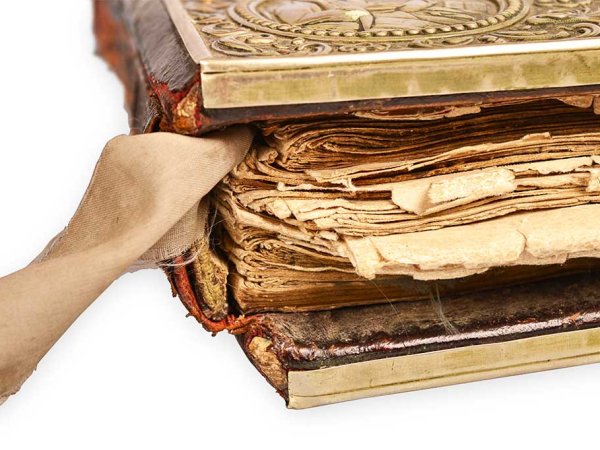
On Oboga Street, in a workshop you only get to see if you call ahead, someone is still doing by hand something Bucharest, by and large, has forgotten how to do: an old book gets repaired thread by thread, not thrown out or scanned.
The trade is called antique bookbinding and restoration, and the city has, based on everything you can search for today, one name that consistently surfaces when it comes to the level of craft rather than quick repairs for files and thesis binding: Mihai Vârtejaru, who runs Legătoria Arta Cărții, a project started in 2011 with the goal of bringing traditional bookbinding back to Romania, using proper techniques, tools, and materials. The rest is, formally, an open market — there are commercial binderies, workshops that make covers for archives or restaurant menus. But actual restoration work, the kind that requires knowing what paper was used in a given century, what binding style a printing house in Moldavia or Wallachia favored, what animal glue won't damage a page from 1780, is a guild with very few members left.
Vârtejaru works alone, across two locations, and visits happen only by appointment. That's not a branding choice — it's structural. This trade can't be scaled. A book brought in for restoration goes through a diagnosis first — what's missing, what's torn, what old glue has hardened and needs softening without touching the ink — then through research, since a binding from the Brâncoveanu era isn't repaired with 19th-century techniques. Only after that does the handwork begin: sewing the pages, pressing, mounting the cover, gold-leaf tooling if the piece calls for it.
What's missing in Bucharest today isn't necessarily the talent — it's passing it on. Over the years, Vârtejaru has trained around twenty apprentices, but most of them didn't stay in the field; the most consistent one opened his own bindery, but in Vaslui, not in the capital. That detail says a lot about how niche trades like this actually die out: not because no one wants to learn them, but because very few people stick with it long enough, and the ones who do don't always have a reason to stay in the city.
There is, technically, an institutional side to this too. The Romanian Academy Library has its own Restoration-Bookbinding Service, staffed with restorers who work on the library's manuscript and rare book holdings. But that work goes toward institutional heritage, not toward the books someone still has in a family library from their grandparents. For an ordinary Bucharester trying to save an old family book, the market options narrow down quickly to a handful of private workshops, and among those, only one still does the work at the level of craftsmanship the trade demanded a century ago.
The hard part isn't the technique, though that takes years to master. It's convincing people that time and material matter as much as labor. Vârtejaru talks about clients who are outraged when the cost of restoration exceeds what they paid for the book itself, as if fixing a damaged object should automatically cost less than buying a new one. It's a logic foreign to the world of bookbinding: a page of 18th-century cotton paper doesn't get swapped for modern wood-pulp paper just to cut costs, and a hand-dyed leather cover isn't comparable to an industrial one.
Even his advice for preserving an old book runs against instinct. He recommends not reading it — not out of some precious attitude toward readers, but because repeated reading is, in his words, the harshest treatment an old book can endure short of burning. The logic is simple: the content can circulate through modern editions, but the original object — the watermark in the paper, the original stitching, the trace of centuries of handling — only survives if it stays closed.
Beyond the technique, what's been lost is a direct link to how books used to circulate before the industrialization of printing. Bucharest was, as early as the 18th century, one of the important printing centers of Wallachia, and by the interwar period it had a solid market of publishers and printing houses — Cartea Românească, Minerva, Sfetea, among others. For a long time, print shops only sold the printed sheets, and the actual binding fell to the buyer or to a local craftsman; manual bookbinding was simply a mandatory step in a book's life. The industrialization of binding in the 20th century changed that: ordinary books started coming out of the factory already bound, and the manual bookbinder's trade retreated into three small niches — heritage restoration, fine editions, and liturgical books. Niches too small to support many practitioners.
Exactly how few are left can't be said with precision — there's no public count of active bookbinders in Bucharest. What can be said is that for an ordinary Bucharester searching on their own for who still does antique book restoration at an artisan level, the search stops quickly at one name that keeps surfacing, in a workshop on a street behind the city center, where one man works alone, by hand, at a pace the rest of the city has forgotten how to measure.
Also recommended Vanished Trades in Bucharest: How Much Did a Shoeshiner or a Carriage Driver Earn?